When should I scale a Meta campaign?
Scale a Meta campaign when four things are true: the ad set has left the learning phase, its return has stayed above your breakeven on your own numbers for at least 7 days, frequency is not climbing, and the account's blended return is holding. Then raise the budget in steps of about 20%, and read each step before the next.
How do I know a Meta campaign is ready to scale?
It is ready when it passes all four checks below; one strong weekend is not enough.
- Out of learning. Meta says ad sets usually exit the learning phase "after about 50 results in the week after the ad set's last significant edit". The "Last significant edit" column in Ads Manager shows when that clock started. Results during learning are "not necessarily indicative of future performance", so do not scale on them.
- Profitable on your own numbers. Compare the campaign's return with your breakeven ROAS, and check that blended ROAS (all shop revenue ÷ all ad spend) stays above breakeven too. Meta, Google and the shop count differently and never agree, so the campaign figure alone is one view, not the verdict.
- Stable for a week. Look at 7 days at least, and at cost per result day by day, not only the average. A week of 4.0, 3.9, 4.1 is a better base than one of 6.0, 2.0, 4.0 with the same mean.
- Not wearing out. If frequency is rising and cost per result rises with it, more budget will mostly buy more repeats to the same people. Fix creative first (see how to fix ad fatigue).
Two ad sets, two answers
Margin 40%, so breakeven ROAS is 2.50×. Both ad sets were checked on the same Monday.
- Ad set A: €250 a day, 63 purchases last week, ROAS between 3.4× and 3.9× every day, frequency flat at 1.6. Passes all four. Scale it.
- Ad set B: €60 a day, 21 purchases last week, ROAS 4.5×. The best return in the account, but 21 results is far from about 50, so it is still learning and the 4.5× may not last. Wait, or give it a reason to learn faster (below), before treating it as a winner.
The tempting move is to pour money into B because its number is highest. The safer one is to scale A, which has shown it holds.
Raising the budget on ad set A
Meta lists budget amount as an edit that "may or may not be significant, depending on the magnitude of the change": $100 to $101 "isn't likely" to restart learning, $100 to $1,000 "may". Meta publishes no safe percentage and advises avoiding frequent budget changes. A step of about 20%, with a week between steps (or 3 days for a second raise that follows a good first one), stays well below Meta's "may" example and gives each step data of its own. Google works differently, which is why the same caution matters less there: it says budget updates take effect in the next auction and never trigger Smart Bidding's Learning status. Kunads' CMO agent proposes budget changes on exactly this rhythm; a person approves each one.
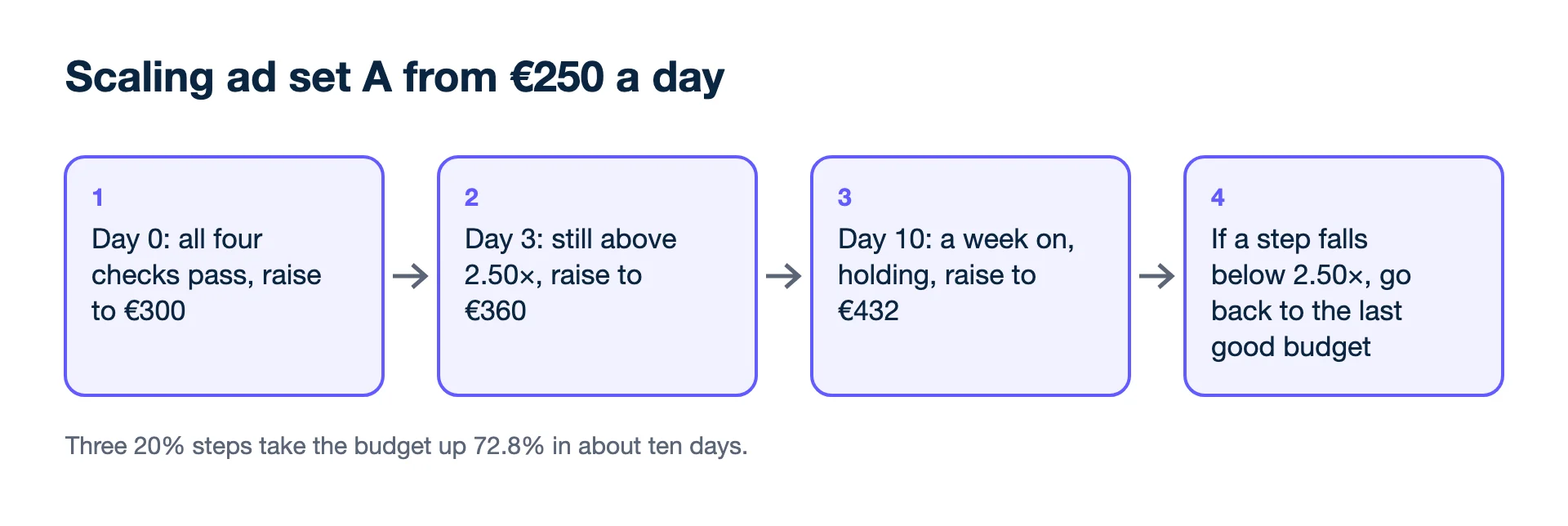
Check the arithmetic: €250 × 1.2 = €300; × 1.2 = €360; × 1.2 = €432, which is 72.8% above the start. If the return at €432 falls below breakeven for a full week, step down 20% to €345.60 rather than waiting and hoping. The ad budget calculator helps size what the month can carry.
Should I duplicate the ad set or raise the budget?
Raise the budget first; duplicate only for a reason. A duplicate starts its own learning phase from zero and competes with the original for the same people, so the two can push up each other's costs. A duplicate makes sense when you want to change something that would count as a significant edit on the original, such as a different optimisation event or audience, without putting the proven ad set back into learning.
When scaling is the wrong fix
- Learning limited. If an ad set cannot reach about 50 results a week, Meta flags it "Learning limited". Combining similar ad sets, or optimising for an event that happens more often, may do more than budget.
- A campaign budget. With Advantage+ campaign budget, a raise is shared out by Meta across ad sets, and a change can send several back into learning at once. Judge the campaign as a whole after the step, not the one ad set you hoped to grow.
- Seasonal peaks. Before Black Friday you may raise faster on purpose; accept the learning cost knowingly and step back down after.
- Lead generation. Judge on cost per qualified lead or won deal, not on form fills, before scaling a form campaign.
Related: how much to increase ad budget and how long the Meta learning phase lasts.
- Meta Business Help Centre: About the learning phase for ad sets in Meta Ads Manager (checked 2026-11-19)
- Meta Business Help Centre: Significant edits and learning phase (checked 2026-11-19)
- Meta Business Help Centre: About creative fatigue recommendations in Meta Ads Manager (checked 2026-11-19)
- Google Ads Help: About Smart Bidding learning (checked 2026-11-19)
- Example figures: illustrative.
See it on your own campaigns. Kunads reads your Meta and Google ads and your shop's orders, read-only, and shows the result per campaign.
Run the free profit audit Start a 14-day trial