Frequency
Frequency is the average number of times each person saw your ad over a period. Meta defines it as the average number of times each Accounts Center account saw your ad, calculated as impressions divided by reach: 126,000 impressions over 63,000 accounts is a frequency of 2.0. It is an estimate, and it only means something next to results.
Frequency = impressions ÷ reach
Two details from Meta's own definition matter. First, it counts Accounts Center accounts, not people: someone with separate, unlinked Facebook and Instagram accounts can count as two. Second, Meta calculates frequency using sampled data, so it is an estimate rather than a census.
Worked example: one ad set over a month
| Period | Impressions | Reach | Frequency | Cost per purchase |
|---|---|---|---|---|
| Week 1 | 126,000 | 63,000 | 2.0 | €24 |
| Week 2 | 120,000 | 48,000 | 2.5 | €27 |
| Week 3 | 117,000 | 39,000 | 3.0 | €33 |
| Week 4 | 114,000 | 30,000 | 3.8 | €41 |
| Whole month | 477,000 | 106,000 | 4.5 |
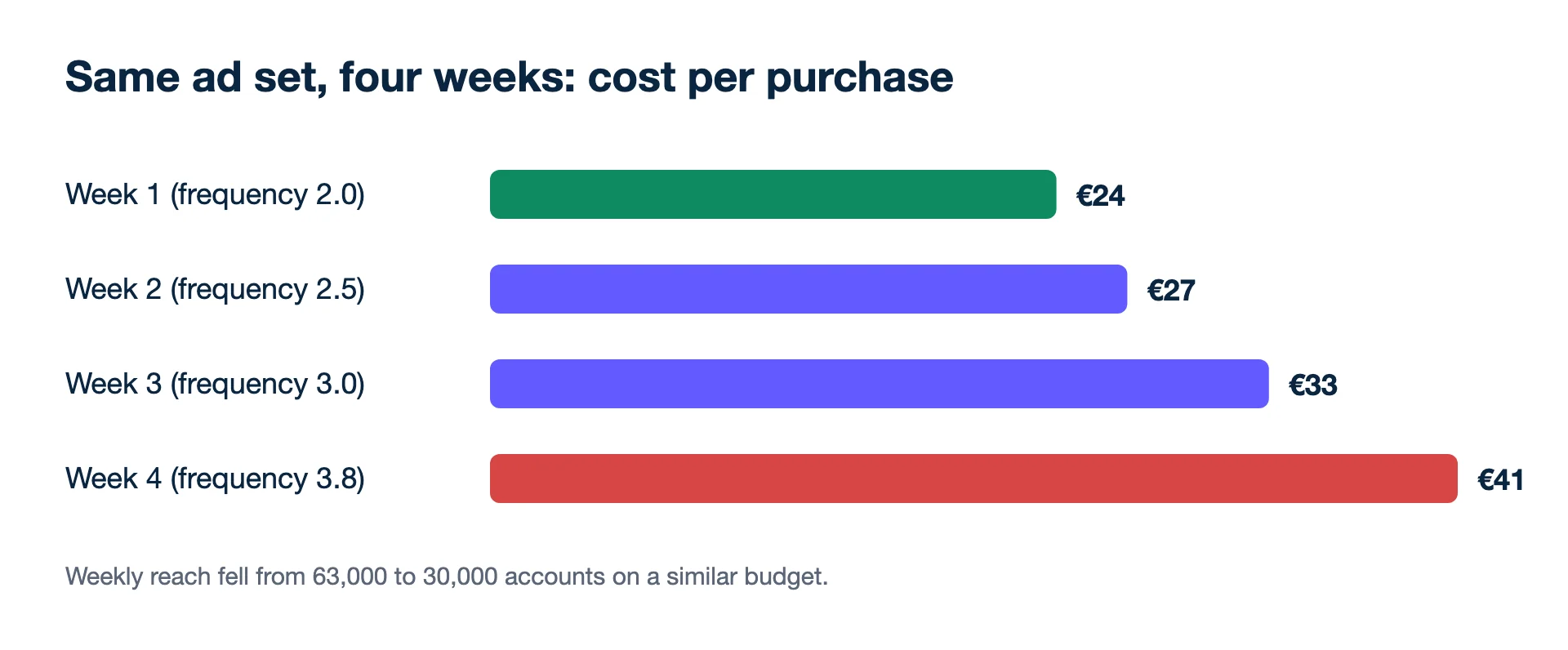
Two things show here. Weekly frequency climbs steadily while weekly reach shrinks: the ad set is spending a similar budget on fewer and fewer new people, and cost per purchase rises with it. That pattern, more than any single frequency value, is the warning sign.
Can I add up frequency across weeks?
No. The monthly frequency of 4.5 is higher than any week's, because monthly reach (106,000) counts each account once even if it saw the ad in several weeks. Frequencies from different date ranges cannot be added or averaged. Always compare like periods.
What is a good ad frequency?
There is no single good number: Meta notes that frequency may average 1 to 2 per ad set or run much higher, depending on budget, audience size and schedule. What matters is whether results fall as frequency rises.
Audience size sets a floor you cannot argue with. A retargeting list of 8,000 recent visitors with €40 a day at an €8 CPM buys 5,000 impressions a day, or 35,000 a week. Even if every visitor is reached, weekly frequency is at least 35,000 ÷ 8,000 = 4.4. For that ad set, 4.4 is simply the price of the budget; judge it on cost per purchase, or lower the budget.
Why repetition helps, then hurts
Seeing an ad more than once helps people remember it; Meta itself says frequency helps build awareness and recall. Past some point, the same people keep seeing the same message, stop responding, and the cost per result climbs. Meta's advice is to monitor frequency together with results, and if performance drops as frequency rises, to consider changing the creative or targeting. That is ad fatigue.
The right level depends on the job. A retargeting ad set aimed at a few thousand recent visitors will reach high frequency quickly, and that can be fine. A prospecting ad set aimed at millions should not need to show the same ad six times a week to the same accounts.
Frequency on Google: caps that also cap spend
Google Ads lets you cap frequency directly on Display and Video campaigns, per day, week or month. A cap changes the arithmetic. A Display remarketing list holds 50,000 people and the campaign is capped at 3 impressions per person per week. At most it can serve 150,000 impressions a week; at a €3 CPM that is €3 × 150 = €450. Give it a €700 weekly budget and €250 of it simply cannot be spent. If a capped campaign underspends, the cap and the list size are the first things to check, not the bids.
What to do when frequency climbs
If results are falling as frequency rises, there are three levers, roughly in order of cost. Add new ads to the ad set, so the same accounts see a fresh message instead of the same one again. Widen the audience, so the budget has more new accounts to reach. Or lower the budget to what the audience can absorb. Meta also offers frequency caps on reservation buying, where the default is 2 impressions every 7 days, but most auction campaigns rely on these levers instead.
Reading errors
- One threshold for everything. "Pause above 3" ignores audience size, objective and the period measured. Use the trend in results.
- Comparing a 7-day frequency with a 30-day one. Reach is de-duplicated over the period, so the longer window always shows a higher number.
- Reading frequency as exact. It is a sampled estimate, counted per account, not per person.
- Blaming frequency for every drop. If CPA rises and frequency is flat, look at CPM, the offer, the site or the season instead.
Kunads puts each Meta ad's frequency beside its verdict, so a rising number is read next to whether the ad still pays; see ad fatigue detection.
Related: reach, CPM, creative testing.
- Meta Business Help Centre: Frequency (checked 2026-11-19)
- Meta Business Help Centre: Estimated metrics (checked 2026-11-19)
- Meta Business Help Centre: Glossary of reservation terms (frequency cap default; checked 2026-11-19)
- Google Ads Help: Frequency capping (Display and Video) (checked 2026-11-19)
See it on your own campaigns. Kunads reads your Meta and Google ads and your shop's orders, read-only, and shows the result per campaign.
Run the free profit audit Start a 14-day trial