Ad fatigue
Ad fatigue is the drop in an ad's results that happens when the same audience has seen the same creative too many times. People scroll past it, click less, and the cost per result climbs. Meta calls it creative fatigue and flags it when cost per result reaches twice your past ads.
How does Meta flag creative fatigue?
Meta flags it by comparing an eligible single-creative ad set's cost per result with your past ads, counting all recent exposures of that image or video, including from other campaigns on your Page:
- Creative limited: cost per result is higher than your past ads, but less than twice as high.
- Creative fatigue: cost per result is twice as high or more.
Meta also warns before publishing if fatigue may occur in the first 7 days. The status is not available for Advantage+ catalog ads, dynamic creative or Advantage+ app campaigns, so the ads that rotate many assets automatically get no flag at all and need your own check.
One edge case follows from how Meta counts. Because exposures of the same image or video from other campaigns on your Page are included, a brand-new campaign can open with a fatigue warning if the video already ran as a boosted post or in last month's sales campaign. The campaign is new; the creative is not. Treat that warning as real and bring a genuinely new asset rather than relaunching the old one under a fresh name.
A test you can run yourself
Frequency = impressions ÷ reach
Profit = revenue × contribution margin − ad spend, compared between the earlier and later half of a date range.
Rising frequency on its own is not fatigue. Rising frequency while profit turns negative is.
Worked example: one ad, four weeks
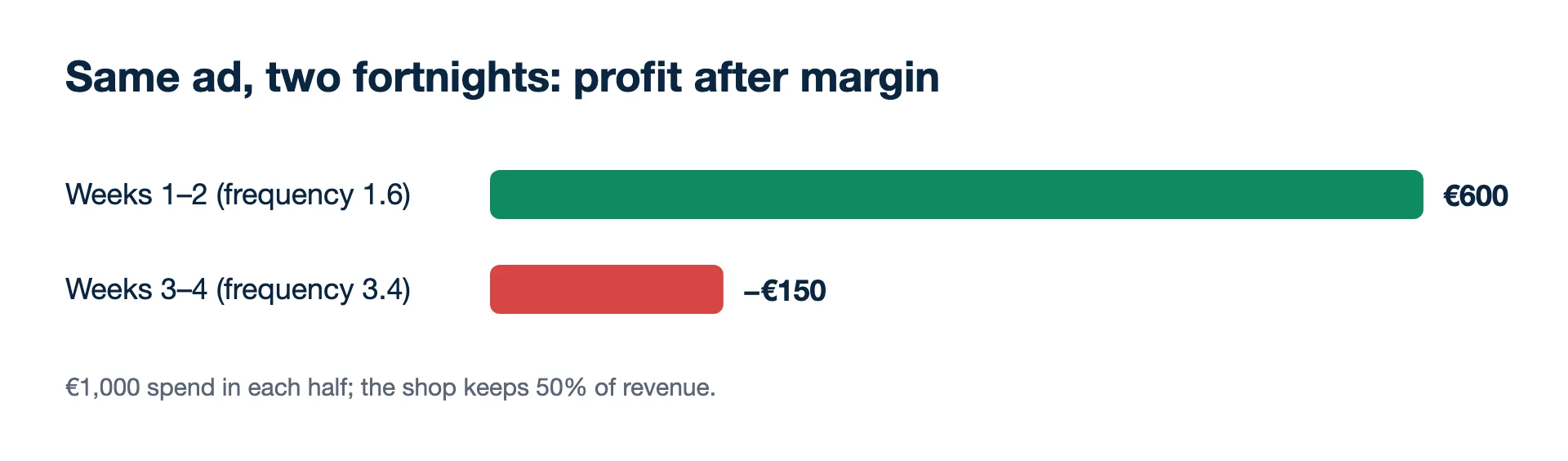
An ad for a skincare set runs at a steady €500 a week. The shop keeps 50% of revenue after goods, fees and delivery (breakeven ROAS 2.0).
| Weeks 1–2 | Weeks 3–4 | |
|---|---|---|
| Spend | €1,000 | €1,000 |
| Revenue | €3,200 | €1,700 |
| ROAS | 3.2 | 1.7 |
| Frequency | 1.6 | 3.4 |
| Profit (revenue × 0.5 − spend) | €600 | −€150 |
Checks: 3,200 × 0.5 − 1,000 = 600; 1,700 × 0.5 − 1,000 = −150. Over the full four weeks the ad still made €450 (600 − 150), so a monthly report would call it a winner. Split in halves, it is clearly fading: profitable early, below water now, with frequency more than doubled. That is the moment to bring in the next creative, not next month.
How fast does a small audience tire?
Faster than most people expect, because the arithmetic is fixed by budget and audience size. A retargeting list holds 20,000 people. The ad set spends €70 a day at a €10 CPM, which buys 7,000 impressions a day (70 ÷ 10 × 1,000). After 7 days that is 49,000 impressions; if 17,500 people were reached, frequency is 49,000 ÷ 17,500 = 2.8. After 14 days it is 98,000 impressions, and reach cannot grow past the list: at 19,600 people, frequency is 98,000 ÷ 19,600 = 5.0. The same €70 a day on a broad audience of two million would barely move frequency. So the size of the pool, not the quality of the ad, often sets the clock.
What fatigue is not
- A seasonal dip. If every ad in the account falls in the same week, the cause is demand (a holiday, payday, weather), not the creative. Compare against the account, not only the ad's own history.
- A tracking break. A sudden fall to near zero overnight is more often a broken pixel or checkout than tired viewers. Fatigue is gradual.
- A rising CPM. Auction prices can rise for everyone in busy selling weeks. A higher cost per result with flat frequency points at the auction.
Fixing it
- Add a materially different ad: a new hook, format or angle, not the same video with a new colour. Meta notes that keeping the original active may still maximise results, so pause the old one only once it stops paying.
- Widen the audience so fewer people see it too often, or lower the budget on a small retargeting list.
- Cap exposure where the platform allows it. Google Ads offers frequency capping for Display and Video campaigns, per day, week or month. On Meta, rotating creative is the main lever for a sales campaign.
- Keep a pipeline. Plan the next creative before the current one fades; see creative testing.
Do not pause on frequency alone while the ad still makes money, and do not judge on CTR when the real question is profit.
Kunads gives every Meta ad a verdict (stop, fading, scale, iterate, keep, early) with frequency shown, and its "fading" verdict is the split-half test above: profitable in the earlier half of the chosen dates, below water in the later half. See ad fatigue detection, and the related terms frequency and reach.
- Meta Business Help Centre: About creative fatigue recommendations in Meta Ads Manager (checked 2026-11-19)
- Google Ads Help: Frequency capping (Display and Video, per day, week or month) (checked 2026-11-19)
Breakeven, per campaign. Give Kunads your margin once; it marks which Meta and Google campaigns sit below it and by how many euros.
Find my losing campaigns Try it for 14 days