Ad fatigue detection: a verdict for every Meta ad
Ad fatigue detection in Kunads gives every Meta ad one of six verdicts (stop, fading, scale, iterate, keep or early) from whether it still makes money, with its frequency beside it. "Fading" means the ad was profitable in the earlier half of the dates you picked and below water in the later half.
It is for media buyers who find out an ad died a week after it did.
In short
- Six verdicts per Meta ad: stop, fading, scale, iterate, keep, early.
- Fading = profitable in the earlier half of the dates, below water in the later half.
- Frequency, hook rate and hold rate on the card; the creative agent proposes the replacement.
What does ad fatigue look like in the numbers?
It shows as rising frequency, falling CTR and a rising cost per result, as the same people see the ad again; that is ad fatigue. Meta reports all three per ad (they are fields in its Ads Insights API). None of them alone tells you whether to act: a retargeting ad can run at a high frequency and still pay, and CTR can dip for a week for reasons unrelated to the ad. What matters is whether the ad still returns more than it costs after the goods are paid for. That is the test Kunads applies.
How it works
- Measure the margin. The CFO agent works out what an order keeps. Without a margin there is no profit verdict.
- Read every ad. Spend, sales, revenue, ROAS and POAS per Meta ad, at the measured margin. Lead-gen accounts use cost per lead.
- Split the dates. The chosen date range is cut into an earlier and a later half, and each ad's profit and clickthrough are read in both.
- Give the verdict. The rules, in the order they are checked:
- Early: under 5 days or under 40 clicks. Too little to judge.
- Stop: live 7 days or more and Meta has all but stopped spending on it. Meta will not fund it, which is its own verdict.
- Fading: profitable in the earlier half and below water in the later half; or clickthrough down by 30% or more while daily frequency sits above this account's own usual level.
- Scale: POAS of 1.5× or more, still above 1.2× lately, and the audience still fresh.
- Iterate: the same profit, but frequency is high or clickthrough is softening, so variants beat a bigger budget.
- Keep: above water, nothing to change.
- Propose the next ad. The creative agent looks at what worked and proposes the next ad, which you can make in the creative lab.
What you see
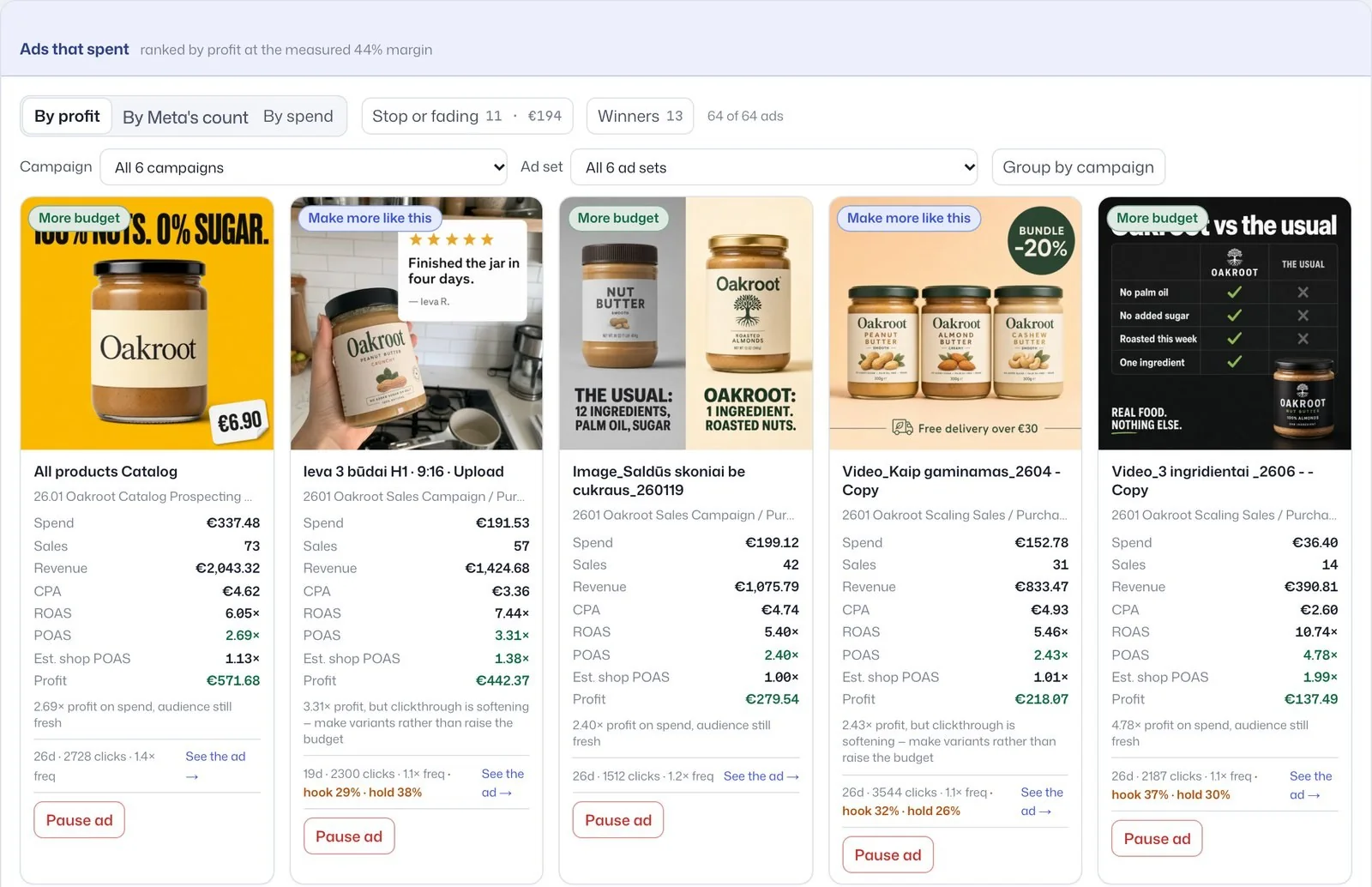
The Ads view shows each Meta ad as a card: the creative, spend, sales, revenue, cost per sale, ROAS, POAS and profit. Under the numbers a sentence explains the verdict with its figures, for example that an ad was profitable in the earlier half of the dates at one POAS and below water in the later half, or that clickthrough is softening so variants beat a bigger budget. The footer shows days running, clicks, frequency and, for videos, hook rate and hold rate. A "Stop or fading" filter at the top collects the ads that need attention, with the money they spent; a "Winners" filter collects the ones to build on. Each card has a Pause button, and pausing keeps an undo.
Which date range should I judge fading on?
Use about 14 days to catch a drop early and about 60 days to see whether a weak week is a trend. Fading is a comparison inside the dates you chose, so the range matters. Over 14 days, fading means the last week was worse than the week before. Over 60 days, it means the last month was worse than the first. Use a short range to catch a drop early and a longer one to see whether a weak week is a trend. If an ad shows fading with very few sales in each half, treat it as a prompt to look, not a verdict to act on.
What should I do with a fading ad?
Replace it rather than starve it: a new ad on the same angle, a new hook, or a new audience usually beats a lower budget. The creative agent proposes the next ad from what worked on this account, and if you want a strict comparison between the old ad and its replacement, Meta's own A/B testing splits the audience between versions. See how to fix ad fatigue and why did my ROAS drop.
Limits of the verdicts
- Cover Google, TikTok, Microsoft or LinkedIn ads. Verdicts are for Meta ads.
- Pause an ad on its own. Pausing is a click, or a rule you set to Do it.
- Judge an ad on a handful of clicks. Under 5 days or 40 clicks it is marked early.
- Call "stop" on every ad below 1× POAS. If Meta keeps spending on such an ad, Kunads marks it as carrying: ads in one ad set work as a funnel, and this one may be buying attention the others convert.
- Call an ad profitable without a margin. Until the CFO has one, the card says profit needs a measured margin.
Who it is for
Meta advertisers running more ads than they can check by hand, shops whose ads tire within weeks, and agencies who need to show a client why an ad was stopped. If you want the same check as an automatic rule, see ad automation rules.
Where to go from a verdict
- Creative lab: make the replacement.
- Competitor ad tracking: see which angles others keep running.
- Profit tracking: the margin behind every verdict.
- AI marketing agents: the creative agent's role.
- Meta for Developers: Ads Insights API (checked 2026-11-19)
- Meta Business Help Center: About A/B testing for Meta Ads (checked 2026-11-19)
Changes wait for you. Kunads proposes budget moves in 20% steps with the reasoning attached; nothing reaches Meta or Google until you press Approve.
See what it would change Begin a free trial