Conversions API (CAPI)
The Conversions API (CAPI) is Meta's way to send events such as purchases, leads and sign-ups straight from your server to Meta, instead of only from the Meta Pixel running in the visitor's browser. Because the data leaves your server, browser settings, connection drops and ad blockers do not stop it.
It handles web, app and offline events. Meta's older, separate Offline Conversions API was discontinued in May 2025; offline events now go to a dataset through the Conversions API.
Do I still need the Meta Pixel if I use CAPI?
You can keep both, and Meta supports sending the same events from each; if you have a pixel, Events Manager can also add the Conversions API for website events in one click. Meta describes two set-ups:
- Different events from each source, for example AddToCart from the browser and Purchase from the server. No deduplication needed.
- The same events from both, to recover what the browser misses. Then each pair needs matching identifiers so Meta counts it once.
How does Meta deduplicate pixel and CAPI events?
Meta treats two events as one when event_name matches and event_id matches, or, as a fallback, when event_name matches and external_id or fbp matches. When both arrive, Meta keeps the one received first. Partner integrations such as Shopify and WooCommerce add these parameters for you; a custom build has to add them in code.
The counting rule that follows from it:
Unique events = browser events + server events − matched pairs
Worked example: 100 purchases
A shop takes 100 orders on a day. Both the pixel and the server send Purchase events.
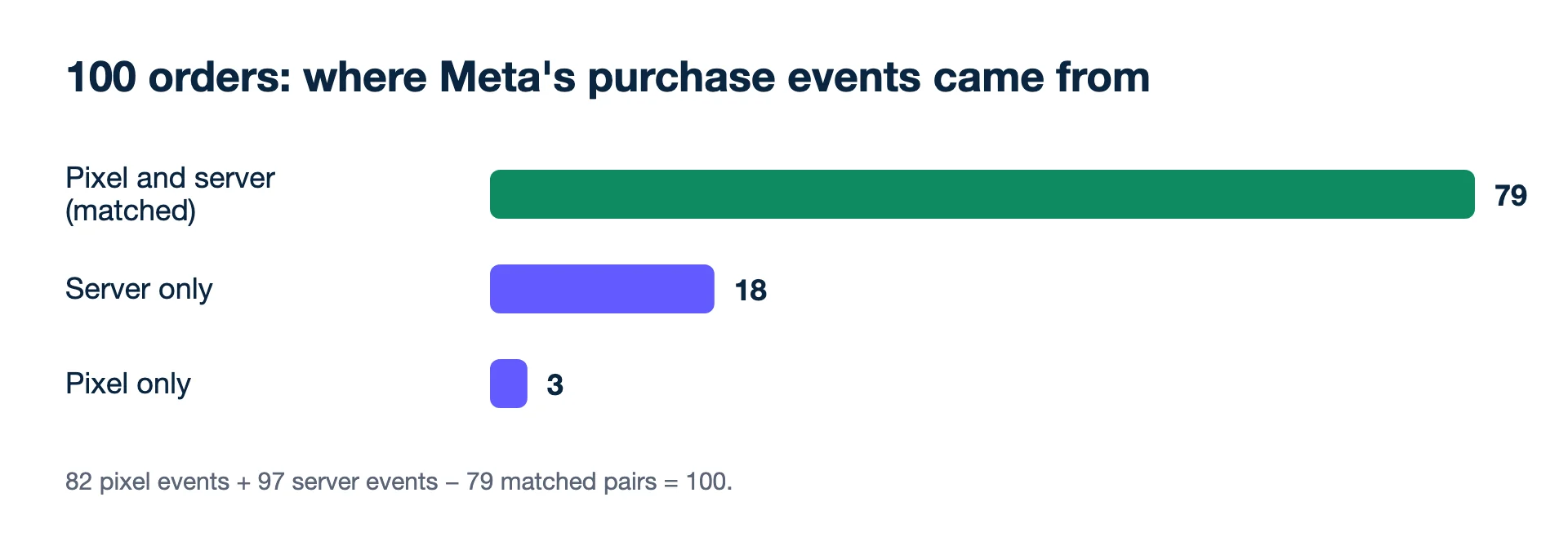
- Pixel events received: 82 (the other 18 browsers blocked or dropped the pixel).
- Server events received: 97 (3 orders failed in the server job and were retried too late).
- Pairs with a matching event_id: 79.
Unique purchases Meta can work with: 82 + 97 − 79 = 100. Of those, 79 arrived from both sources, 3 from the pixel only (82 − 79) and 18 from the server only (97 − 79). Check: 79 + 3 + 18 = 100.
Now the same day with event_id missing on the server events and no external_id or fbp to fall back on: nothing pairs up, and Events Manager shows 82 + 97 = 179 purchases for 100 orders. Meta's own help page names mismatched or missing event_id as the most common deduplication problem.
An edge case: the event_id that is unique but different
A common custom build generates the browser event_id from a random string at checkout and the server event_id from the order number. Both are unique, both look correct in testing, and none of them ever pair. The symptom is a purchase count close to the sum of both sources, as in the 179 above. The fix is to create one identifier when the order is placed, usually the order ID, and pass the same value to the pixel and to the server call.
What sending from the server makes possible
- Meta's delivery learns from the events it receives. Events lost in the browser are events the system never learns from.
- You choose what to send. From the server you can send the order's value after discounts, or a separate event carrying profit, or a won deal from your CRM.
- It is the route for offline events such as phone orders and closed deals.
Set-up errors
- Different event_id formats in browser and server (for example "order_1001" and "1001").
- Sending the server event hours later. Delays between the two sources are a listed cause of deduplication trouble.
- Forgetting customer information. Server events without hashed email, phone or the fbp/fbc cookies are harder for Meta to match to a person.
- Expecting Meta and the shop to agree afterwards. CAPI improves what Meta receives; Meta still credits purchases within its own attribution window, while the shop records every order once, so the two totals keep differing. Compare them side by side and steer on blended ROAS.
Sending profit instead of revenue
Kunads can send real profit or won-deal value back to Meta through the Conversions API as a separate conversion, opt-in per account. How that works for lead businesses is covered in sending CRM won deals to Meta and Google. Google's counterpart for the same idea is the Data Manager API, and for website tags enhanced conversions.
Related: server-side tracking, offline conversions, POAS.
- Meta Business Help Centre: About deduplication for Meta Pixel and Conversions API events (checked 2026-11-19)
- Meta Business Help Centre: About the Offline Conversions API (discontinued May 2025) (checked 2026-11-19)
- Meta for Developers: Conversions API (checked 2026-11-19)
- Meta for Developers: Deduplicate pixel and server events (checked 2026-11-19)
Would rather not do this by hand? Kunads' agents check every campaign against your margin each day and propose a fix you approve or ignore.
Audit my ads for free Try Kunads, no cardCAPI and offline sales
Can I send offline sales with the Conversions API?
Yes. Meta's separate Offline Conversions API was discontinued in May 2025, and offline events now go to datasets through the Conversions API, a partner integration or a manual upload in Events Manager.