Can AI manage my Meta and Google ads?
Partly. Google and Meta already use AI to set bids, choose placements and decide who sees each ad, and an assistant such as Claude or ChatGPT can now read your accounts and draft changes. What AI cannot know on its own is your margin, your goal and what a lead is worth, so approval stays with a person.
What does AI already do inside Google and Meta?
It already runs the auction-level work: bids, placements and audience selection are automated on both platforms, inside the limits you set.
- Google: Smart Bidding sets bids per auction toward a target ROAS or target CPA; Performance Max chooses channels and combines assets. Google can also apply some of its recommendations automatically if you switch that on, per recommendation type.
- Meta: the delivery system chooses who sees each ad; Advantage+ campaign budget moves budget between ad sets in real time.
These systems optimise toward the conversion you send them. Send revenue and they chase revenue; send form fills and they chase form fills. The biggest lever left to you is what you ask them to optimise for, and that choice depends on numbers the platforms do not hold.
Can ChatGPT or Claude change my campaigns?
Yes on Meta, only in a limited way on Google. Through the Model Context Protocol (MCP), assistants connect to ad accounts with tools the platform exposes:
- Meta's official Ads MCP server (Meta Ads AI connectors) can pull reports and create and edit campaigns, ad sets and ads. Business admins can allow or block actions per ad account, including budget changes above a set amount.
- Google's official Google Ads MCP server reads data through GAQL and makes only limited changes (assets, labels); it cannot create or edit campaigns, budgets or bids.
What assistants do well: pulling reports in plain language, comparing periods, spotting outliers, drafting ad copy, explaining a drop. What they do badly without your data: judging profit, because the ad account does not know your cost of goods, refunds or close rates.
Worked example 1: a shop with two margins
Ask an assistant "Which campaign is best?" with only the ad account connected. It sees Campaign A at ROAS 4.0× and Campaign B at 3.0×, and says A. Now add the shop's margins: A sells items keeping 20% (breakeven 5.00×), B sells items keeping 50% (breakeven 2.00×). On €1,000 spend each:
- A: €4,000 × 0.20 − €1,000 = −€200.
- B: €3,000 × 0.50 − €1,000 = +€500.
Same AI, opposite answer, because it was given the margin. The POAS calculator does this sum by hand.
Worked example 2: leads that never close
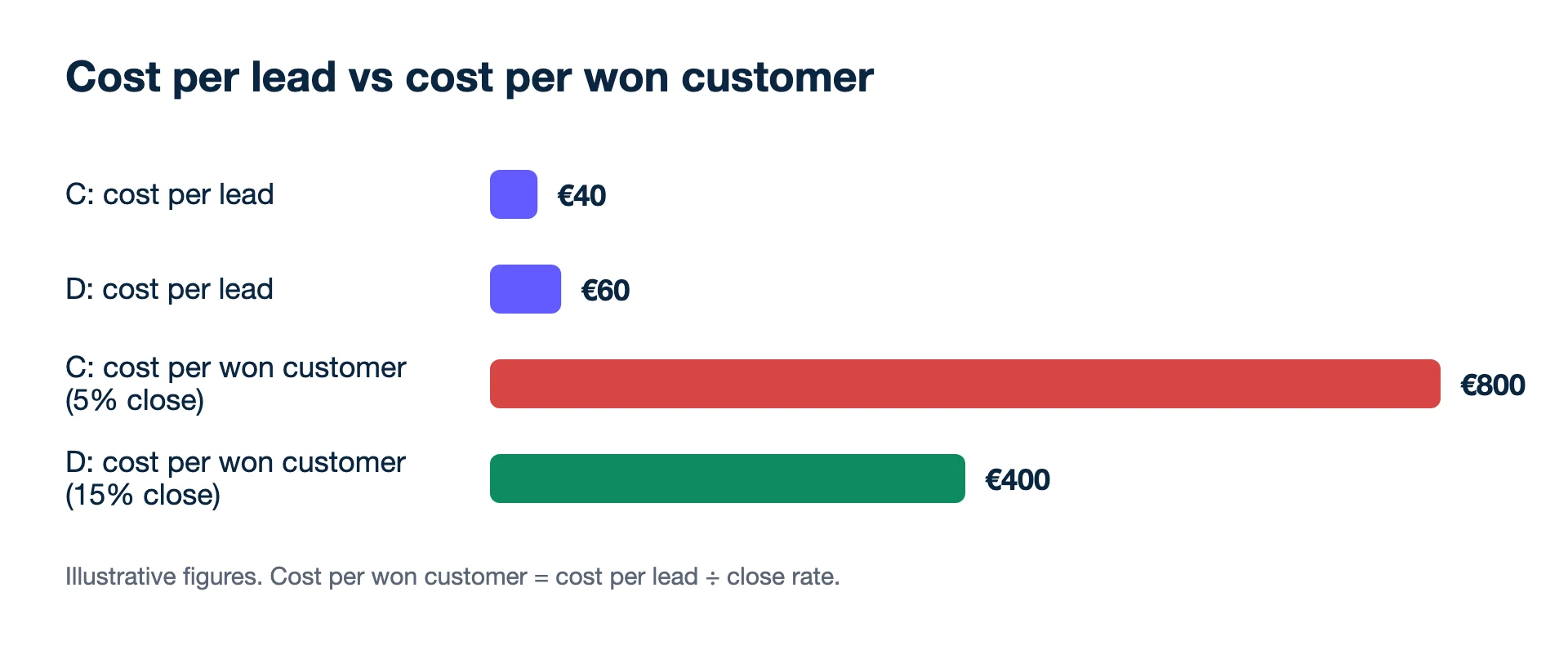
A lead-gen account runs two Meta campaigns. The ad account shows Campaign C at €40 per lead and Campaign D at €60 per lead, so an assistant reading Ads Manager alone moves budget to C. The CRM tells a different story: 5% of C's leads become customers, 15% of D's do.
- C: €40 ÷ 0.05 = €800 per won customer.
- D: €60 ÷ 0.15 = €400 per won customer.
D wins customers at half the cost. No model can see this from the ad account, because the close rate lives in your sales data. Until won deals flow back to the platform or to the assistant, "cheapest lead" is the only thing either can optimise.
Which decisions should stay with a person?
The ones that need facts or judgement the ad account does not hold: goals, margins, lead values, brand and legal calls, and the final yes on anything that spends money.
| Task | AI | Person |
|---|---|---|
| Bids and delivery inside a campaign | Platform AI | Set the target |
| Reports, anomalies, explanations | Yes | Read and question |
| Draft budget moves, pauses, new ads | Yes | Approve |
| Goals, margins, what a lead is worth | No | Yes |
| Brand, legal and policy calls | No | Yes |
Where software can act alone, and where it should not
Small, stable accounts with clear rules (for example "cut 20% if below breakeven for 7 days") can let software act within caps, because the rule was written by a person who knows the margin. New accounts have too little history for any rule to be reliable. Regulated industries such as health, finance, housing and employment need a person on every ad and targeting change. And an assistant reading live data can be steered by text it reads, such as a comment or a landing page, so keep a human on changes that cost money. Before connecting anything, read is it safe to give AI access to ad accounts?
Kunads takes the middle route: its agents (CEO, CFO, CMO, CRE, DATA) work from your margins and shop or CRM data and propose changes, a person approves, and every change has an undo.
- Meta Business Help Centre: Manage ads from an AI agent with Meta Ads AI connectors (checked 2026-11-19)
- Google Ads API: Google Ads MCP server, developer integration guide (checked 2026-11-19)
- Google Ads Help: About Smart Bidding (checked 2026-11-19)
- Google Ads Help: About applying recommendations automatically (checked 2026-11-19)
- Google Ads Help: About Performance Max campaigns (checked 2026-11-19)
- Meta Business Help Centre: About budgets (Advantage+ campaign budget) (checked 2026-11-19)
- Example figures: illustrative.
Numbers from your shop, not from the ad platforms. Connect Meta, Google and Shopify, WooCommerce or Magento and see what each campaign kept.
Get my profit audit Open a free workspaceBefore you hand your ads to an assistant
Does connecting an assistant change how my campaigns bid?
No. Connecting Claude or ChatGPT through MCP only gives it tools to read and, where you allow it, to change settings. Smart Bidding and Meta's delivery keep working as before until someone changes a target, a budget or a conversion goal.
Is it safe to let an assistant act on its own?
It can be, with narrow access, approval before changes, spending caps and a log with undo. See our page on giving AI access to ad accounts.