Campaign budget optimization (now Advantage+ campaign budget)
Campaign budget optimization (CBO) puts one budget on a Meta campaign instead of on each ad set and lets Meta move that money in real time to the ad sets with the best opportunities. Meta now calls it Advantage+ campaign budget. The alternative, a budget on each ad set, is often called ABO.
What is CBO called now?
Meta calls it Advantage+ campaign budget, and in Ads Manager it can also appear as "campaign budget" or "budget with Advantage+ on". In the Marketing API it is simply a daily_budget or lifetime_budget set on the campaign rather than on its ad sets.
The rules, from Meta's help centre
- On by default for new sales, leads and app promotion campaigns.
- Best suited to campaigns with at least 2 ad sets.
- All ad sets need the same budget type (daily or lifetime), the same bid strategy, standard delivery, and, with the highest-volume bid strategy, the same optimisation event.
- Up to 200 ad sets in one campaign, with editing limits above 70.
- Once switched on or off, it must stay that way for at least 2 hours.
- Daily budgets are an average: on some days spend can be up to 75% above the daily budget, but never more than 7 times the daily budget in a week.
Why does one ad set get most of the budget?
Because Meta does not split a campaign budget evenly: it spends where it expects the best overall result for the next euro, and Meta says the largest audiences usually get the most budget. That is why the campaign total is the number to judge.
Campaign cost per result = total campaign spend ÷ total campaign results
Worked example: three ad sets, €200 a day
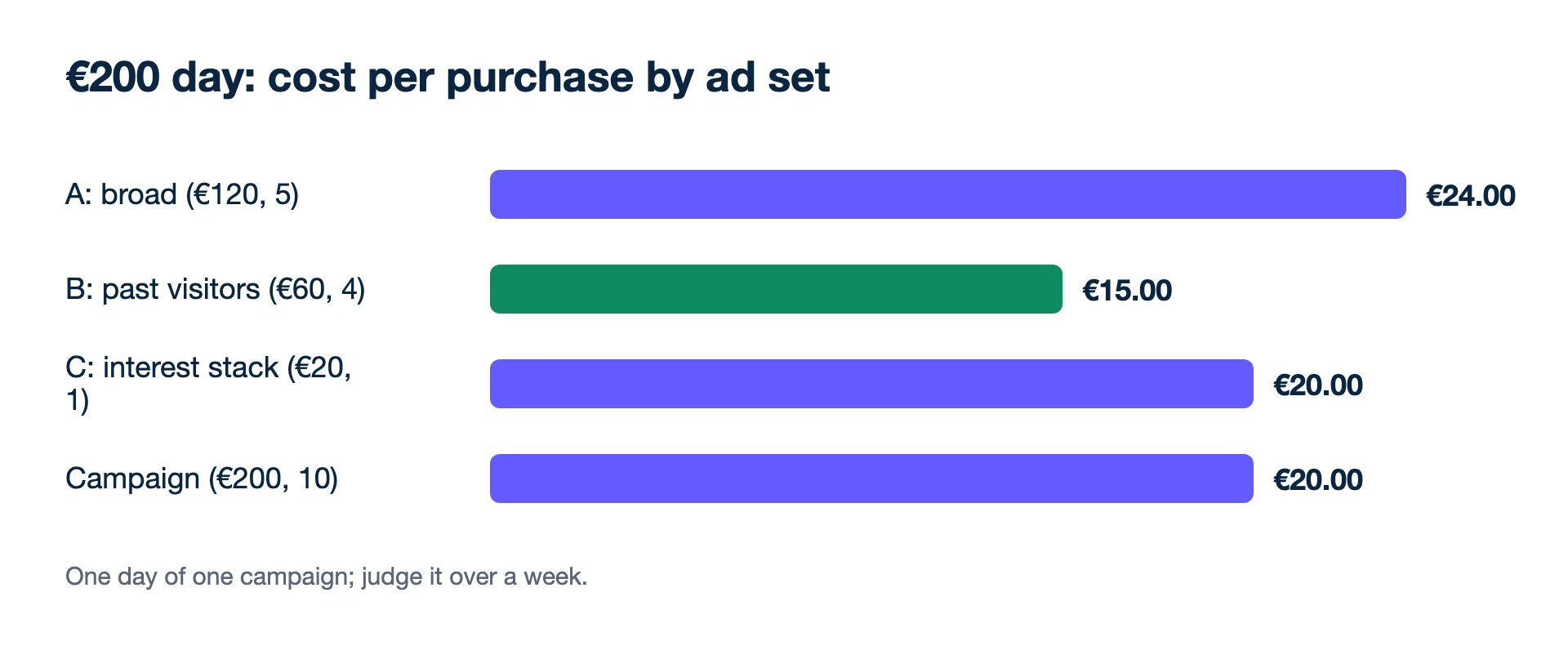
A campaign with a €200 daily budget and three ad sets ends a day like this:
| Ad set | Spend | Purchases | Cost per purchase |
|---|---|---|---|
| A: broad | €120 | 5 | €24.00 |
| B: past visitors | €60 | 4 | €15.00 |
| C: interest stack | €20 | 1 | €20.00 |
| Campaign | €200 | 10 | €20.00 |
It looks as if Meta "wasted" money on A, the most expensive ad set. But B's audience is small: its cheap purchases may already be used up, and the next €60 there could cost far more than €15 each. Meta's own guidance warns that judging spend per ad set can mislead for exactly this reason. Judge the €20.00 campaign figure, and judge it over a week.
On spend limits: at €200 a day, a single day can reach €200 × 1.75 = €350, but the week cannot exceed €200 × 7 = €1,400.
What happens if you pause the expensive ad set
Suppose you pause A because €24 is the worst number in the table. The €200 now has to go to B and C. B's audience of past visitors is small, so the extra money reaches people less likely to buy: say B spends €150 for 6 purchases (€25.00 each) and C €50 for 2 (€25.00 each). The campaign now gets 8 purchases for €200, a cost of €25.00, worse than the €20.00 it had with A running. These numbers are illustrative, but the pattern is the reason Meta tells you to judge the campaign as a whole: the average cost of an ad set says little about what its next euro will buy.
When a budget per ad set still makes sense
- A test that needs equal spend. If two audiences must get the same money to be compared fairly, set budgets per ad set, or use Meta's own A/B test.
- A fixed commitment. A retargeting or brand ad set that must keep a set amount whatever happens elsewhere. Inside a campaign budget, ad set spend limits can do this too; in the API, an ad set daily spend cap requires a daily budget on the campaign.
- Very different audience sizes that you do not want to compete for one pot.
What it changes
- Fewer budgets to manage, and money flows to where results are cheapest at the margin.
- Advantage+ sales and leads campaigns rely on it: Advantage+ campaign budget is one of the three settings that make a campaign "Advantage+ on".
- Learning is per ad set. Meta says budget moving between ad sets does not reset learning, but changing the campaign budget or bid strategy can reset several at once.
Habits that make it look worse than it is
- Mixing audiences of very different sizes and expecting an even split. Meta says the largest audiences usually get the most budget.
- Reading hourly breakdowns as trends.
- Large budget jumps. If you need to grow, step up gradually; see how much to increase ad budget.
Other budget terms
- Meta Business Help Centre: About Advantage+ campaign budget (checked 2026-11-19)
- Meta Business Help Centre: Set up Advantage+ campaign budget (checked 2026-11-19)
- Meta Business Help Centre: Understand Advantage+ campaign budget results (checked 2026-11-19)
- Meta for Developers: Advantage campaign budget in the Marketing API (checked 2026-11-19)
- Meta Business Help Centre: Significant edits and learning phase (checked 2026-11-19)
Lead generation? Send won deals from your CRM and Kunads ranks campaigns by what the leads were worth, not by how many came in.
Check my lead campaigns Start free for 14 days