How much should I increase my ad budget at a time?
Increase an ad budget by about 20% at a time, then judge the step on what the extra money brought back, not on the campaign's average. Meta publishes no safe percentage, only that small changes are unlikely to restart learning and large ones may. Google says budget changes never trigger its Learning status.
A 20% step is big enough to show a difference within a week and small enough that, if it fails, going back costs little. The harder question is how to tell whether a step worked, and that is where most raises go wrong.
Does a budget raise restart Meta's learning phase?
It might, and Meta decides by size. Meta lists budget amount among the edits that "may or may not be significant, depending on the magnitude of the change". Its own example: $100 to $101 is not likely to send ad sets back into the learning phase; $100 to $1,000 may. With a campaign budget (Advantage+ campaign budget), one change can affect several ad sets at once. Meta's best practice is to "avoid frequent budget changes".
Meta also re-plans the week when you change a daily budget: it prorates the rest of the Sunday-to-Saturday week from the new figure, and on any one day may spend up to 75% over the daily budget, never more than 7× the daily budget across the week. So a raise on Thursday shows its full effect only from the next week.
Does Google Ads relearn after a budget increase?
No: Google says updates to budgets "take effect in the next auction, but never trigger 'Learning' status" for Smart Bidding. That status appears only for a new or reactivated strategy, a change in which campaigns or keywords the strategy covers, or a significant change in conversion goals. It does not make a large raise free. More budget buys auctions the campaign was skipping, which are often dearer. Google may also spend up to twice the average daily budget on a given day, and no more than 30.4× the average daily budget in a month.
A stepping plan
A shop spends €3,000 a month on one profitable Meta campaign (€100 a day) and wants to reach about €5,000. Kunads' budget rules use this rhythm: 20% steps, one change per campaign per 7 days, and a second raise allowed after 3 days if the first held.
| Day | Change | Daily budget |
|---|---|---|
| 1 | +20% | €120 |
| 4 | +20% (second raise, 3 days on) | €144 |
| 11 | +20% (7 days later) | €172.80 |
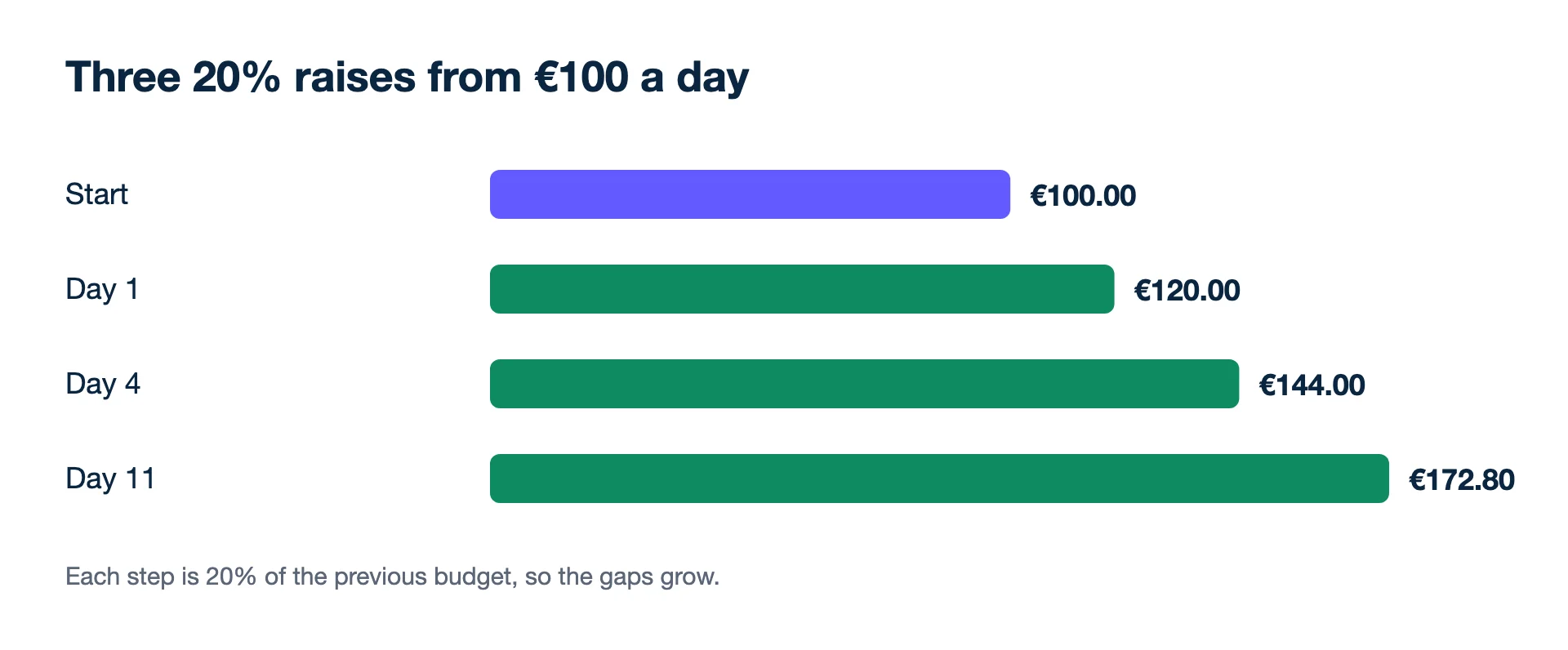
By day 11 the campaign runs at about €5,180 a month (€172.80 × 30). Each step has its own data. If on day 11 the return had dropped below breakeven, the move would be −20% to €138.24, not another raise.
Judge the extra euros, not the average
The average ROAS of a campaign hides what the last euro bought. Look at the change instead: extra revenue ÷ extra spend, the marginal return.
Second example, with a margin of 40% (breakeven ROAS 2.50×):
- At €100 a day the campaign brings €400 of revenue a day: ROAS 4.00×.
- After a raise to €120, it brings €444 a day: ROAS 3.70×. Still well above 2.50×, so it looks fine.
- But the extra €20 brought only €44 more. The marginal return is 44 ÷ 20 = 2.20×, below breakeven.
- Profit check: at €100, €400 × 0.40 − €100 = €60 a day. At €120, €444 × 0.40 − €120 = €57.60 a day. The raise cost €2.40 a day of profit.
The campaign's average would say "keep raising"; the margin on the step says "go back". Compare like with like: the same weekdays, the same attribution setting, and a full week either side, so one strong Saturday does not decide it. Size a month with the ad budget calculator.
When a bigger or smaller step makes sense
- Tiny budgets. At €10 a day, 20% is €2. If the ad set gets only a handful of results a week, a larger step may be needed to learn anything at all.
- Hard deadlines. A four-day sale cannot wait for weekly steps. Raise before it starts and accept less efficient days.
- Moving money between campaigns. Cutting one campaign 20% and raising another 20% is two changes, and each needs its own week to read.
- Lifetime budgets. On Meta a lifetime budget is spread over the schedule, so raising it late in the flight packs the extra money into fewer days, which is a bigger daily jump than the percentage suggests.
- Monthly goals. If a goal needs much more spend, plan it across months; Kunads caps a goal-driven raise at +50% of today's spend per month.
Related: when to scale a Meta campaign, how often to change ad budgets.
- Meta Business Help Centre: Significant edits and learning phase (checked 2026-11-19)
- Meta Business Help Centre: About daily budgets (checked 2026-11-19)
- Google Ads Help: About Smart Bidding learning (checked 2026-11-19)
- Google Ads Help: About overdelivery and your average daily budget (checked 2026-11-19)
- Example figures: illustrative.
Numbers from your shop, not from the ad platforms. Connect Meta, Google and Shopify, WooCommerce or Magento and see what each campaign kept.
Get my profit audit Open a free workspaceBefore you raise the budget again
Is the 20% budget rule from Meta?
No. Meta does not publish a percentage. It says a budget change may or may not restart learning depending on its size, with $100 to $101 unlikely to and $100 to $1,000 possibly doing so. The 20% step is a working rule, not a platform rule.
Can I double my budget overnight?
You can, and sometimes it works. The risk is that a Meta ad set re-enters learning and costs rise for a while. Before a short sale, where speed matters more than efficiency, it can be a deliberate choice.
What if the results drop after a raise?
Go back one step rather than waiting and hoping. Give each step at least a few days of data before judging it, because daily results are noisy.