Revenue and profit goals that set the ad budget
Revenue and profit goals in Kunads turn a target such as "€30,000 this month" into the ad budget it needs: (revenue goal − revenue that comes without ads) ÷ revenue per €1 of ads. The goal card then shows every day whether the month is on pace. Lead-gen businesses set a leads goal and a maximum cost per lead.
It is for owners and agencies who plan budgets from a business target rather than from last month's spend.
In short
- Goal card: last year's same month, so far, and where the current pace lands.
- Budget needed = (revenue goal − revenue without ads) ÷ revenue per €1 of ads.
- Raises capped at +50% of today's spend per month; the CEO agent proposes, you approve.
How it works
- Set the month's goals. Revenue and profit for a shop, or leads and a max cost per lead for lead gen. Kunads suggests a starting figure from last year's month and this season's pace; you move it with a slider or the − and + buttons.
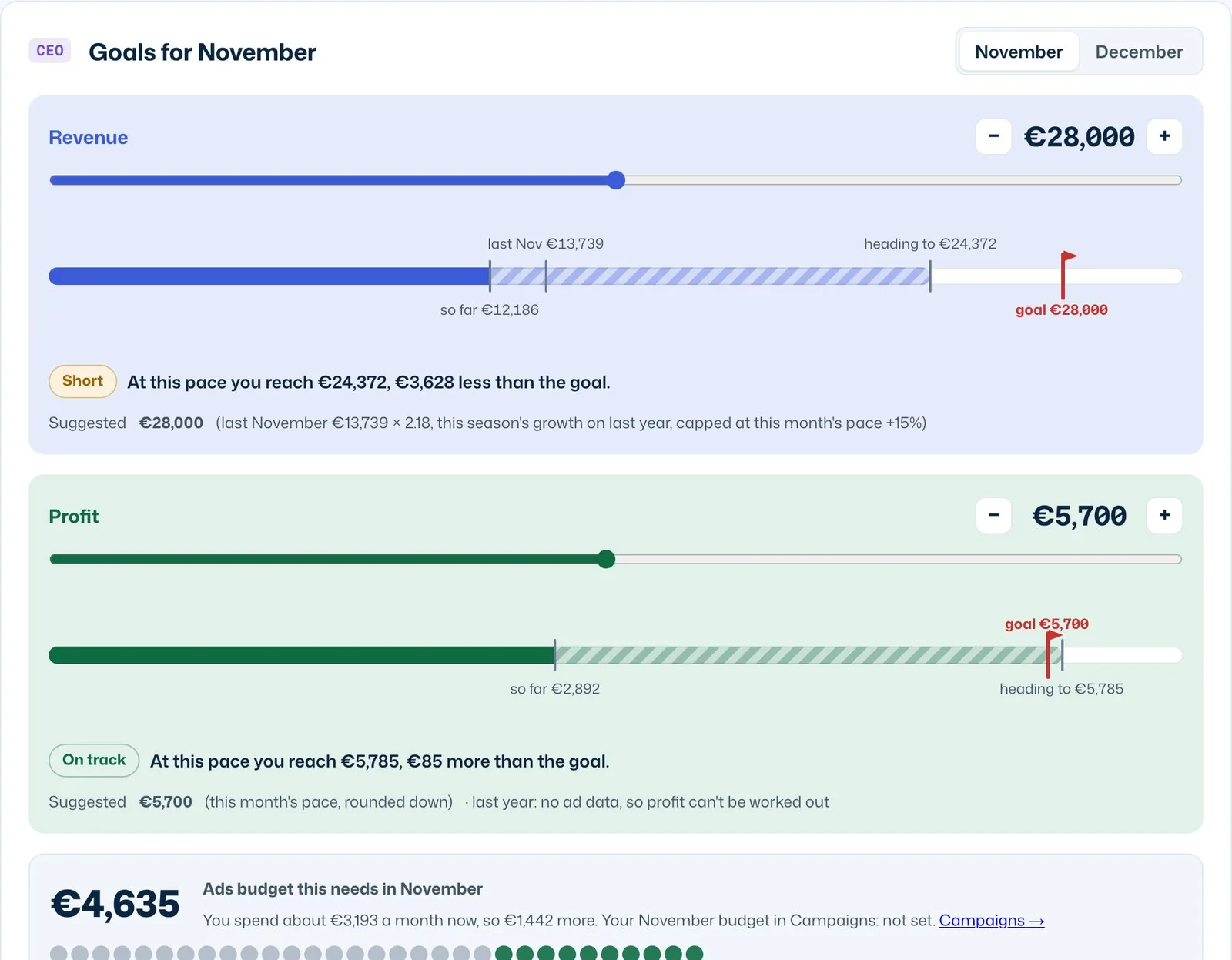
- See the pace. Each goal shows a bar with what has come in so far, where the current pace lands by month end, last year's same month as a mark, and the goal as a flag. A label says On track or Short, and by how much.
- Work out the budget. Kunads estimates the ad budget the revenue goal needs with one formula, shown below.
- The CEO proposes. The CEO agent turns the result into a proposal for the month's budget. Approving it sets the account's monthly budget, which budget pacing then spreads across campaigns.
How much ad budget does a revenue goal need?
Take the revenue that comes without ads off the goal, then divide what is left by the revenue each €1 of ads brings in.
Ad budget needed = (revenue goal − revenue that comes without ads) ÷ revenue per €1 of ads
Not all revenue comes from ads: returning customers, direct visits and organic search bring some regardless. That part is taken off the goal first.
An illustration with round numbers. A shop sets a €30,000 revenue goal. About €10,000 a month comes without ads. Each €1 of ads has been bringing €5 of revenue. Budget needed: (€30,000 − €10,000) ÷ 5 = €4,000.
Why is a raise capped at +50% a month?
Because revenue per euro of ads usually falls as spend grows, so a large jump is the least predictable move a budget can make. If the shop above spends €2,000 a month today, a raise is capped at +50% of that, so the CEO proposes €3,000 now and the rest once the raises show what the extra money brings.
The cap does not always bite. A second shop sets the same €30,000 goal, gets €12,000 a month without ads and €3 of revenue per €1 of ads, and spends €5,000 today. It needs (€30,000 − €12,000) ÷ 3 = €6,000, and the cap would allow up to €7,500, so the CEO proposes the full €6,000.
One exception: if each extra euro of ads already keeps less than a euro after margin, the proposal holds the budget at today's spend instead of raising it. The averages behind the estimate are the last 30 days'.
What you see
The Goals card, tagged CEO, has a tab per month. The revenue panel shows the goal, a bar with so far, last year's month and where the pace is heading, a status (On track or Short) and the suggested figure with how it was worked out. The profit panel does the same with profit; if last year has no ad data, it says profit cannot be worked out for last year instead of guessing. Below them, the ads budget the month needs sits next to what you spend now and whether a monthly budget has been set in Campaigns.
What a goal will not do
- Set budgets by itself. The CEO proposes; approving sets the monthly budget.
- Promise the goal. The estimate assumes revenue per euro of ads stays near what it has been; it often falls as you spend more.
- Chase revenue that loses money. The CEO will not propose spend your margin says is a loss.
- Plan for TikTok, Microsoft or LinkedIn Ads; only Meta and Google are connected.
An approved monthly budget still runs through the platforms' daily budgets, and those flex: Google may spend up to twice a campaign's average daily budget on a day but no more than 30.4 times it in a month (Google Ads Help), and Meta's daily budgets can run over on some days and under on others (Meta Business Help). Budget pacing reads that and keeps the month on course.
Who it is for
Owners who think in monthly targets, and agencies that agree a target with each client and need the budget conversation to start from arithmetic. If you want to try the maths first, the ad budget calculator works without an account, and how to set a monthly ad budget explains the reasoning. For how big a single step should be, see how much to increase an ad budget.
Next steps in Kunads
- Budget pacing: land the approved budget across campaigns.
- Profit tracking: where profit and margin come from.
- Lead generation ads: leads goals and max cost per lead.
- AI marketing agents: what the CEO agent does.
- Google Ads Help: About overdelivery and your average daily budget (checked 2026-11-19)
- Meta Business Help Center: About budgets (checked 2026-11-19)
Agencies: one screen for every client account, with each campaign measured on what the client kept and a white-label report each Monday.
Free audit for one client Trial for agenciesLeads goals and who sets the budget
Can I set a goal in leads instead of revenue?
Yes. Lead-gen accounts set a monthly leads goal and a maximum cost per lead.
Does setting a goal change my budgets?
No. The CEO agent proposes the month's budget from the goal. Approving the proposal sets it as the account's monthly budget.