Breakeven ROAS
Breakeven ROAS is the return on ad spend at which an order exactly pays for its goods, fees, delivery and the advertising that brought it in, leaving zero profit. Below it, each ad-driven sale loses money; above it, each one earns something.
Breakeven ROAS = average order value ÷ contribution per order = 1 ÷ contribution margin
Contribution per order is what an order leaves after every cost that grows with one more sale. Fixed costs such as rent and salaries stay out, and so does VAT.
Worked example: a skincare order
A skincare brand's average order is €48.00 without VAT. Per order it pays:
| Line | Cost | Left |
|---|---|---|
| Order value | €48.00 | |
| Products (cost of goods) | €12.00 | €36.00 |
| Payment fee (2.5%) | €1.20 | €34.80 |
| Delivery the brand pays | €4.80 | €30.00 |
| Expected refunds (5% of orders) | €2.40 | €27.60 |
- Contribution margin: €27.60 ÷ €48.00 = 57.5%
- Breakeven ROAS: €48.00 ÷ €27.60 = 1.74× (174% in Google's format)
- Highest cost per purchase that still breaks even: €27.60
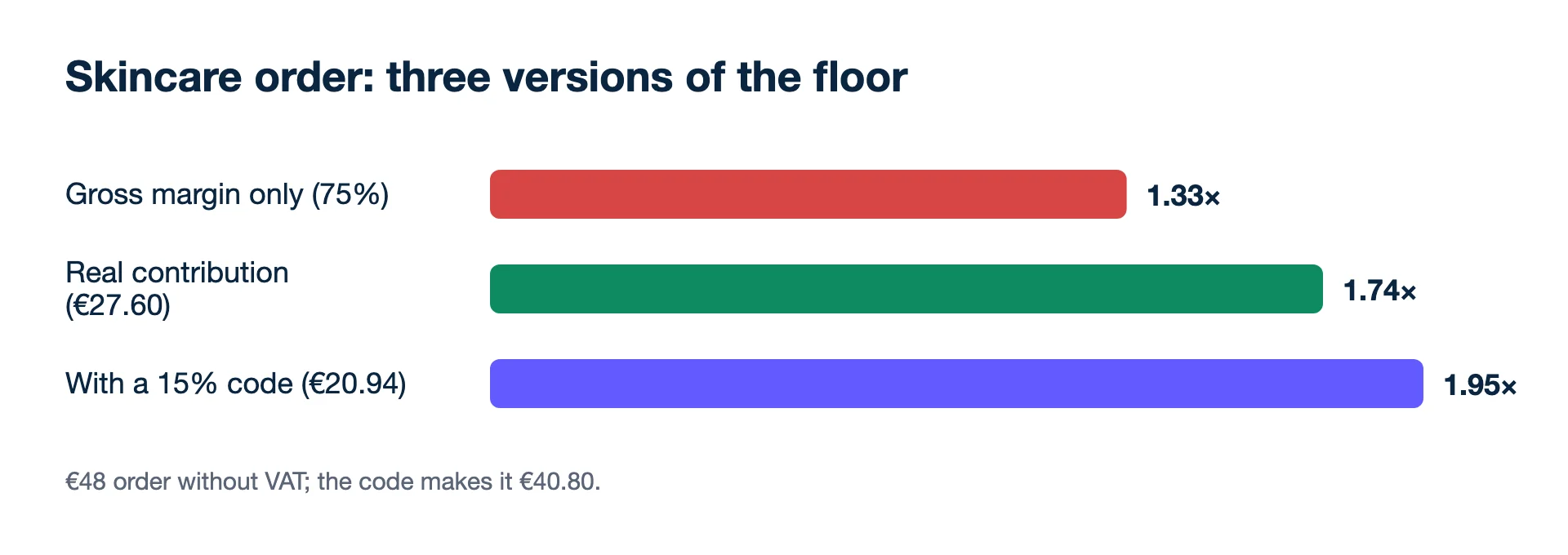
Notice how far that is from the catalogue view. Price €48 against product cost €12 is a 75% gross margin and a "breakeven" of 1.33×. The delivery, fee and refund lines move the real floor up by 0.41.
Is a ROAS of 1 breakeven?
No: a ROAS of 1 only returns the ad money as revenue, and the goods, payment fees and delivery for those orders are still unpaid. For the skincare brand above, a ROAS of 1 means every €48 order brings in €48 against €48 of ad spend plus €20.40 of other costs, a loss of €20.40 per order. Real breakeven is almost always well above 1.
Why the floor matters more than the ROAS
A ROAS figure means nothing until you know the breakeven it has to beat. A 2.0× campaign is profitable for this skincare brand and loses money for a shop at a 40% margin, whose breakeven is 2.50×. Breakeven ROAS turns a platform number into a yes or no. It is also the starting point for setting a target ROAS in Google or a ROAS goal in Meta, and for judging the whole account with blended ROAS.
How margin moves the floor
The relationship is not linear. Each step down in margin raises the floor more than the one before:
- 60% margin: 1.67×
- 45% margin: 2.22×
- 30% margin: 3.33×
- 15% margin: 6.67×
This is why a discount hurts more than it looks. A 15% code on the skincare order takes €7.20 off the price, but only the payment fee and refund lines shrink with it (to €1.02 and €2.04). Contribution drops from €27.60 to €20.94 on a €40.80 order, and breakeven climbs from 1.74× to 1.95×.
A second shop: low order value
A European food shop averages €25.20 per order and keeps €13.57 of it after goods, payment fees and delivery. Its breakeven ROAS is 25.20 ÷ 13.57 = 1.86×, and the most it can pay for one order is €13.57. The ratio looks gentler than many fashion shops, but the euro amount is small: one bad week where cost per purchase drifts to €16 loses €2.43 on every order. With small baskets, watch the cost per purchase in euros as closely as the ratio.
How do I enter breakeven ROAS in Google and Meta?
In Google Ads you enter it as a percentage: conversion value per €1 of spend × 100, so 1.74× becomes a target ROAS of 174%. Meta's ROAS goal serves the same purpose on its side. Either way, the platform aims at its own reported conversion value, counted in its own window, so a goal set exactly at the shop's breakeven leaves no room for the orders the shop and the platform count differently. Set the goal above the floor and check the result against the shop's own revenue and blended ROAS.
Errors that move the floor
- Using gross margin. It leaves out delivery, fees and refunds, so the floor comes out too low.
- Spreading fixed costs per order. Dividing rent by order count gives a number that changes with volume. Cover fixed costs from total contribution instead.
- VAT in the order value but not in the costs. That alone can make the floor look 15–20% lower than it is.
- Forgetting to update during a sale. The floor moves the moment a code goes live.
Work it out for your own numbers with the breakeven ROAS calculator. The full guide, with a margin table and how to enter targets in Google and Meta, is breakeven ROAS: how to calculate the minimum ROAS for profit.
Related: contribution margin, POAS (where breakeven is always 1.0) and CPA.
- Google Ads Help: About Target ROAS bidding (target ROAS as a percentage) (checked 2026-11-19)
- Meta Business Help Centre: About ROAS goal (checked 2026-11-19)
Changes wait for you. Kunads proposes budget moves in 20% steps with the reasoning attached; nothing reaches Meta or Google until you press Approve.
See what it would change Begin a free trialBreakeven ROAS in practice
Should I use breakeven ROAS as my target ROAS?
Not usually. At breakeven, ads earn nothing toward fixed costs. Most shops set a target above it, unless they have measured that repeat purchases pay back a lower first-order return.
Does breakeven ROAS change by campaign?
It can. The formula uses the margin of what a campaign actually sells, so a campaign selling mostly low-margin products, or mostly discounted ones, needs its own higher floor.