Target ROAS
Target ROAS is the return on ad spend you tell the bidder to aim for on average. Google calls it Target ROAS (tROAS) and takes it as a percentage, so 3.33× is 333%; Meta calls it the ROAS goal and takes a decimal. Set it above your breakeven ROAS, by the share of revenue you want left after ads.
Target ROAS = 1 ÷ (contribution margin − the share of revenue you want left after ads)
The formula starts from your breakeven ROAS (1 ÷ contribution margin) and adds room for profit. Both platforms aim at the average over time, not at every single sale.
How do I work out my target ROAS?
Subtract the profit share you want from your contribution margin and take the reciprocal; then check it against what the campaign actually achieves. A cookware shop keeps 45% of each order after goods, fees and delivery.
- Breakeven: 1 ÷ 0.45 = 2.22×.
- Profit wanted: 15% of revenue left after ads, to pay for staff and rent.
- Target: 1 ÷ (0.45 − 0.15) = 1 ÷ 0.30 = 3.33×, entered in Google as 333%. Google's own example of the format: $5 of sales per $1 of spend × 100% = 500%.
- Check against reality: the campaign's last 30 days ran at 2.9× in Google's reporting. A 333% target is 15% above that, so Google would likely bid down and spend less. The shop starts at 300% and moves toward 333% over several weeks.
- Check the money: at €20,000 of revenue at 3.33×, ad spend is about €6,000, contribution is €9,000 and €3,000 (15%) is left after ads. At 2.9× with more volume, say €26,000 of revenue, spend is about €8,966, contribution €11,700, and €2,734 is left.
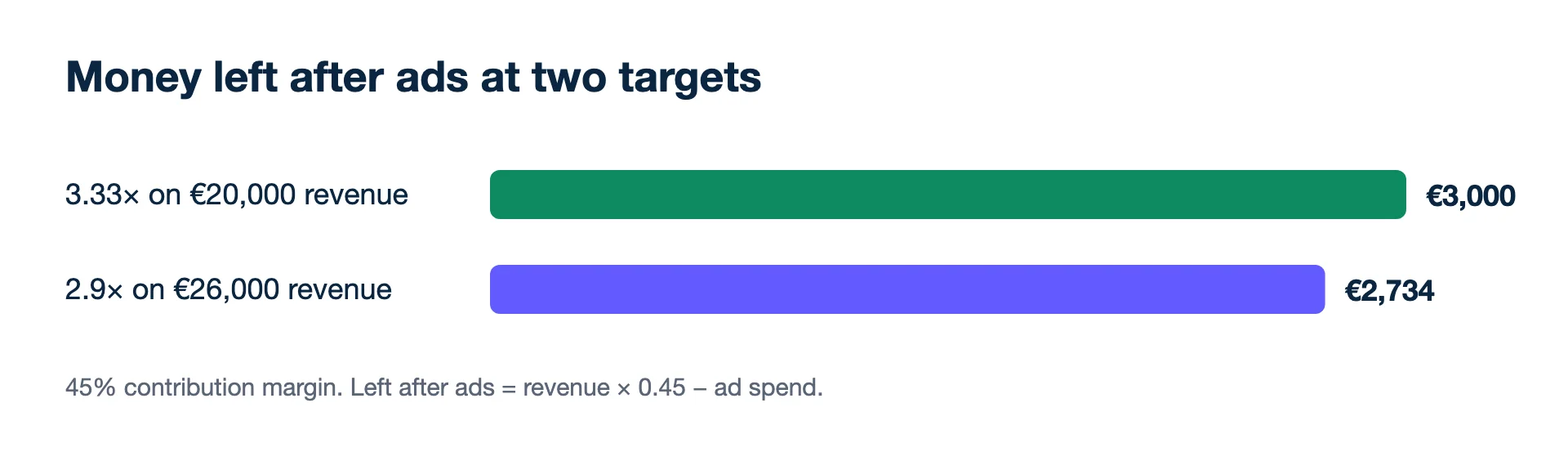
Here the higher target leaves slightly more money on less spend, but the gap is small, and that is common. The target that makes the most total profit usually lies between breakeven and the highest ROAS you have seen.
The volume trade-off
A target is a choice between efficiency and volume. Raise it and the bidder drops less certain auctions: ROAS rises, sales fall. Lower it and it buys more: sales rise, each costs more. Google warns that a target set too high may limit the traffic your ads get. Meta says the ROAS goal may spend less than the full budget in a competitive market to protect the target, which is the difference from its Highest value strategy, which prioritises spending the budget.
What should my first Meta ROAS goal be?
Meta recommends starting 10–20% below your average ROAS, measured within your attribution setting. If the cookware shop's Meta ad set has averaged 2.5× over the last three weeks, that means a first goal between 2.0 and 2.25.
That raises an edge case: 2.0 is below the shop's 2.22× breakeven. It is not automatically a loss, because Meta's ROAS is built on purchases Meta attributes on its own window, while breakeven is about all the money the shop keeps. The two count differently and never agree. The honest check is the account's blended ROAS (all revenue ÷ all ad spend) before and after the change. If blended stays above 2.22×, the lower goal is affordable; if it slides, raise the goal. When the ad set spends its full budget but runs well below goal, Meta suggests raising the goal by 5–10%; when much of the weekly budget is left, lowering it by 5–10%.
Requirements on each platform
- Google: conversions need values. For Search and Shopping, at least 15 conversions in the past 30 days. Google's recommended target is based on your actual ROAS over the last few weeks, leaving out the most recent days because of conversion delay.
- Meta: choose "Maximise value of conversions" as the performance goal first. The goal is a number from 0.001 to 1000.00, and Meta describes 1.00 as break even on ad spend: spend $100, get about $100 of purchase value. That is not your real breakeven once goods and delivery are paid. Meta says the goal works best with at least 50–100 conversions per ad set per week.
Mistakes before and after the switch
- Using Meta's 1.00 as breakeven. At 1.00 only the ad spend comes back.
- Big jumps. Moving from 300% to 450% overnight can stall delivery. Change in steps and give each one time.
- Too little data. Below the conversion thresholds above, results swing and the bidder has little to learn from.
- Keeping a revenue target after sending profit values. If the conversion value becomes profit, a target of 333% becomes a POAS target and must be rescaled (old target × margin: 3.33 × 0.45 = 1.50).
Work out your floor first with the breakeven ROAS calculator.
Related terms
- Google Ads Help: About Target ROAS bidding (checked 2026-11-19)
- Meta Business Help Centre: About ROAS goal (checked 2026-11-19)
- Meta Business Help Centre: Best practices for ROAS goal (checked 2026-11-19)
Numbers from your shop, not from the ad platforms. Connect Meta, Google and Shopify, WooCommerce or Magento and see what each campaign kept.
Get my profit audit Open a free workspaceBefore you switch to tROAS
Should target ROAS equal breakeven ROAS?
Only if you are happy for ads to earn nothing toward fixed costs. Usually the target sits above breakeven. It can sit below only if you have measured repeat purchases that pay back the gap.
How long should I wait after changing the target?
Meta says to wait at least 7 days after any adjustment before re-evaluating a ROAS goal. Google suggests giving a new Target ROAS 1–2 conversion cycles before judging it.
Does Google need conversion history for Target ROAS?
For Search and Shopping, Google lists at least 15 conversions in the past 30 days, and conversions must carry values. Google also suggests reporting values for 4 weeks or 1–2 conversion cycles, whichever is longer, before setting a target.