Target CPA
Target CPA is the average cost per conversion you tell the bidder to aim for. Google's Target CPA sets bids to win as many conversions as possible at or near that average, so some conversions cost more and some less. Set it from what one conversion leaves you, minus the profit you want to keep.
Target CPA = what one conversion leaves you − the profit you want to keep from it
For a shop, "what one conversion leaves you" is the contribution per order. For lead generation it is what a lead is worth: what a won deal keeps × the share of leads that become customers.
How do I set a target CPA?
Start from the money: take what a conversion leaves after costs, subtract the profit you want per conversion, and then check the result against what the campaign has actually been paying. Two businesses show both halves.
An online pharmacy
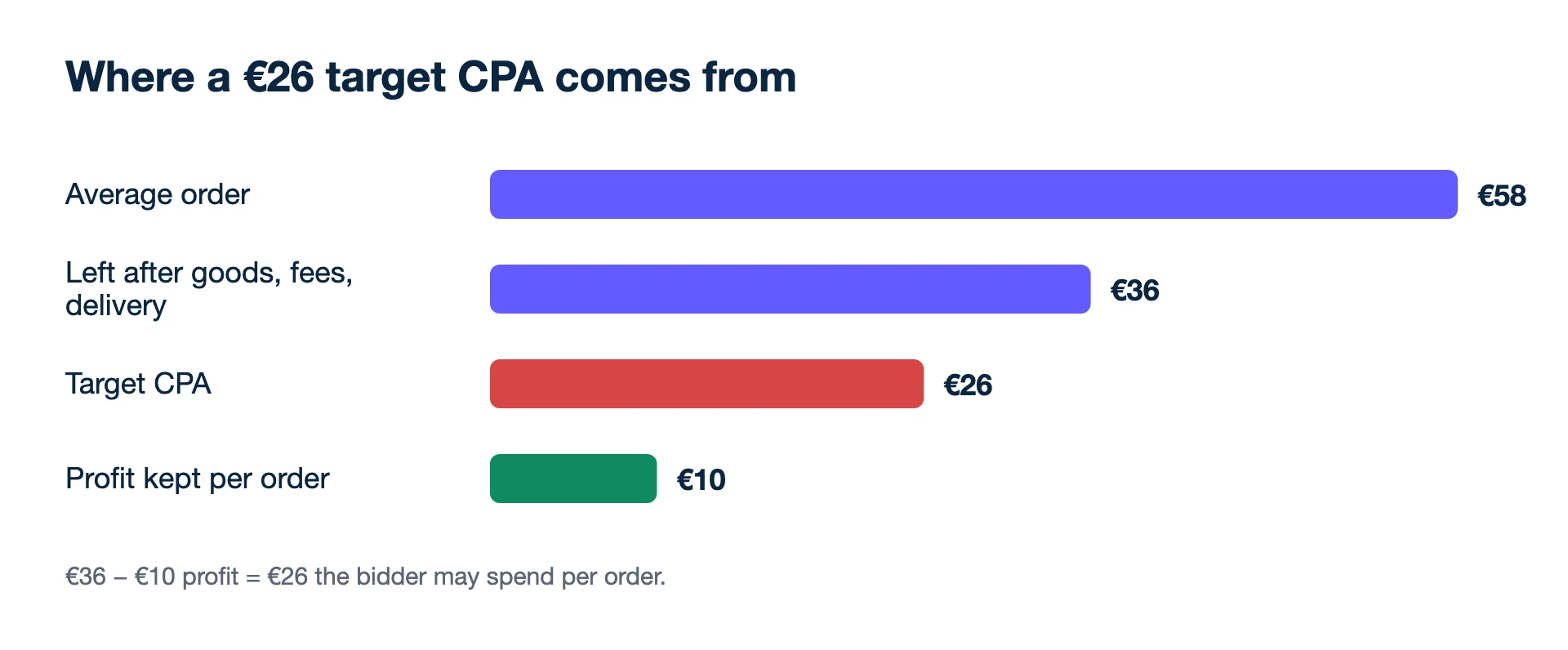
- Average order €58, of which €36 is left after goods, payment and delivery.
- Profit it wants to keep per order: €10.
- Target CPA: €36 − €10 = €26.
- Equivalent ROAS: €58 ÷ €26 = 2.23×. Breakeven ROAS: €58 ÷ €36 = 1.61×.
An accounting firm
- A new client keeps the firm €1,200 in the first year after staff time.
- 1 in 8 consultation requests becomes a client.
- Most a lead can cost: €1,200 ÷ 8 = €150.
- Wanting half of that as profit: target CPA (per lead) €75.
Here a CPA target fits better than a ROAS target, because each conversion is worth about the same and there is no basket value to bid on. The lead value calculator gives a lead's worth and the most it can cost.
Why is my CPA above target on some days?
Because the target is an average, not a cap. Google says some conversions may cost more than the target and some less, while the overall cost per conversion is kept near it. A day at €40 against a €26 target is not a malfunction; judge it over weeks. Google recommends measuring performance over the last 30 days with at least 30 conversions.
Conversion delay adds to the noise. If people often buy several days after the click, the last few days always look expensive until their conversions arrive. Google adjusts its recommended target (the average CPA of the last 30 days) for that delay; do the same when you read the report.
Lowering a target without stalling the campaign
Say the pharmacy campaign has averaged €38 per order and the owner wants €26. Setting €26 overnight asks the bidder to drop every auction it currently wins above that price, and Google warns that a target that is too low may cause you to forgo clicks that could result in conversions. A gentler path is €38 → €34 → €30 → €26, holding each step for at least one conversion cycle.
Google's Smart Bidding guidance says a target change takes effect immediately and does not put the strategy into "Learning"; performance settles over the conversion cycle. What does trigger Learning is a new or reactivated strategy, adding or removing campaigns or keywords, or a significant change to the conversion goal, and Google says that status never lasts more than 7 days. Google also advises against several target changes within one conversion cycle unless the business clearly needs it.
Platform details worth knowing
- Device adjustments change the target, not the bid. Google's example: a +40% mobile adjustment on a $10 target makes the mobile target $14.
- Conversion tracking is required before the strategy can be set.
- Meta calls its version the cost per result goal. Its ROAS goal guidance suggests raising the cost per result goal, broadening the audience or adding budget when an ad set gets too few weekly conversions.
- Both platforms bid on the conversions they count. Check the cost per order or per won client in your own records from time to time, and adjust the target if the two drift apart.
Where targets usually go wrong
- Using revenue instead of contribution. A €58 order does not allow a €50 CPA.
- One target for different conversions. A lead form and a phone call may close at different rates. Value them separately, or use separate campaigns.
- Counting cheap micro-conversions. If add-to-cart is a primary conversion, the bidder will happily buy add-to-carts at your target.
- Changing it every few days, so no step is ever judged on a full conversion cycle.
Related terms
- Google Ads Help: About Target CPA bidding (checked 2026-11-19)
- Google Ads Help: About Smart Bidding learning (checked 2026-11-19)
- Meta Business Help Centre: About ROAS goal (mentions the cost per result goal; checked 2026-11-19)
Would rather not do this by hand? Kunads' agents check every campaign against your margin each day and propose a fix you approve or ignore.
Audit my ads for free Try Kunads, no cardSetting the first tCPA
Can I use target CPA with no conversion history?
Google says you can start Target CPA with no conversion history, and then bases the recommended target on your business goals instead of past CPA. Conversion tracking must be set up first.
Will target CPA spend more than my daily budget?
On some days, yes. Google suggests reviewing your budget settings so you are comfortable spending up to twice your average daily budget on a given day.
Does Meta have target CPA?
Meta's equivalent is the cost per result goal bid strategy, which aims to keep the average cost per result near your goal. Meta suggests raising that goal when an ad set gets too few conversions to optimise.