CPL (cost per lead)
CPL (cost per lead) is your ad spend divided by the number of leads it produced: form fills, calls, booked consultations or whatever you count as an enquiry. €5,400 of ads that brought 40 leads is a CPL of €135.
CPL = ad spend ÷ leads
The formula is trivial. The work is in the number you compare it with, because a lead is not a sale. Two lines do the job:
- Value of a lead = average deal value × close rate (useful for forecasting revenue)
- Maximum CPL = what a won deal keeps × close rate (the most you can pay without losing money)
Worked example: a kitchen renovation company
A renovation company runs Google Search and Meta lead ads for one month.
- Spend and leads: €5,400 across both, 40 leads. CPL = €5,400 ÷ 40 = €135.
- Deal value: an average kitchen is €9,000. After materials, fitters and travel, the company keeps €2,700 per job.
- Close rate: over the past year, 1 in 15 leads (6.7%) became a signed job.
- Value of a lead in revenue: €9,000 ÷ 15 = €600.
- Maximum CPL: €2,700 ÷ 15 = €180.
At €135 the ads are working: each lead costs €45 less than the line where it stops paying. Forty leads should bring about 40 ÷ 15 ≈ 2.7 jobs, keeping roughly 2.7 × €2,700 = €7,200 against €5,400 of ads. If the close rate on the Meta leads alone turned out to be 1 in 30, their maximum CPL would halve to €90, and a €110 Meta CPL that looked fine would be losing money.
What is a good cost per lead?
A good cost per lead is one below what a lead is worth to you: what a won deal keeps × the share of leads that become customers. There is no universal figure. For the renovation company the line is €180; for the clinic below it is lower for one source than the other. Published averages mix industries with nothing in common, so they are no guide to your own limit.
Second example: a cheap lead source that costs more
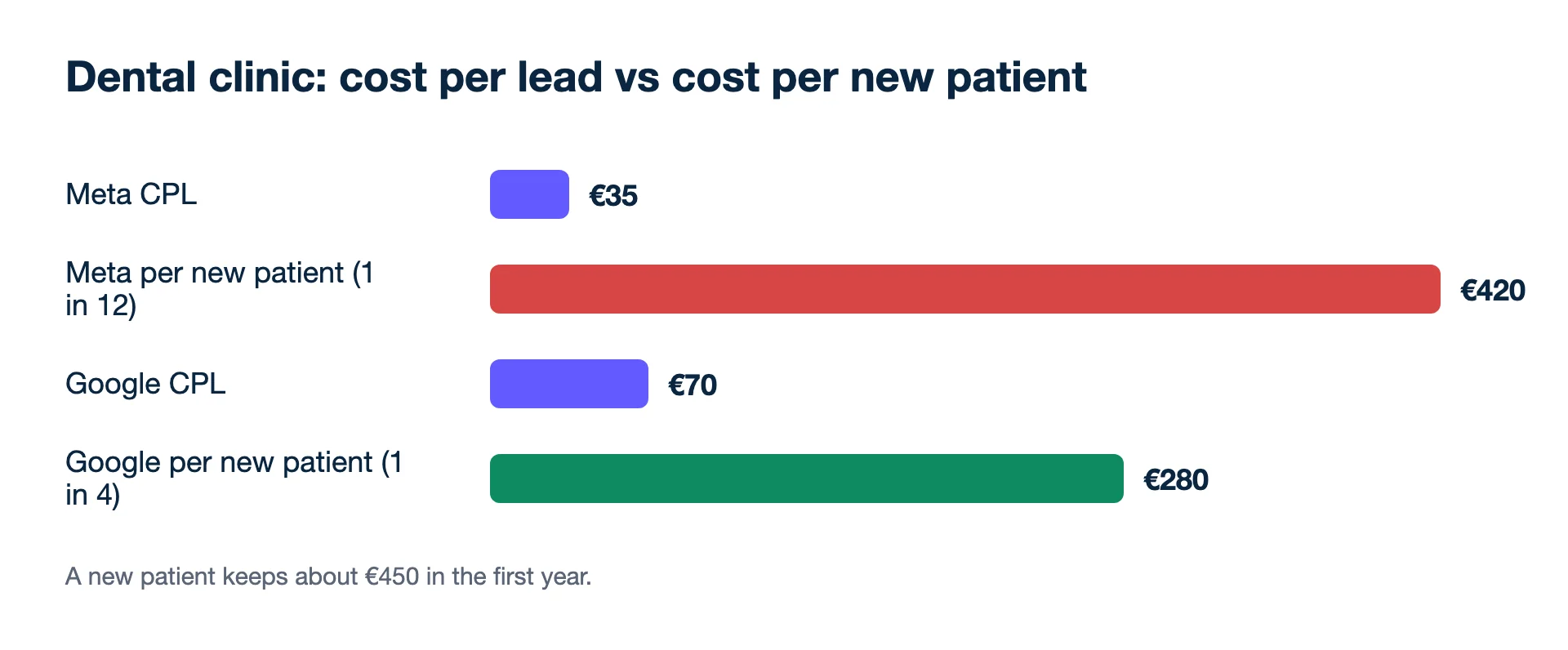
A dental clinic keeps about €450 in the first year from a new patient. It runs Meta lead ads with an instant form and a Google Search campaign to a booking page.
- Meta: CPL €35, and 1 in 12 leads books and attends. Cost per new patient: €35 × 12 = €420.
- Google: CPL €70, and 1 in 4 leads books and attends. Cost per new patient: €70 × 4 = €280.
The Meta leads cost half as much each and the patients cost 50% more. Both sources still pay against €450, but the €140 gap per patient decides where the next euro goes. Maximum CPL makes the same point: Meta's is €450 ÷ 12 = €37.50, barely above the €35 it pays; Google's is €450 ÷ 4 = €112.50, far above €70.
How do Meta and Google collect leads?
Both can collect the lead inside the ad: Meta with lead ads and their instant forms, Google with lead form assets on its campaigns. A form that never leaves the app removes a step, which tends to raise volume and can change who fills it in. Count leads from forms, landing pages and calls in one total only if they close at similar rates; otherwise keep each with its own close rate. Sending won deals back to each platform, through Meta's offline event upload or Google's GCLID-based offline conversion import, lets the systems learn which leads became customers.
Why CPL needs the back end
CPL is what the platforms optimise and report, so it is the number in front of you every day. It is only useful once tied to the back end. A lead source that is twice as cheap and closes three times worse is the expensive one. That is why the two lines above, and a close rate per source, belong next to every CPL report. The lead value calculator works out both numbers from your own deal value and close rate.
Where lead reports go wrong
- Comparing CPL across sources without close rates. Instant forms on Meta can cost less per lead than a landing page and close at a different rate, as in the clinic example. Measure each.
- Using deal value instead of what the deal keeps. The €600 "value of a lead" above includes materials and labour. Paying €400 per lead would look fine on revenue and lose money on every job.
- Counting junk. Spam, duplicates and wrong numbers pad the lead count and shrink CPL on paper. Clean the list before you divide.
- Closing the books too soon. If deals take 60 days to sign, a month-old campaign has not shown its close rate yet.
- Not sending results back. If the platform only sees leads, it finds more people who fill in forms. Sending won deals back as offline conversions lets it look for people who buy.
For more on setting that limit, see what is a good cost per lead. Related: CPA, CAC.
- Meta Business Help Centre: About lead ads (checked 2026-11-19)
- Meta Business Help Centre: Upload offline event data (checked 2026-11-19)
- Google Ads Help: About lead form assets (checked 2026-11-19)
- Google Ads Help: Set up offline conversions using Google Click ID (GCLID) (checked 2026-11-19)
Agencies: one screen for every client account, with each campaign measured on what the client kept and a white-label report each Monday.
Free audit for one client Trial for agenciesCounting calls as leads
Should I count phone calls as leads?
Yes, if calls turn into customers at a similar rate. Count them in the same lead total, or track them separately with their own close rate if they behave differently.