CAC (customer acquisition cost)
CAC (customer acquisition cost) is the total cost of winning one new customer: what you spent on acquisition in a period divided by the number of first-time customers you gained in it. €22,500 of acquisition cost and 450 first-time buyers make a CAC of €50. Returning customers stay out of the count.
CAC = acquisition costs in the period ÷ new customers in the period
What goes into the top line
There is no single standard, which is why two companies' CAC numbers are rarely comparable. Most teams use one of two versions:
- Paid CAC: ad spend only, divided by new customers. Quick, and good for comparing months.
- Fully loaded CAC: ad spend plus agency or freelancer fees, creative production, influencer payments, acquisition tools and the share of salaries spent on acquisition.
Keep out costs that serve existing customers, such as retention email or loyalty discounts. They belong to the repeat side of the business.
Worked example: one month at a tea shop
| Cost | Amount |
|---|---|
| Meta and Google ad spend | €18,000 |
| Agency fee | €3,000 |
| Creative production (photos, video edits) | €1,500 |
| Total acquisition cost | €22,500 |
In the same month, the shop recorded 1,240 orders. Of those, 450 were from email addresses that had never ordered before.
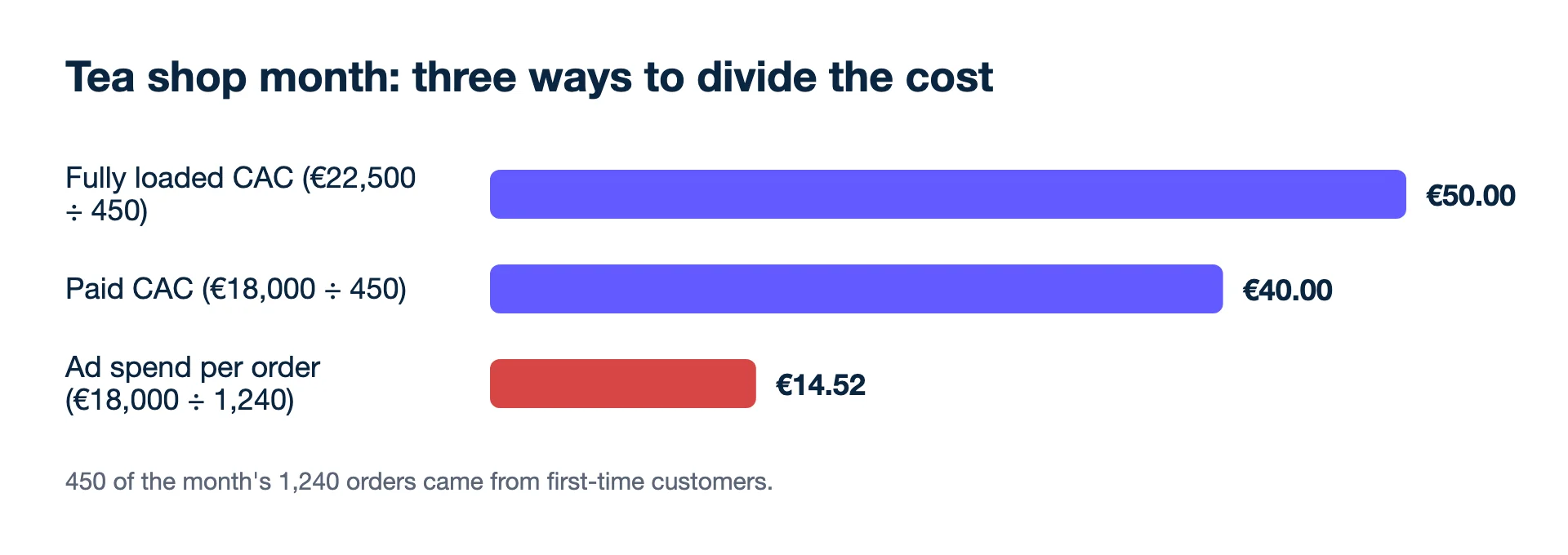
- Paid CAC: €18,000 ÷ 450 = €40.00
- Fully loaded CAC: €22,500 ÷ 450 = €50.00
- For contrast, ad spend per order of any kind: €18,000 ÷ 1,240 = €14.52. That is closer to what the ad platforms show as CPA, and it makes acquisition look nearly three times cheaper than it is.
Whether €50 is fine depends on what a new customer is worth over time. If the first order leaves €14 and the average new customer orders four times in a year, the 12-month contribution is about €56, so the shop barely gets its €50 back in a year.
How is CAC different from CPA?
CPA divides ad spend by every conversion the platform counts, returning customers included; CAC divides acquisition cost by first-time customers only, and often includes more than ad spend. The tea shop shows the gap: €14.52 per order against €40 to €50 per new customer.
Where does the new-customer count come from?
From your shop or CRM, matched on email or customer ID, because neither ad platform knows by default who has bought before. GA4 has a "First time purchasers" metric (users who made their first purchase in the period), which is closer to CAC's denominator than "New users", a count of first visits. Google Ads can bid differently for new customers with its customer acquisition goal, but only once you tell it who your existing customers are, through a customer list or the website tag. Meta works the same way: upload a customer list custom audience and you can exclude existing buyers from prospecting or see them as a separate segment. Without such a list, a platform's "conversions" are simply purchases, from anyone.
Second example: when the month is the wrong window
A furniture shop's customers usually buy about four weeks after the first click. It spends €20,000 in March and €20,000 in April. March brings 160 new customers and April 240, partly from March's clicks. Monthly CAC reads €125.00 in March (20,000 ÷ 160) and €83.33 in April (20,000 ÷ 240), as if acquisition got a third cheaper overnight. Over the two months together it is €40,000 ÷ 400 = €100.00. With long buying cycles, measure CAC over a quarter or by cohort, and do not react to one month.
Why CAC deserves its own line
Growth means new customers, and CAC is the price of them. Repeat buyers make blended numbers look healthy even when acquisition is getting more expensive, so a shop can watch MER hold steady while CAC climbs month after month. Tracking CAC on its own shows that early. Set next to LTV, it tells you how much you can afford to spend to grow, and the LTV:CAC calculator does that comparison.
Ways CAC gets understated
- Dividing by all customers. Returning buyers are not acquired. Counting them makes CAC look lower than it is.
- Using platform conversions as "new customers". Platforms count conversions, not first-time buyers. Take the new-customer count from your shop or CRM.
- Mixing paid and fully loaded. Pick one for each purpose and label it.
Next steps from here: LTV:CAC ratio, payback period and new-customer ROAS.
- Google Analytics Help: Analytics dimensions and metrics (First time purchasers, New users) (checked 2026-11-19)
- Google Ads Help: About customer lifecycle goals (new customer acquisition) (checked 2026-11-19)
- Meta Business Help Centre: About customer list custom audiences (checked 2026-11-19)
Lead generation? Send won deals from your CRM and Kunads ranks campaigns by what the leads were worth, not by how many came in.
Check my lead campaigns Start free for 14 daysCAC questions from the finance side
Should salaries be in CAC?
If people spend their time on acquisition, a fully loaded CAC includes their share. Many teams track two numbers: paid CAC (ad spend only) for weekly decisions and fully loaded CAC for planning.
What is a good CAC?
One that the customer pays back. Compare CAC with the contribution a new customer brings over a period you can fund, for example 6 or 12 months. See LTV:CAC ratio and payback period.