New-customer ROAS
New-customer ROAS (ncROAS) is revenue from first-time buyers divided by ad spend in the same period. A shop that spends €30,000 and takes €54,000 in first orders has an ncROAS of 1.8, whatever its blended ROAS says. It isolates the growth the ads are buying from sales to customers you already had.
How do you calculate new-customer ROAS?
Divide the revenue from first orders in a period by all ad spend in that period. The hard part is the first term, not the division.
New-customer ROAS = revenue from first orders in the period ÷ ad spend in the period
"First order" should come from your shop or CRM: an email address, phone number or customer ID that has never ordered before. Ad platforms count conversions, not first-time buyers, unless you tell them who your existing customers are. Use all ad spend, not only prospecting spend; otherwise the cost of reaching new people through retargeting and brand search goes missing from the denominator.
Worked example: a healthy-looking September
- Ad spend, Meta and Google: €30,000
- Total revenue: €120,000, so blended ROAS is 4.0
- Revenue from returning customers: €66,000
- Revenue from first orders: €54,000 (1,200 new customers × €45)
- New-customer ROAS: €54,000 ÷ €30,000 = 1.8
At a 45% contribution margin, those first orders left €54,000 × 0.45 = €24,300. Against €30,000 of spend, the shop paid €5,700 more to acquire them than their first orders brought in: €25 of ad spend per new customer (€30,000 ÷ 1,200) against €20.25 left on the first order (€45 × 0.45), a gap of €4.75 each.
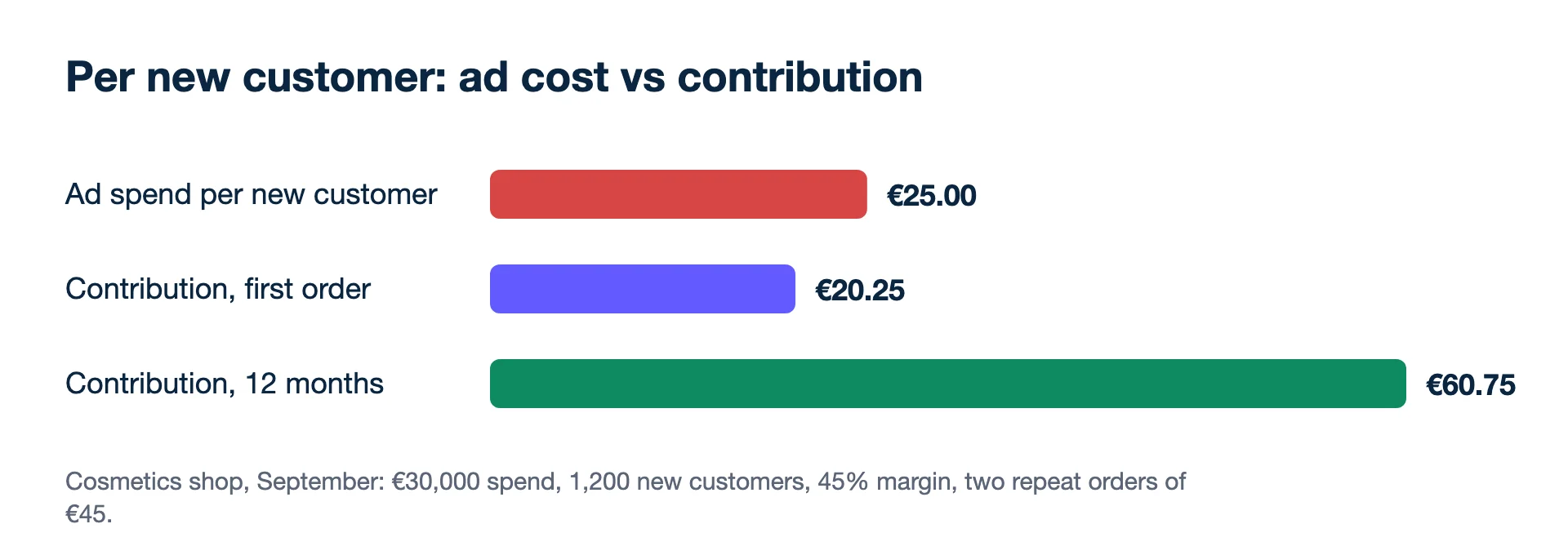
Is that bad? Only repeat data can say. If a new customer typically places two more €45 orders within 12 months, each leaving €20.25, the 12-month contribution is €60.75 against €25 of ad spend. The shop is buying growth at a good price. If customers rarely come back, the same 1.8 means acquisition loses money, and the 4.0 blended figure is being carried by last year's customers.
Second example: October, when blended ROAS rose
In October the team moved budget from prospecting to retargeting and brand search. Spend stayed at €30,000.
- Total revenue: €126,000, blended ROAS 4.2 (up from 4.0)
- Returning-customer revenue: €84,000
- First orders: 1,000 new customers × €42 = €42,000
- New-customer ROAS: €42,000 ÷ €30,000 = 1.4 (down from 1.8)
- Ad spend per new customer: €30,000 ÷ 1,000 = €30, up from €25
The headline improved while the shop bought 200 fewer new customers at a higher price each. Retargeting and brand search mostly reach people who already know the shop, so this pattern (blended up, ncROAS down) is the usual sign of budget drifting towards existing demand. Kept up for a few months, it shrinks the customer base that next year's blended ROAS depends on.
Is a low new-customer ROAS a problem?
Not on its own. In a repeat business ncROAS is expected to sit below first-order breakeven; the question is whether the customer pays back later. Judge it with LTV and the payback period, using repeat rates you have measured on past cohorts rather than hoped for. In a business where most customers buy once (furniture, a one-off course), the first order is most of the value, and an ncROAS below breakeven is a real loss.
How Google reports new customers
Google Ads has customer lifecycle goals. In the customer acquisition category there are three modes:
- New Customer Value: recommended by Google for all advertisers with purchase goals. It bids higher for new customers while still reaching returning ones. It works on Search, Performance Max, Shopping and Demand Gen with Target ROAS or Maximise conversion value.
- High Value New Customer: sets separate priorities for high-value new customers, other new customers and existing ones.
- New Customer Only: bids only for new customers. Google recommends it for strict acquisition budgets or non-purchase goals such as lead generation, with a separate campaign for existing customers.
Existing customers are defined with first-party data, such as customer lists and the site tag. By default Google can also detect them itself from up to the last 540 days of campaign activity and tracked purchases, which it calls easier but less complete, because people clear cookies and opt out. Customer lists under 1,000 members can hurt acquisition.
For reporting, Google adds segments (new customers, returning, Unknown, additional conversions) and columns such as New customers and Customer Acquisition Cost. Two limits matter: the reporting covers only purchase conversions, and it starts on the day you activate the goal, with no history before it.
Where the count goes wrong
- Guest checkouts. If returning buyers check out under a new email, first-order revenue looks higher than it is. Match on phone, address or customer ID too where you can.
- Using platform conversions as new customers. Take the split from your own order data; platform segments cover only their own attributed purchases.
- Comparing with other shops' figures. "New" can mean never ordered, or no order in 12 months. The numbers are not comparable without the rule.
- Reading one month alone. A sale month pulls in bargain hunters who return less; compare cohorts, not single months.
To check whether a new customer pays back on your own numbers, use the LTV:CAC calculator.
Related terms
- Google Ads Help: About customer lifecycle goals (checked 2026-11-19)
- Google Ads Help: How customer lifecycle goals detect customer segments (checked 2026-11-19)
- Google Ads Help: Measure your lifecycle goals campaigns (checked 2026-11-19)
- Google Ads API: Lifecycle goals (checked 2026-11-19)
Agencies: one screen for every client account, with each campaign measured on what the client kept and a white-label report each Monday.
Free audit for one client Trial for agenciesCounting new customers correctly
What is a good new-customer ROAS?
There is no general figure. It usually sits below blended ROAS and often below first-order breakeven. It is healthy when the 12-month contribution of a new customer covers what you paid in ads to win them.
Should a customer who comes back after two years count as new?
Decide one rule and keep it. Many shops count only customers who have never ordered; others treat buyers with no order in 12 or 24 months as new again. Google's lifecycle goals keep these apart: lapsed customers belong to the re-engagement modes, not to new customer acquisition.
Why is my new-customer count higher in the shop than in Google Ads?
They count different things. Google's lifecycle reporting covers only purchase conversions attributed to its own campaigns, and it labels some conversions Unknown when it cannot tell new from existing. The shop counts every first order from every source.