AI marketing agents: five roles, one approval queue
Kunads runs five AI marketing agents over your Meta and Google accounts: a CEO, a CFO, a CMO, a creative agent and a data agent. Each has one job and reads the same numbers from your shop or CRM, and every proposal goes to one queue where a person approves it before anything changes.
It is for brands, lead-gen businesses and agencies that want the daily analysis done but the final say kept.
In short
- Five agents with separate jobs, wired to your measured margin.
- They report and propose; a person approves; every change has an undo.
- Each proposal names the rule it rests on and shows its arithmetic.
What does each agent decide?
Each agent owns one decision, from the month's budget (CEO) to the price one sale may cost (CFO), and each has a line it will not cross.
| Agent | Job | What it will not do |
|---|---|---|
| CEO | Turns a revenue, profit or leads goal into a monthly ad budget. | Chase revenue your margin says is a loss. |
| CFO | Unit economics: what one sale or lead may cost. | Guess a margin. No margin, no verdict. |
| CMO | Budgets in 20% steps across Meta and Google, structure, negative keywords. | Judge an ad still inside Meta's learning phase. |
| CRE | The creative lab: makes ads and judges them. | Re-test what was already stopped. |
| DATA | Puts each platform's count next to what the shop or CRM recorded. | Take sides between the counts. |
The order matters. Measurement feeds the CFO, the CFO sets the price a sale may cost, the CMO and the creative agent work inside that price, and the CEO decides what reaches you.
How it works
- Connect the ledger. Shop orders from Shopify, WooCommerce or Magento, a custom shop by Sheet, CSV or API, or won deals from any CRM. This is what the agents trust; platform reports sit beside it.
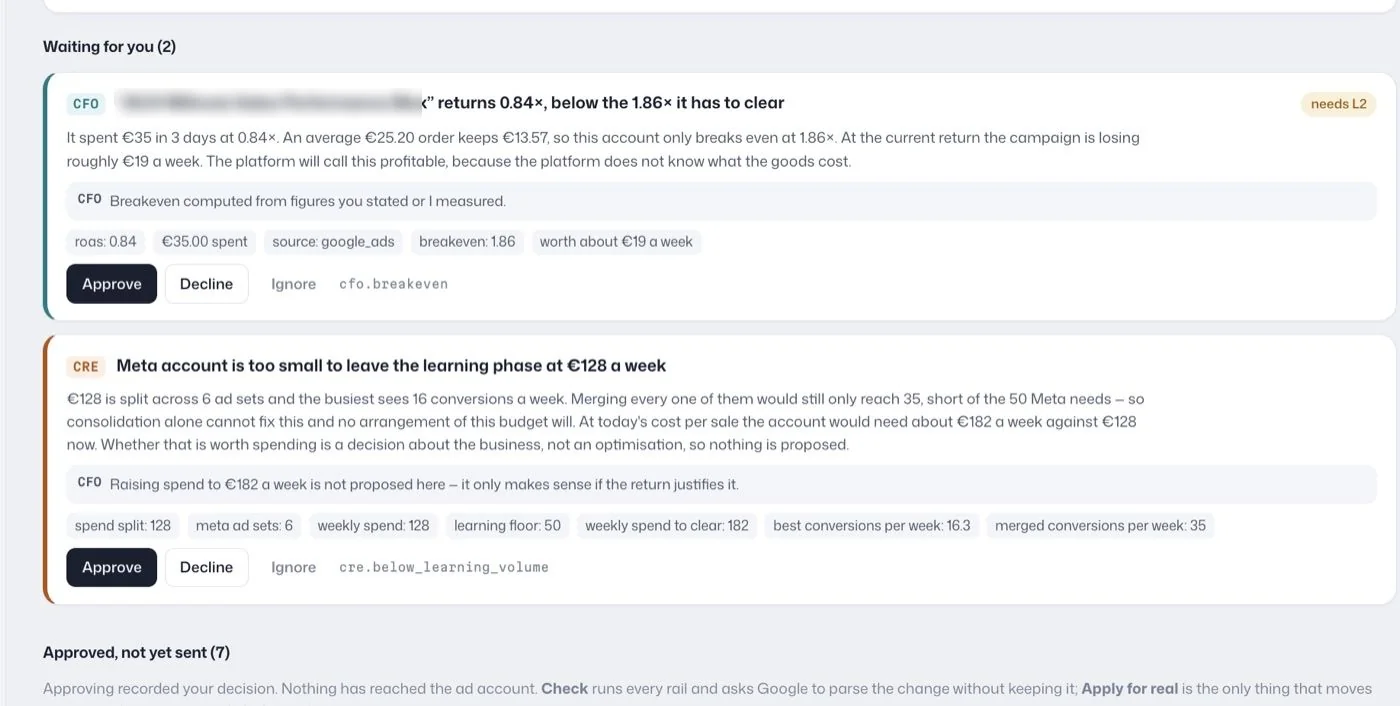
- Price the sale. The CFO measures what an order keeps. In one European food shop a €25.20 order keeps €13.57, so the ads must return 1.86× to break even.
- Agents read and draft. Each morning the agents check campaigns, ads and search terms against that line and draft proposals, each sized in euros.
- You decide. Approve, Decline or Ignore each one. Approving records your decision; the change is then checked against your rules and the platform before it is sent.
- Measured afterwards. Seven days later, each applied change is compared with the week before it.
What you see
The queue lists proposals waiting for you. Each card carries the agent's tag (CFO, CMO, CRE…), a one-line title with the number that matters, a paragraph with the reasoning, the figures it used as small chips (spend, ROAS, breakeven, what it is worth a week) and the rule id it cites. Below the queue, approved changes wait to be sent, and applied ones keep their receipt and undo. Some notes deliberately propose nothing: when the fix is a business decision rather than an optimisation, the agent says so.
You can also talk to the agents in chat, ask for a PowerPoint or an Excel KPI plan, or reach the same data from Claude or ChatGPT through the Kunads connector.
Rules the agents follow
Every expert rule cites a source. You can add your own as plain "if → then" lines per account, each with an Off · Ask me · Do it switch (see ad automation rules). Budget changes move in 20% steps, one change per campaign per 7 days, inside a monthly cap and a brand floor.
Two of the limits come straight from platform behaviour. The CMO does not judge an ad set still learning because Meta says an ad set usually leaves the learning phase after about 50 results in the week after its last significant edit; before that, its cost per result is still settling. And because an approved change is made in the ad account itself, it also appears in Google's own change history, so the account keeps a record outside Kunads too.
Do the agents change my ad accounts by themselves?
No, unless you switch a specific rule to Do it; otherwise every change waits for a person to approve it, and each keeps an undo. Other things they leave alone:
- Work on TikTok, Microsoft or LinkedIn Ads; these are not built.
- Build a multi-touch attribution model or MMM. The DATA agent shows counts side by side and the account is steered on blended ROAS.
- Follow CRM pipeline stages. Lead-gen accounts use won deals only.
Who gets the most from them
- A shop or lead-gen business without a full-time media buyer.
- A media buyer who wants the checks prepared and the arithmetic shown.
- An agency that needs one queue across many client accounts.
Related answers: can AI manage my ads? and is it safe to give AI access to ad accounts?
Related features
- AI media buyer: the CMO agent in detail.
- Revenue and profit goals: what the CEO plans from.
- Creative lab: what the CRE agent makes.
- Profit tracking: the CFO and DATA agents' numbers.
- Meta Business Help Center: About the learning phase for ad sets in Meta Ads Manager (checked 2026-11-19)
- Google Ads Help: About change history (checked 2026-11-19)
Numbers from your shop, not from the ad platforms. Connect Meta, Google and Shopify, WooCommerce or Magento and see what each campaign kept.
Get my profit audit Open a free workspaceTalking to the agents, and missing margins
Can I ask the agents questions?
Yes, in chat inside Kunads, or from Claude and ChatGPT through the Kunads connector, which reads your accounts and can queue a change for approval.
What happens if my margin is not known?
The CFO will not guess one. Without a margin there is no profit verdict, and the agents say so instead of calling a campaign profitable.