What is a good cost per lead?
LocaliQ's 2026 benchmarks put the all-industry average cost per lead at $27.39 for Facebook lead campaigns and $66.69 for search ads. A good cost per lead for your business is any figure below what a lead is worth to you: profit per won deal × share of leads that close.
The published averages
| Source | Platform | Average cost per lead | Other averages |
|---|---|---|---|
| LocaliQ, Facebook Advertising Benchmarks for 2026 (updated 23 Sep 2026) | Facebook, lead campaigns | $27.39 (previous edition $27.66) | CTR 2.70%, CPC $1.80, conversion rate 8.54% |
| LocaliQ, 2026 Search Advertising Benchmarks (updated 1 Jun 2026) | Google Ads and Microsoft Ads search | $66.69 | CTR 6.64%, CPC $5.42, conversion rate 8.18% |
Both reports cover about 20 industries, and the all-industry figure hides wide gaps between them. The search report says it draws on thousands of LocaliQ and WordStream customer campaigns; neither page gives the exact sample, countries or date range. Use them to see whether you are in the right range, then stop looking at them.
Why does a Google lead cost more than a Facebook lead?
Because the two buy different people. A search lead typed the problem into Google and is often ready to buy; a social lead saw an ad while scrolling and may not have been looking at all. The higher search price usually buys a higher close rate, which is why the per-lead figures cannot be compared on their own.
Is my cost per lead good?
It is good if it sits below your own limit per lead, worked out from your own deals. An accountancy firm signs clients worth €1,500 profit in the first year. Last quarter it had 240 leads and 18 new clients: 18 ÷ 240 = 7.5%.
- Limit per lead: €1,500 × 0.075 = €112.50.
- Keeping half of that as profit after ads gives a target of €56.25, so about €56.
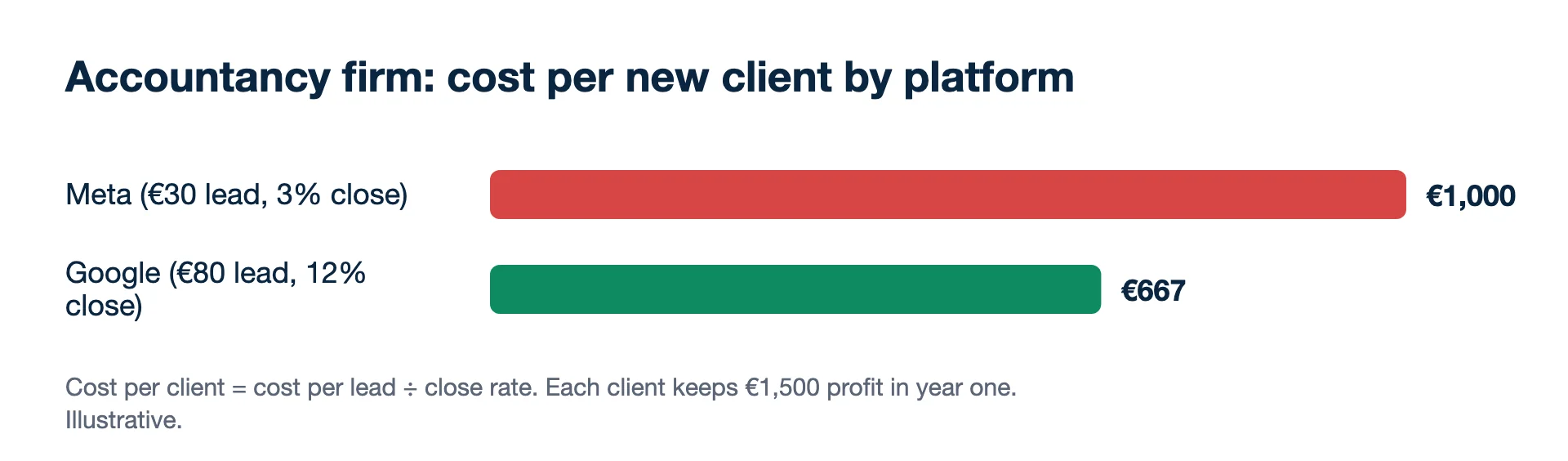
- Meta leads at €30 closing at 3% are worth €45 each: inside the limit, with a thin €15 left.
- Google leads at €80 closing at 12% are worth €180 each: €100 left per lead.
On cost per lead, Meta looks cheaper. On cost per new client, €30 ÷ 0.03 = €1,000 against €80 ÷ 0.12 = €667, so Google is a third cheaper.
Same benchmark, opposite verdicts
Take a $27 lead, the Facebook average. A shop selling €40 phone cases that keeps €12 per order and closes 20% of leads can afford €2.40 per lead; $27 is more than ten times too much. A solar installer that keeps €4,000 per installation and closes 5% of leads can afford €200; $27 is a bargain. The benchmark is identical; only the business's own numbers decide.
What counts as a lead changes the figure
Cost per lead is spend ÷ leads, so the definition of a lead sets the result. On Meta it may be Instant Form submissions, website forms or calls placed. On Google, call reporting lets you count calls of a chosen minimum length as conversions, so a 10-second wrong number does not count. Mixing forms, calls and bookings in one number makes month-to-month changes hard to read. Pick the definition, write it down and report cost per lead for each type.
Lowering it without buying worse leads
- Feed back the outcome. Send qualified and won leads to the platforms as offline conversions, so bidding learns which leads turn into clients.
- Ask one qualifying question on the form. Cost per lead rises a little; cost per client often falls.
- Drop sources that never close, however cheap their leads look.
- Test the offer as well as the ad: a free review, a price guide, a booked call.
Your own limit, worked out in full: how much should a lead cost? Stage values for bidding: how to value a lead. Kunads shows cost per lead on every campaign and flags any that pays more per lead than a lead is worth. Quick check: the lead value calculator.
- LocaliQ: Facebook Advertising Benchmarks for 2026 (last updated 23 September 2026) (checked 2026-11-19)
- LocaliQ: 2026 Search Advertising Benchmarks (last updated 1 June 2026) (checked 2026-11-19)
- Google Ads Help: About call reporting (counting calls of a set length as conversions) (checked 2026-11-19)
- Meta Business Help Centre: Differences between conversion optimisations (conversion leads) (checked 2026-11-19)
- Accountancy, phone case and solar figures: illustrative.
Numbers from your shop, not from the ad platforms. Connect Meta, Google and Shopify, WooCommerce or Magento and see what each campaign kept.
Get my profit audit Open a free workspaceReading cost-per-lead benchmarks
Are these benchmarks in euros?
No. Both LocaliQ reports are in US dollars and do not state which countries they cover. Treat them as an order of size for a European account, not a converted target.
Should I compare my cost per lead with my industry's average?
Only as a first check while you have no close-rate data. A figure far above your industry's average is worth investigating; a figure below it is not proof the leads are good.
Do phone calls count as leads in these averages?
The reports do not say which actions each advertiser counted. In your own account, decide once whether calls, forms and bookings count, and keep it the same every month.