How much should a lead cost?
A lead should cost less than the profit it brings: profit a won deal keeps × the share of leads that become customers. If a won deal keeps €800 and one lead in ten closes, €80 per lead is breakeven. Pay less than that, by a margin you choose, and the ads make money.
What is the maximum I can pay for a lead?
The maximum is the breakeven cost per lead: profit per won deal multiplied by your lead-to-customer rate. Above it, every lead you buy loses money even when the sales team does its job. Below it, the gap is your profit after ads.
Breakeven cost per lead = profit per won deal × lead-to-customer rate
Target cost per lead = breakeven cost per lead × (1 − share of that value you want to keep)
"Profit per won deal" is revenue minus what it costs to deliver: materials, labour, subcontractors, payment fees. The invoice total is the wrong input, because it pretends the work is free. "Lead-to-customer rate" is won deals ÷ leads over the same period, and it should be measured per source where you can, since a Meta form lead and a Google search lead rarely close alike. Definitions: cost per lead and CPA.
A kitchen fitter, step by step
Average job €6,000. Materials and labour take €4,200, so a won job keeps €1,800.
- Last quarter: 300 leads, 24 won jobs. Close rate = 24 ÷ 300 = 8%.
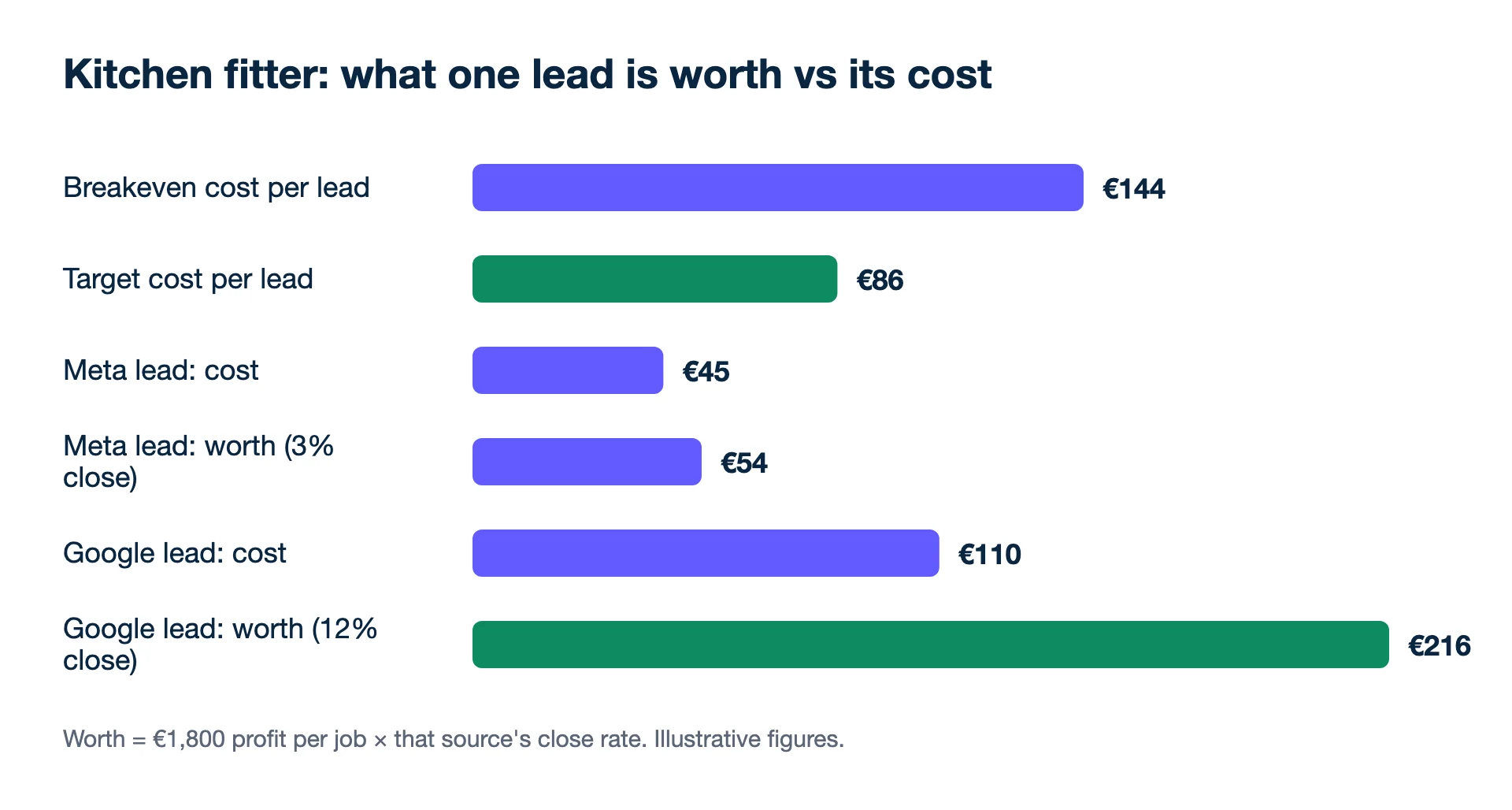
- Breakeven cost per lead = €1,800 × 0.08 = €144.
- To keep 40% of that value as profit after ads: €144 × 0.60 = €86.40, round to €86.
- Cost per won job at €86: €86 ÷ 0.08 = €1,075, which leaves €725 of the €1,800.
Now split by source. Meta brings leads at €45 that close at 3%: each is worth €1,800 × 0.03 = €54, so they pay, by €9 a lead. Google brings leads at €110 that close at 12%: each is worth €216, so they leave €106. The dearer lead is the better buy.
A second case: a small online course
The formula holds at the low end too. A course sells for €300; payment fees, the platform and a refund allowance leave €240. From 1,000 webinar sign-ups last month, 50 bought: a 5% rate.
- Breakeven cost per sign-up: €240 × 0.05 = €12.
- Keeping half of that value: target €6.
- At €6 a sign-up, 1,000 sign-ups cost €6,000, bring 50 sales and €12,000 of kept profit, so €6,000 is left after ads.
Same maths as the kitchen fitter, a target fourteen times smaller. Public averages cannot tell you which of the two you are; only your own deal profit and close rate can.
How much margin should I leave below breakeven?
Leave enough to cover what the formula does not see: sales time, no-shows and the months when the close rate dips. A cautious start is 30–50% below breakeven, loosened once three or four months of data show the close rate is stable. If the business is new to paid leads, the wider gap protects you while the numbers are still noisy.
What moves the limit
- Lead quality. A shorter form, a broader audience or an Instant Form with no qualifying question can halve cost per lead and cut the close rate by more. Re-measure the close rate after each such change, before judging it a win.
- Deal size by source. Referrals and search leads often buy larger jobs. If they do, give them their own profit per deal, not the average.
- Capacity. If the diary is full for two months, a lead worth €144 is worth less right now. Lower spend instead of lowering the bar.
- Too little history. With fewer than about 20 won deals, treat the limit as a working guess and revisit it monthly.
Make the platforms bid towards it
Ad platforms optimise for the event you send. If they only see form fills, they find people who fill in forms. Meta's conversion leads optimisation and Google's offline conversion imports both let you send back which leads became customers, so delivery learns what a good lead looks like; see offline conversions and how to send CRM conversions to Meta and Google. Once that is in place, Google's Target CPA bidding can be set to the €86 above, not to a guess. Kunads' CFO agent applies the same limit to won deals from your CRM and alerts when a campaign pays more per lead than a lead is worth. Try your own figures in the lead value calculator; for outside averages, see what is a good cost per lead?
- Kitchen fitter and course figures: illustrative, chosen so the arithmetic is easy to follow.
- Meta Business Help Centre: Differences between conversion optimisations (conversion leads optimisation, CRM events) (checked 2026-11-19)
- Google Ads API: Manage offline conversions (new implementations use the Data Manager API) (checked 2026-11-19)
- Google Ads Help: About Target CPA bidding (checked 2026-11-19)
See it on your own campaigns. Kunads reads your Meta and Google ads and your shop's orders, read-only, and shows the result per campaign.
Run the free profit audit Start a 14-day trial