CPA (cost per acquisition)
CPA (cost per acquisition, also cost per action or cost per conversion) is what you spent on ads divided by the number of conversions they brought. If €3,000 of ads produced 100 purchases, the CPA is €30. Whether €30 is good depends on what one conversion leaves you, which is the CPA you can afford.
CPA = ad spend ÷ conversions
"Conversion" is whatever you told the platform to count: a purchase, a lead form, a sign-up, a call. The formula is the same; the meaning depends entirely on that choice. Meta shows it as "cost per result" (amount spent ÷ results for the objective you chose), Google as "Cost / conv.", and Google's target CPA bidding aims for an average cost per conversion you set.
Worked example: a Meta ad set
An online bike-parts shop ran a prospecting ad set for 14 days:
- Spend: €2,700
- Purchases reported by Meta: 90
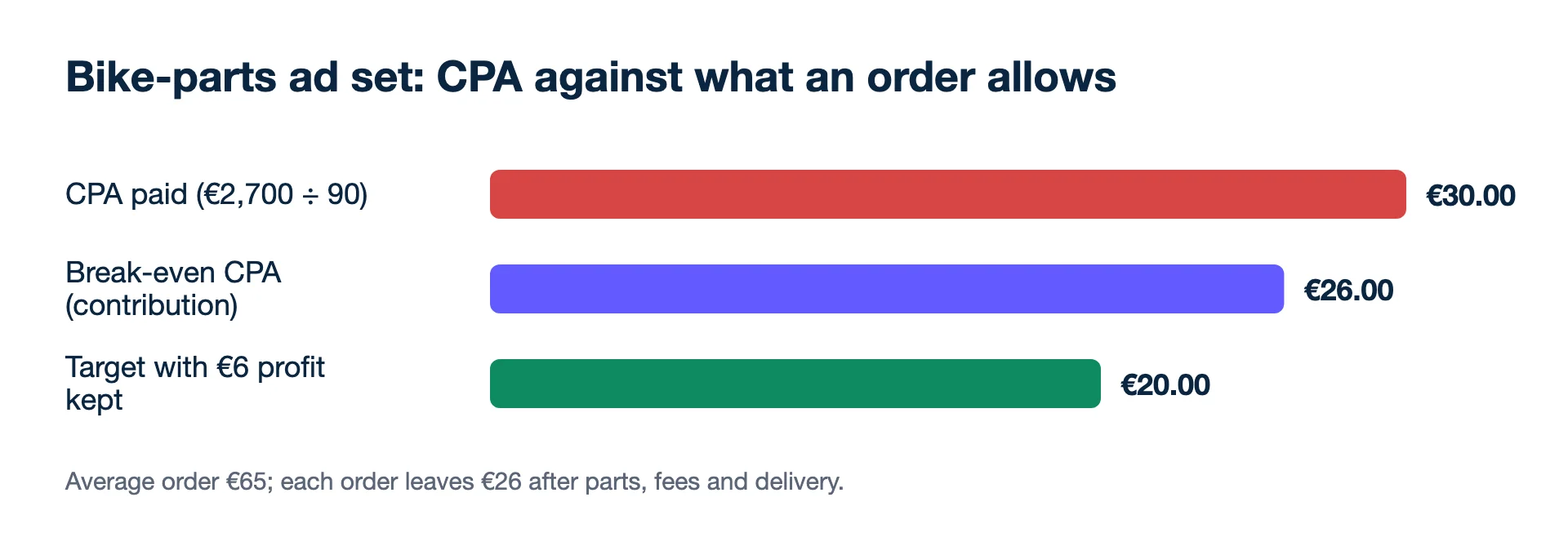
- CPA: €2,700 ÷ 90 = €30.00
The shop's average order is €65, and after parts, payment fees and the delivery it pays, an order leaves €26. So the highest CPA it can pay and still break even on the first order is €26. At €30, each purchase loses about €4 before the customer ever comes back. Only a lower cost per purchase, a bigger basket or a better margin changes that.
What is the highest CPA I can afford?
The highest CPA you can afford on a first order is the contribution that order leaves: what remains after goods, fees, delivery and refunds.
Maximum CPA = order value − cost of goods − payment fees − delivery you pay − expected refunds
That is the contribution per order, the same number behind breakeven ROAS. In fact the two are linked: ROAS = average order value ÷ CPA. The bike shop's €65 order at a €30 CPA is a ROAS of 2.17×, below its breakeven of €65 ÷ €26 = 2.50×.
For lead generation, use the value of a lead instead (see CPL). If you also want profit per order, subtract the amount you want left over: a €26 contribution with €6 kept as profit gives a target of €20, which is the logic of target CPA.
Second example: the cheaper CPA that loses money
Two campaigns in one shop, both with 50 purchases last month and a 45% contribution margin:
- Campaign X sells a €120 kit: €1,500 spend, CPA €30. Each order leaves €120 × 0.45 = €54, so €24 after the ad, and €1,200 for the 50 orders.
- Campaign Y sells a €40 refill: €1,000 spend, CPA €20. Each order leaves €40 × 0.45 = €18, so −€2 after the ad, and −€100 for the 50 orders.
Ranked by CPA, Y looks better. Ranked by what is left, X makes €1,300 more. A single CPA ceiling for the whole shop would have cut the wrong campaign.
When CPA is the right number
CPA is the cleanest number when every conversion is worth roughly the same: one lead type, one subscription price, one main product. It answers "can I afford this customer?" in one comparison. When order values vary a lot, CPA hides that: a €30 CPA on a €200 basket is great and on a €40 basket is a loss. Then ROAS or POAS tells you more.
Why does one campaign show several CPAs?
Because the spend is fixed but the conversion count depends on who counts. Meta, Google and the shop each count conversions their own way: Meta in its attribution window (by default 7-day click plus 1-day view), Google with its own model and conversion delay, the shop by order. So the same campaign shows a different CPA in each, and they never agree. None of them is "wrong". Pick the one you will steer on and use it the same way every week.
CPA pitfalls
- Counting the wrong conversion. If "add to cart" is set as a conversion, CPA drops and means far less.
- Judging too early. On 5 conversions, one extra sale moves CPA by 20%. Wait for enough volume before cutting.
- Calling it CAC. CPA includes returning customers; CAC is about new ones.
- Comparing a CPA with VAT in the ceiling. Compare ad spend with order values without VAT. If the order value behind your ceiling includes VAT at 21%, the ceiling comes out too high by roughly a fifth.
- Ignoring order value. A rising CPA with a rising basket can be fine. Look at both.
The ad performance calculator turns spend, clicks and conversions into CPA, ROAS and the breakeven next to them.
Related: AOV, conversion rate.
- Meta Business Help Centre: Cost per result (checked 2026-11-19)
- Google Ads Help: About Target CPA bidding (checked 2026-11-19)
Breakeven, per campaign. Give Kunads your margin once; it marks which Meta and Google campaigns sit below it and by how many euros.
Find my losing campaigns Try it for 14 daysCPA next to CAC
What is the difference between CPA and CAC?
CPA is ad spend divided by any conversion the platform counts, from new and returning buyers alike. CAC is the full cost of winning one new customer, usually including more than ad spend and counting only first-time buyers.