Conversion rate
Conversion rate is the share of people (or clicks, or visits) that complete the action you care about: a purchase, a lead form, a sign-up. Google Ads defines it as the average number of conversions per ad interaction, shown as a percentage: 96 purchases from 3,200 clicks is 3.0%.
Conversion rate = conversions ÷ interactions (or sessions) × 100%
The denominator decides what the number means. In Google Ads it is ad interactions that can be tracked to a conversion, usually clicks. In a shop's analytics it is sessions or visitors from every source. Both are called "conversion rate" and they are rarely the same.
Worked example: the same month, two rates
An outdoor-clothing shop looks at October.
From Google Ads, one Search campaign:
- Clicks: 3,200
- Purchases counted by Google: 96
- Conversion rate: 96 ÷ 3,200 = 3.0%
From the shop, all traffic:
- Sessions: 41,000
- Orders: 820
- Conversion rate: 820 ÷ 41,000 = 2.0%
Why is my shop's conversion rate lower than Google Ads shows?
Because the two divide different things: Google divides the conversions it counts by clicks on its own ads, and the shop divides all orders by all sessions from every source. Search clicks come from people looking for a product, so they convert better than the average visit, which includes people reading a blog post or checking an order. Google also counts conversions its own way (by click date, within its conversion window), while the shop counts orders by order date. Use each number for its own job: the Google rate for that campaign, the shop rate for the site as a whole.
How each tool defines it
| Tool | Numerator | Denominator |
|---|---|---|
| Google Ads | Conversions Google counts | Ad interactions that can be tracked to a conversion |
| GA4 (session key event rate) | Sessions with a key event | All sessions |
| Shopify (online store) | Sessions that completed checkout | All online store sessions |
GA4 also has a user key event rate, which divides by users rather than sessions, so a visitor who comes three times counts once. Pick one definition per report and write it in the column header.
Conversion rate moves CPA directly
Conversion rate sits between the price of traffic and the price of a sale:
CPA = CPC ÷ conversion rate
At a €0.90 CPC and a 3.0% conversion rate, each purchase costs €0.90 ÷ 0.03 = €30. Raise the rate to 3.6% through a faster checkout or clearer delivery costs and CPA drops to €25, with the same ads and the same bids. A 20% better site is a 17% cheaper customer. This is why falling ad results are often a site problem: a slow page, an out-of-stock best-seller, a new shipping fee.
Second example: the rate fell and nothing got worse
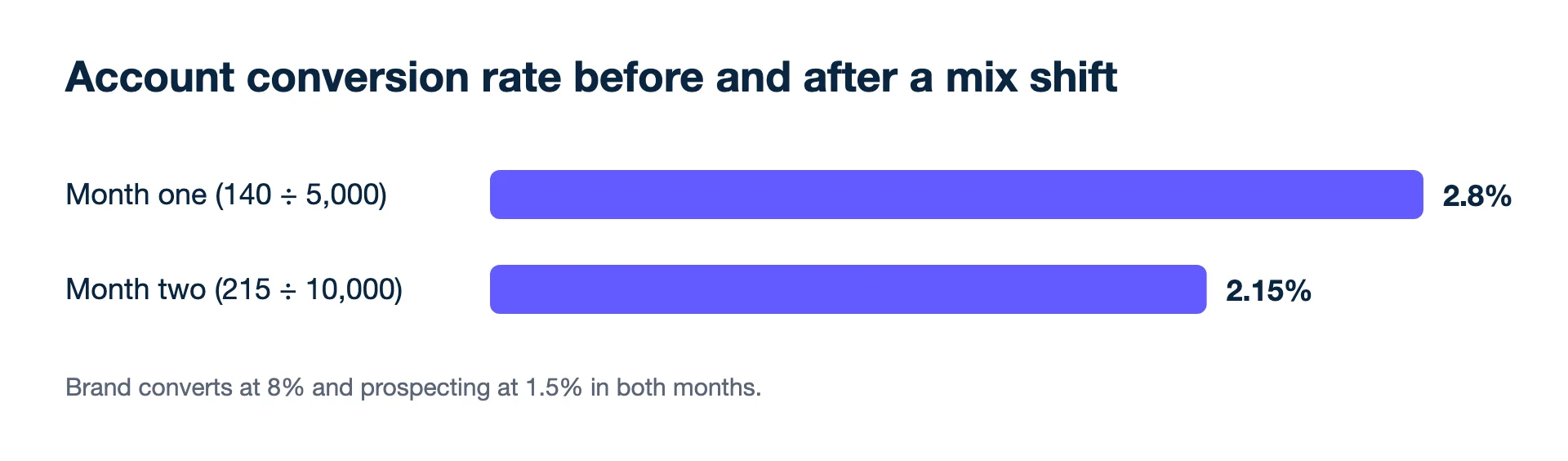
A shop's Google account has two parts. In month one, brand search gets 1,000 clicks at an 8% rate (80 purchases) and prospecting gets 4,000 clicks at 1.5% (60 purchases): 140 purchases from 5,000 clicks, a 2.8% account rate. In month two the shop doubles prospecting to 9,000 clicks, still converting at 1.5% (135 purchases), and brand stays at 1,000 clicks and 80 purchases. The account now shows 215 ÷ 10,000 = 2.15%. Every campaign converts exactly as before, and the shop got 75 more purchases; the average fell only because the mix shifted towards colder traffic. Read conversion rate per campaign type, never only for the account.
What is a good conversion rate?
A good conversion rate is one that is stable or rising for the same kind of traffic in your own account; there is no single benchmark worth chasing, because price, product and traffic source move it more than ad quality does. A €900 bike will convert a smaller share of visits than a €15 phone case, and both can be profitable. Judge the rate together with order value: what matters is revenue per click, conversion rate × AOV.
Traps when reading it
- Counting soft actions. If "add to cart" or "page view" is set as a primary conversion, the rate rises and the number stops meaning sales. Keep the main goal to what earns money.
- Comparing ad and shop rates as if one should equal the other. Different denominator, different counting. Show them next to each other and use each for its own job.
- Small samples. 4 orders from 100 clicks is 4%; one more order makes it 5%. A difference between ads needs hundreds of clicks each before it means much.
- Ignoring the time lag. If buyers take a week to decide, the last few days' rate always looks low and fills in later.
The ad performance calculator shows how conversion rate, CPC and order value combine into CPA and ROAS.
- Google Ads Help: Conversion rate (checked 2026-11-19)
- Google Analytics Help: Analytics dimensions and metrics (session and user key event rate) (checked 2026-11-19)
- Shopify Help Center: Analytics fields (online store conversion rate) (checked 2026-11-19)
Changes wait for you. Kunads proposes budget moves in 20% steps with the reasoning attached; nothing reaches Meta or Google until you press Approve.
See what it would change Begin a free trial