CTR (click-through rate)
CTR (click-through rate) is the share of impressions that led to a click. Google describes it as a ratio showing how often people who see your ad end up clicking it: clicks ÷ impressions, so 5 clicks from 100 impressions is a 5% CTR.
CTR = clicks ÷ impressions × 100%
Which CTR should I use on Meta?
Use CTR (link click-through rate) for any ad that sends people to a website or lead form, because it counts only clicks that can lead to a sale. The formula is the same everywhere; what counts as a click is not.
- Google Ads: CTR uses clicks on the ad, so for Search it is mostly clicks through to your site.
- Meta, CTR (all): the percentage of impressions where a click (all) occurred. Clicks (all) include link clicks plus reactions, comments, shares, clicks to your Page or profile and expanding media to full screen.
- Meta, CTR (link click-through rate): link clicks ÷ impressions. Only clicks on links to a destination, such as your site or a lead form.
Worked example: one Meta ad, two CTRs
A video ad for a language-learning app, one week:
| Metric | Value | Calculation |
|---|---|---|
| Impressions | 50,000 | |
| Clicks (all) | 1,400 | |
| CTR (all) | 2.80% | 1,400 ÷ 50,000 |
| Link clicks | 450 | |
| CTR (link) | 0.90% | 450 ÷ 50,000 |
| Sign-ups | 27 | 6% of link clicks |
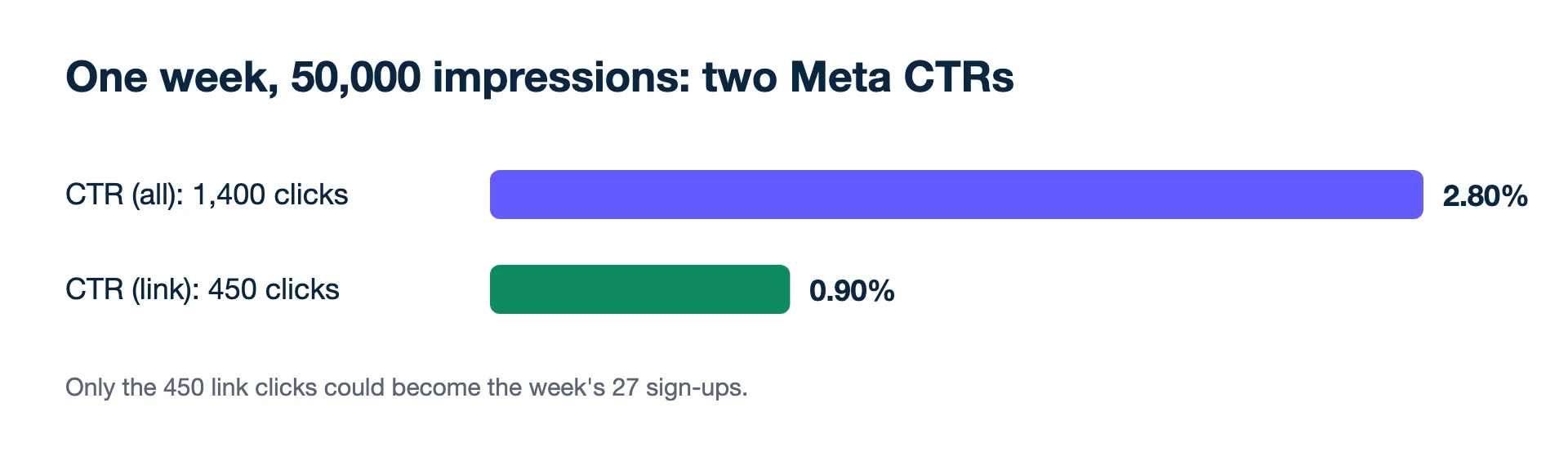
Two-thirds of the "clicks" were people reacting, commenting or tapping the profile. That can be useful for reach, but only the 450 link clicks could become sign-ups. An ad with a 2.8% CTR (all) and an ad with a 1.2% link CTR are not comparable, and the second may well send more traffic.
Is a high CTR a good ad?
Not by itself; a high CTR is a good ad only if the people who click go on to convert at a decent rate. Two hooks for the same app, each shown 50,000 times at a €6 CPM, so €300 each:
- Hook A ("Fluent in 30 days?"): link CTR 1.8%, 900 clicks, 2% sign up, so 18 sign-ups at €300 ÷ 18 = €16.67.
- Hook B (a real lesson clip): link CTR 1.0%, 500 clicks, 5% sign up, so 25 sign-ups at €300 ÷ 25 = €12.00.
A wins on CTR by 80% and loses on cost per sign-up by 39%. The promise in A pulled curious people who left on the first screen. Pick the winner on the result you pay for, and use CTR to explain why.
What is a good CTR?
A good CTR is one at or above your own past ads in the same placement and campaign type; published averages mix search and feed, brand and cold traffic, and say little about your account. Search ads on keywords people type when ready to buy get far higher CTRs than feed ads shown to people who were not looking, and Reels behave differently from the feed. Keep a running median per placement and judge new ads against it.
When a low CTR is fine
Some ads are not meant to be clicked much. A retargeting ad that reminds past visitors of a basket they left, or a video bought for views, can show a low CTR and still do its job, because the action comes later or elsewhere. On Google Search, look at CTR per keyword and search term rather than per campaign: a broad keyword with a CTR far below its neighbours is often matching searches it should not, which is a broad match problem, not a copy problem.
Why CTR is worth watching
CTR is the fastest signal you get about an ad's message. It moves within a day or two, long before purchases accumulate. It also changes cost: on Meta, cost per link click = CPM ÷ (1,000 × link CTR), so lifting link CTR from 0.9% to 1.2% at a €6 CPM cuts the cost per click from €0.67 to €0.50. On Google, a higher CTR feeds the expected-CTR part of Quality Score, which affects ad rank and cost.
Before launch, the ad copy checker flags copy that is too long or vague for the placement.
Five ways CTR misleads
- Reading CTR (all) as traffic. Use the link version for anything that sends people off the platform.
- Comparing across placements. Stories, Reels, feed and Search behave differently. Compare like with like.
- Counting a different click in each report. An agency report that shows Google CTR next to Meta CTR (all) compares two different things. Put Meta's link CTR next to Google's.
- Judging on tiny numbers. 3 clicks from 200 impressions is 1.5%, and one more click makes it 2%. Wait for a few thousand impressions.
- Ignoring falling CTR. A steady drop on the same ad as frequency rises is a classic sign of ad fatigue.
Related: CPC, CPM, conversion rate, creative testing.
- Google Ads Help: Clickthrough rate (CTR) (checked 2026-11-19)
- Meta Business Help Centre: CTR (link click-through rate) (checked 2026-11-19)
- Meta Business Help Centre: Clicks (all) (checked 2026-11-19)
Changes wait for you. Kunads proposes budget moves in 20% steps with the reasoning attached; nothing reaches Meta or Google until you press Approve.
See what it would change Begin a free trial