Creative testing
Creative testing is running two or more versions of an ad under comparable conditions, with the same budget, audience and dates, to learn which one performs better on a metric chosen before the test starts. Done well, it tells you what to make more of. Done informally, it mostly measures luck.
Which Meta test should I use?
Use an A/B test when the versions must reach separate people and you want a declared winner; use the creative test inside Ads Manager when you want to try 2 to 7 ads within a running campaign without starting it over.
| A/B test | Creative test (in Ads Manager) | |
|---|---|---|
| What it compares | Two versions of a strategy: images, text, audience, placement | 2 to 7 copies of an ad with different creative |
| Audience | Split so nobody sees both | Inside the existing campaign |
| Budget | Same budget for both versions, Meta advises | A share of the campaign or ad set budget; Meta suggests at most 20% |
| Bid strategy | Any | Highest volume only |
| Result | Winner by cost per result or cost per conversion lift | Top performers flagged; no confidence level given |
| After the test | You choose | Test ads keep running with the campaign's budget until you turn them off |
Meta explicitly advises against "informal" testing by switching ad sets on and off by hand, because audiences overlap and results become unreliable.
How much budget does a creative test need?
Enough for tens of conversions per variant, which you can work out before you start:
Test budget ≈ variants × conversions wanted per variant × expected cost per conversion
Test length (days) = test budget ÷ daily test spend
The conversions-per-variant figure is your choice. A common working number is around 30; fewer than ten per variant is usually noise.
Worked example: four hooks for one product
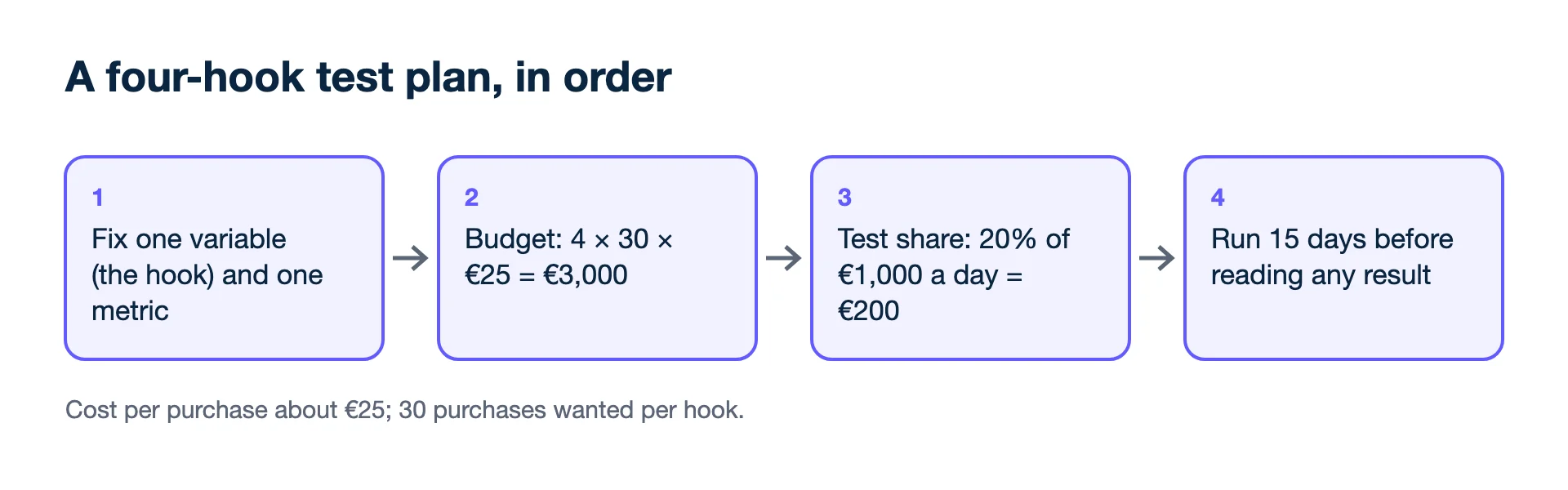
A shop wants to test four opening hooks for a video ad. Its cost per purchase is about €25, and it wants about 30 purchases per variant.
- Budget: 4 × 30 × €25 = €3,000
- The campaign spends €1,000 a day. Following Meta's 20% suggestion, the test gets €200 a day.
- Length: €3,000 ÷ €200 = 15 days
If 15 days is too long, test fewer variants (three hooks: €2,250, about 11 days) or test on a cheaper, earlier event such as add to cart, accepting that it is a weaker signal. What not to do is run eight hooks for three days and crown the one with four purchases.
Second example: reading the result
The four hooks each spent €750 over the 15 days. Hook A brought 34 purchases (€22.06 each), B 29 (€25.86), C 31 (€24.19) and D 26 (€28.85): 120 purchases for €3,000, the €25 average the plan assumed. A looks like the winner, but with around 30 purchases per variant a gap of three purchases between A and C is well within ordinary chance, and Meta's creative test gives no confidence level to say otherwise. A fair reading: D is the weakest and can go; A, B and C are close. Keep A and C, and give them a second round or a proper A/B test before spending the whole budget on one.
Testing outside Meta
Google Ads has its own route for Search, Display and Video campaigns: custom experiments, which split a campaign's traffic between the original and a changed copy for a set period, so ad text or landing pages can be compared on the same auctions. The same rules apply: one change at a time, a metric chosen first, and enough conversions before you call it.
Judge on what pays
Pick the metric first. Click-through rate tells you which hook stops the scroll; cost per purchase tells you which one sells; profit per €1 tells you which one makes money. They often disagree. A hook that wins on CTR with a cheap-sounding promise can lose on profit because buyers return the product.
How tests go wrong
- Changing two things at once, then not knowing which one mattered.
- Stopping early because one variant leads after a day.
- Testing tiny differences (a button colour) when bigger ones (the angle, the offer) are untested.
- No record. Write down the hypothesis, the metric and the result, or the lesson is lost by next quarter.
- Ignoring fatigue. A winner today still fades; see ad fatigue.
The Kunads creative lab makes images and short videos from product photos, launches tests on Meta, and judges ads on profit (or on cost per lead for lead accounts), with a client approval flow for agencies. See the creative lab.
Related: learning phase, holdout test.
- Meta Business Help Centre: About A/B testing for Meta ads (checked 2026-11-19)
- Meta Business Help Centre: Set up a creative test in Meta Ads Manager (checked 2026-11-19)
- Meta Business Help Centre: About creative testing for the Meta Marketing API (checked 2026-11-19)
- Google Ads Help: Set up a custom experiment (checked 2026-11-19)
Breakeven, per campaign. Give Kunads your margin once; it marks which Meta and Google campaigns sit below it and by how many euros.
Find my losing campaigns Try it for 14 daysReading a finished creative test
Does Meta's creative test say which ad won with confidence?
Meta says the creative test identifies top performers against your comparison metric but does not include a confidence level. Treat close results as a tie.