Learning phase (Meta)
The learning phase is the period when Meta's delivery system is still exploring how best to deliver an ad set, either after it is created or after a significant edit. Meta says ad sets usually exit after about 50 results in the week after the last significant edit. Until then, results swing more and cost per result is usually higher.
How long does the learning phase last?
As long as it takes the ad set to collect about 50 results after its last significant edit, which is a matter of budget and cost per result rather than a fixed number of days. Meta ties the exit to that volume of results within a week. The arithmetic follows directly:
Weekly budget needed to exit ≈ 50 × expected cost per result
Daily budget ≈ (50 × expected cost per result) ÷ 7
Meta does not publish this formula; it is the plain arithmetic of its 50-results guidance.
Worked example: will this ad set leave learning?
A shop expects a cost per purchase of about €30 on a new ad set optimised for purchases.
- To get 50 purchases in a week: 50 × €30 = €1,500 a week, or about €1,500 ÷ 7 = €214 a day.
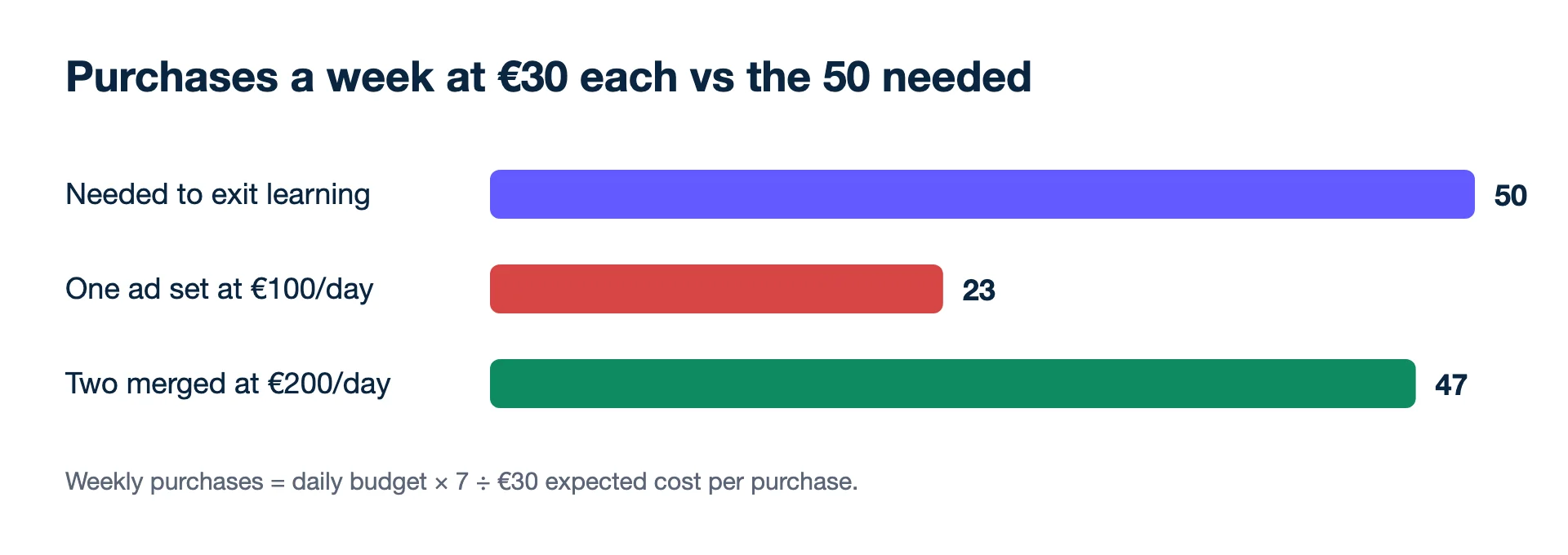
- The owner wants to spend €100 a day. That is €700 a week, or about €700 ÷ €30 = 23 purchases. Well short of 50, so the ad set is likely to show Learning Limited.
Options Meta lists for that situation: combine ad sets, widen the audience, raise the budget, raise the bid or cost control, or optimise for a more frequent event such as add to cart. At €100 a day, merging two similar ad sets of €100 each into one of €200 gets close: €1,400 ÷ €30 ≈ 47 purchases a week.
The same rule for a lead-gen account
Cheaper results make the threshold easier. A home-services company optimises for lead form submissions at about €12 per lead. 50 × €12 = €600 a week, or about €86 a day. Its €100-a-day ad set should leave learning within the week. If the same company optimises for a booked appointment instead, at around €60 each, it needs 50 × €60 = €3,000 a week, about €429 a day, to exit. The deeper event may be the better signal of value, but on a €100 budget it brings only €700 ÷ €60 ≈ 12 results a week, so the ad set stays unstable. Here the trade-off is the choice of optimisation event, not the budget.
What counts as a significant edit?
Any change to targeting, creative or optimisation event, adding a new ad, changing the bid strategy, or pausing for 7 days or longer. That is Meta's own list:
- Always significant: any change to targeting, ad creative or optimisation event; adding a new ad; changing the bid strategy; pausing the ad set for 7 days or longer (it re-enters learning when unpaused).
- Depends on size: budget, bid control, cost per result goal, ROAS goal or spending limit changes. Meta's example: $100 to $101 is unlikely to reset; $100 to $1,000 may.
- With Advantage+ campaign budget, changing the campaign budget or bid strategy can send several ad sets back into learning. Budget moving between ad sets on its own does not.
Google's version is shorter and narrower
Google Ads Smart Bidding shows a "Learning" bid strategy status after major structural changes: a new or reactivated strategy, campaigns, ad groups or keywords added to or removed from it, or a significant change to conversion goals. Google says the status never lasts more than 7 days, and that changing a target (for example a target ROAS from 500% to 400%) never triggers it. That differs from Meta, where a large change to a cost or ROAS goal can count as significant. Google adds that performance may take one to two conversion cycles to settle. So the same habit, "don't touch it for a week", means different things on the two platforms: on Meta it is about result volume, on Google about structural changes.
Why it matters for spending
- Early numbers mislead. Meta says results during learning are not necessarily indicative of future performance. Killing an ad set on day two usually judges the noise.
- Every reset costs money. Frequent edits keep an ad set in its least efficient stretch.
- Fragmentation hurts. Many small ad sets each collect fewer results than a few larger ones.
- Testing needs learning. New creative goes through it by design. Plan tests so each ad set can reach the threshold.
Habits that keep ad sets in learning
- Daily tinkering. Small tweaks to creative or audience each count as significant.
- Big budget jumps. Doubling a budget overnight can restart learning. Smaller steps, spaced out, are safer.
- Optimising for a rare event on a small budget, as in the booked-appointment case above.
In Kunads, budget rules move in 20% steps with one change per campaign per 7 days (a raise after a raise may come after 3 days), which keeps edits small and spaced. For timing in more detail, see how long the Meta learning phase lasts.
Related terms
- Meta Business Help Centre: About the learning phase for ad sets in Meta Ads Manager (checked 2026-11-19)
- Meta Business Help Centre: Significant edits and learning phase (checked 2026-11-19)
- Meta Business Help Centre: About Learning Limited (checked 2026-11-19)
- Google Ads Help: About Smart Bidding learning (checked 2026-11-19)
Changes wait for you. Kunads proposes budget moves in 20% steps with the reasoning attached; nothing reaches Meta or Google until you press Approve.
See what it would change Begin a free trialStuck in learning? Short answers
What does Learning Limited mean?
Meta shows it when an ad set is unlikely to get about 50 optimisation events in the week after its last significant edit. Meta names the usual causes as a small audience, low budget, low bid or cost control, or a rare optimisation event.
Do Shops ads follow the same 50-result rule?
No. For Shops ads, Meta says the learning phase completes after at least 17 purchases through your website and 5 through Meta.