Advantage+ shopping campaigns (now Advantage+ sales campaigns)
Advantage+ shopping campaigns (ASC) were Meta's automated campaigns for online sales: one campaign in which Meta's system chooses the audience, placements and budget split, and the advertiser mainly supplies creative, a country and a budget. Meta's help centre now calls them Advantage+ sales campaigns, part of a single Advantage+ campaign set-up for the sales, leads and app promotion objectives.
What are Advantage+ shopping campaigns called now?
Meta now calls them Advantage+ sales campaigns: a sales-objective campaign with Advantage+ audience, placements and budget switched on, created in the same flow as any other campaign. The older name, ASC, is still what most agencies say.
| Before | Now (Meta's names, November 2026) |
|---|---|
| Advantage+ shopping campaign (ASC), a separate creation flow | Advantage+ sales campaign: a sales-objective campaign with Advantage+ on |
| Campaign budget optimization (CBO) | Advantage+ campaign budget |
| Separate flows for manual, ASC and Advantage+ app campaigns | One flow; choosing sales, app promotion or leads shows the Advantage+ set-up |
| API: smart_promotion_type = automated shopping ads | From Marketing API v25.0: build with Advantage+ audience, campaign budget and placements; the old ASC route is gone |
Meta says the most advanced automation is on when a sales campaign uses Advantage+ audience, placements and budget together. Manual controls are still available; using them switches Advantage+ off for that campaign.
How should you judge an Advantage+ sales campaign?
Judge it on what the whole shop earns and on what the new-customer part of the spend brings, not on the campaign's own reported ROAS.
Blended ROAS = all shop revenue ÷ all ad spend, read alongside new-customer revenue ÷ campaign spend.
An automated sales campaign is free to find buyers wherever they are cheapest, and existing customers are often cheapest. Meta's best practices mention building audience segments so reports can break results down by new, engaged and existing audiences. The original ASC set-up also let you define existing customers and cap their share of budget.
Worked example: the existing-customer question
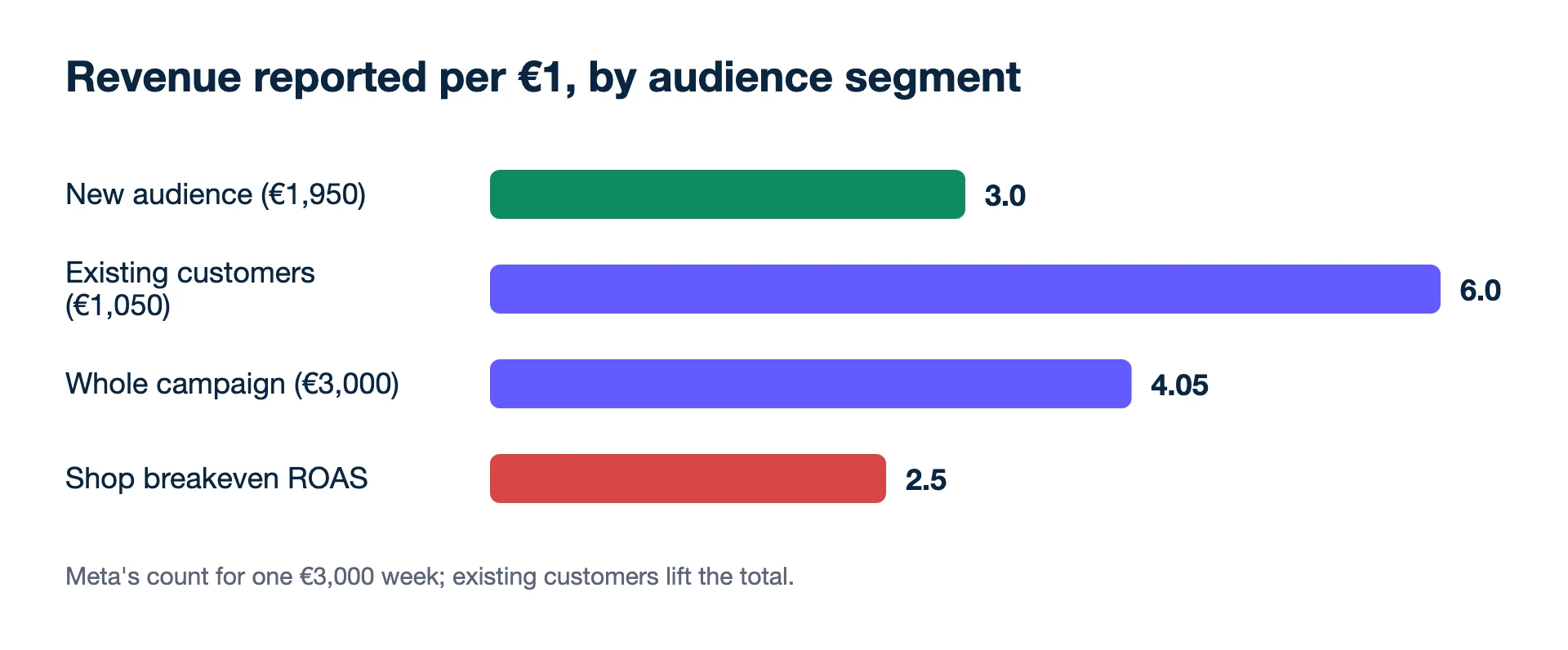
A shop runs one Advantage+ sales campaign at €3,000 a week. With audience segments set up, the breakdown for a week shows:
- New audience: €1,950 spend, €5,850 revenue reported (3.0 per €1)
- Existing customers: €1,050 spend, €6,300 revenue reported (6.0 per €1)
- Total: €3,000 spend, €12,150 revenue reported, so a campaign ROAS of 12,150 ÷ 3,000 = 4.05
The 4.05 looks excellent, but 35% of the budget (1,050 ÷ 3,000) went to people already buying from the shop, many of whom would have bought anyway. The honest question is what the new-customer part earns: 3.0 per €1 on Meta's count. If the shop's breakeven ROAS is 2.5, that part still pays, so the next move is to shift spend towards new people, not to cut the campaign. Then check the shop's own blended ROAS and new-customer counts over the next weeks, because Meta and the shop count differently and never agree.
The opposite case: when the new-customer part loses money
Change one number. Same shop, same €3,000 week, but the new-audience segment reports 2.2 per €1 instead of 3.0. The €1,950 spent on new people returns €4,290 on Meta's count (1,950 × 2.2). The shop keeps 40% of revenue after goods, fees and delivery, which is what a 2.5 breakeven means (1 ÷ 0.4), so that revenue leaves €1,716 (4,290 × 0.4) against €1,950 of spend: a loss of €234 a week on the new-customer part. The campaign total would still read (4,290 + 6,300) ÷ 3,000 = 3.53, comfortably above breakeven, because existing customers carry it. Here the right move is new creative or a smaller budget for prospecting, and a report that shows the segments separately so the total cannot hide the loss.
What it changes for the team
- Less to manage. One campaign replaces a portfolio of manually split ones.
- Creative becomes the main lever. Meta's best practices ask for a wide variety of creative assets.
- Data quality matters more. Meta recommends connecting first-party data, such as the Conversions API.
Mistakes we see with it
- Judging it on its own reported ROAS when much of the spend reaches existing customers.
- Running it alongside manual prospecting campaigns that target the same people, then reading each campaign in isolation.
- Starving it of creative, then blaming the automation for fatigue.
- Resetting it with frequent edits (see learning phase).
For when to raise its budget, see when to scale a Meta campaign.
Neighbouring terms
- Meta Business Help Centre: About Advantage+ sales campaigns (checked 2026-11-19)
- Meta Business Help Centre: About the Advantage+ campaign experience (checked 2026-11-19)
- Meta for Developers: Advantage+ shopping campaigns (API change from v25.0) (checked 2026-11-19)
- Meta Business Help Centre: About Advantage+ campaign budget (checked 2026-11-19)
Would rather not do this by hand? Kunads' agents check every campaign against your margin each day and propose a fix you approve or ignore.
Audit my ads for free Try Kunads, no cardBefore you move budget into Advantage+ sales
What makes a sales campaign an Advantage+ sales campaign?
Meta says the most advanced automation is on when a sales campaign uses Advantage+ audience, Advantage+ placements and Advantage+ campaign budget. If you set manual controls, such as picking placements, Advantage+ turns off for that campaign.
Can I still create ASC through the API?
Meta's Marketing API documentation says that from version 25.0 developers can no longer create ASC with smart_promotion_type set to automated shopping ads. Instead they build campaigns with Advantage+ audience, campaign budget and placements.
Should I run everything in one Advantage+ sales campaign?
Not by default. It suits shops with a pixel or Conversions API set-up, enough purchases and plenty of creative. Judge it on blended ROAS and new-customer revenue, not only on its own reported ROAS.