How long is the Meta learning phase?
The Meta learning phase lasts until an ad set gets about 50 results in the week after its last significant edit, Meta's own threshold. So it is counted in results, not days: at 50 results a week it can be over within days; at 10 a week it may never end, and Ads Manager shows "Learning limited".
What happens while an ad set learns
When you create an ad set or make a significant edit, Meta's delivery system explores who to show the ads to. Meta says ad sets in this period are "less stable and usually have a higher CPA". The Delivery column in Ads Manager reads "Learning". Two other columns help: "Last significant edit" shows when the clock last restarted, and "Results" shows how far you are towards about 50.
"Results" means the optimisation event you chose. Optimise for purchases and it counts purchases; for leads, leads. That is why the same budget leaves learning quickly when optimising for add-to-cart and slowly when optimising for purchases.
How many days will mine take?
Divide 50 by the results you get in a week at today's cost; the daily budget that reaches 50 is roughly 50 × cost per result ÷ 7.
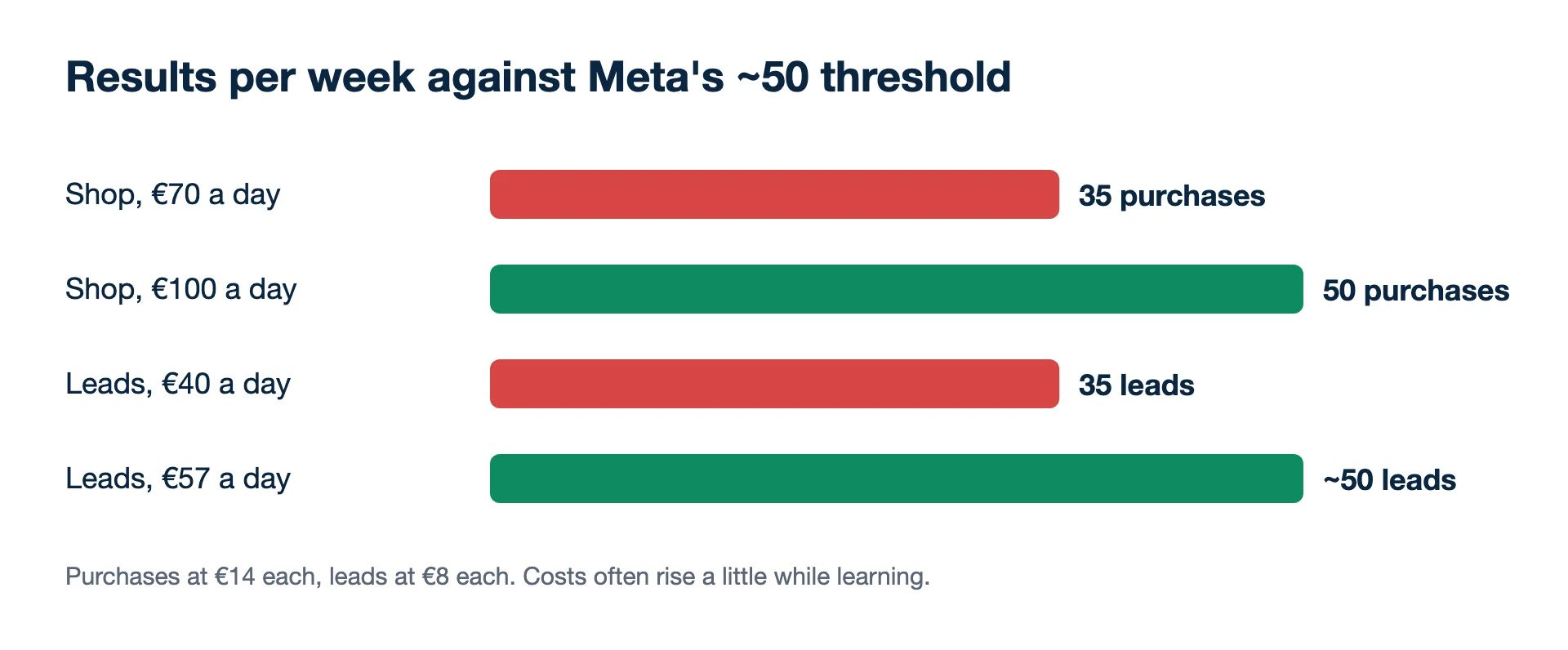
- A shop at €70 a day spends €490 a week. At €14 a purchase that is 490 ÷ 14 = 35 purchases a week: below 50, so the ad set is likely to stay "Learning limited" on purchases.
- At €100 a day, €700 a week ÷ €14 = 50 purchases. Just enough, if cost per purchase holds during learning; it often rises a little, so plan some headroom.
- Or keep €70 a day and optimise for an event that happens about three times as often, but only if that event predicts purchases.
A lead-generation example with different numbers: a form ad set at €40 a day spends €280 a week. At €8 a lead that is 35 leads a week, short of 50. To reach 50 it needs 50 × €8 ÷ 7 ≈ €57 a day. At €57 × 7 = €399 a week, that buys 399 ÷ 8 ≈ 50 leads.
What restarts the Meta learning phase?
Any significant edit restarts it, and Meta names them. Always significant:
- any change to targeting;
- any change to ad creative;
- any change to the optimisation event;
- adding a new ad to the ad set;
- pausing the ad set for 7 days or longer (learning restarts on unpause);
- changing bid strategy.
Edits that "may or may not be significant, depending on the magnitude": the ad set spending limit, the bid control, cost per result goal or ROAS goal amount, and the budget amount. Meta's example is that a budget change from $100 to $101 is unlikely to restart learning, while $100 to $1,000 may. With a campaign budget, one change can send several ad sets back at once. Changing the disclaimer on social issue or political ads also counts.
The practical rule: batch your edits. Three small changes on three different days restart the clock three times; the same three made together restart it once.
What does "Learning limited" mean?
It means the ad set is not getting enough results to finish learning, so delivery may stay less stable for as long as nothing changes. It is a diagnosis, not a penalty, and waiting does not fix it. The three levers:
- Combine. Meta warns that many ads and ad sets each learn less; merging similar ad sets pools their results.
- Optimise for a more frequent event that still predicts the outcome you want.
- Budget. Raise it to what 50 results a week costs, using the formula above.
If none of these is possible, for example a niche product with ten sales a week whatever you spend, the ad set can still be profitable. Judge it on your own numbers over a longer period rather than chasing the status.
Thresholds that differ
Shops ads have their own minimum: Meta lists 17 purchases through your website and 5 through Meta. Google's Smart Bidding is a different system with a different meaning of "learning". Google shows a Learning status only for a new or reactivated bid strategy, a change in which campaigns or keywords the strategy covers, or a significant change in conversion goals. It says that status never lasts more than 7 days and that budget, target and creative changes never trigger it. So a habit learned on one platform does not carry over: on Google, waiting for "50 results" means nothing.
What to do while it learns
- Leave it. Meta's advice is to wait to edit until the ad set is out of learning, and to edit only when you believe the change will improve performance.
- Do not judge early. Results during learning are "not necessarily indicative of future performance".
- Do not try to avoid it altogether. Meta calls the phase necessary; new creative means some learning. The aim is to avoid restarting it without a reason.
Kunads' budget rules space changes 7 days apart (3 days for a raise after a raise) partly for this reason; that spacing is Kunads' practice, not Meta's. Once learning ends, see when to scale a Meta campaign.
- Meta Business Help Centre: About the learning phase for ad sets in Meta Ads Manager (checked 2026-11-19)
- Meta Business Help Centre: Significant edits and learning phase (checked 2026-11-19)
- Google Ads Help: About Smart Bidding learning (checked 2026-11-19)
- Example figures: illustrative.
See it on your own campaigns. Kunads reads your Meta and Google ads and your shop's orders, read-only, and shows the result per campaign.
Run the free profit audit Start a 14-day trial