CPM (cost per 1,000 impressions)
CPM (cost per mille) is the average cost of 1,000 ad impressions. Meta defines it as the amount spent divided by impressions, multiplied by 1,000: spend €50 for 10,000 impressions and your CPM is €5. It is the auction's price for attention, not a result: what counts is what those impressions go on to buy.
CPM = ad spend ÷ impressions × 1,000
An impression, on Meta, is counted when an ad is on screen for the first time; scrolling away and back to the same ad does not add a second one. CPM is mostly a price signal: it tells you what the auction charged to put your ad in front of people.
How does CPM turn into cost per purchase?
Through click-through rate and conversion rate: cost per purchase = CPM ÷ (1,000 × CTR × conversion rate). A worked case shows each step. A jewellery brand runs a Meta prospecting campaign for a week:
- Spend: €1,800
- Impressions: 240,000
- CPM: €1,800 ÷ 240,000 × 1,000 = €7.50
CPM on its own says little about results. Follow it through the funnel:
- Link click-through rate 1.2%: 240,000 × 0.012 = 2,880 link clicks, so cost per link click is €1,800 ÷ 2,880 = €0.625.
- Conversion rate on the site 2.5%: 2,880 × 0.025 = 72 purchases.
- Cost per purchase: €1,800 ÷ 72 = €25.00.
The same chain written as one formula: CPA = CPM ÷ (1,000 × CTR × conversion rate) = €7.50 ÷ (1,000 × 0.012 × 0.025) = €7.50 ÷ 0.30 = €25.00.
That formula shows why CPM is only one lever. If CPM rose 20% to €9.00 but a better ad lifted CTR to 1.5%, the cost per purchase would fall to €9.00 ÷ (1,000 × 0.015 × 0.025) = €24.00.
Is a low CPM good?
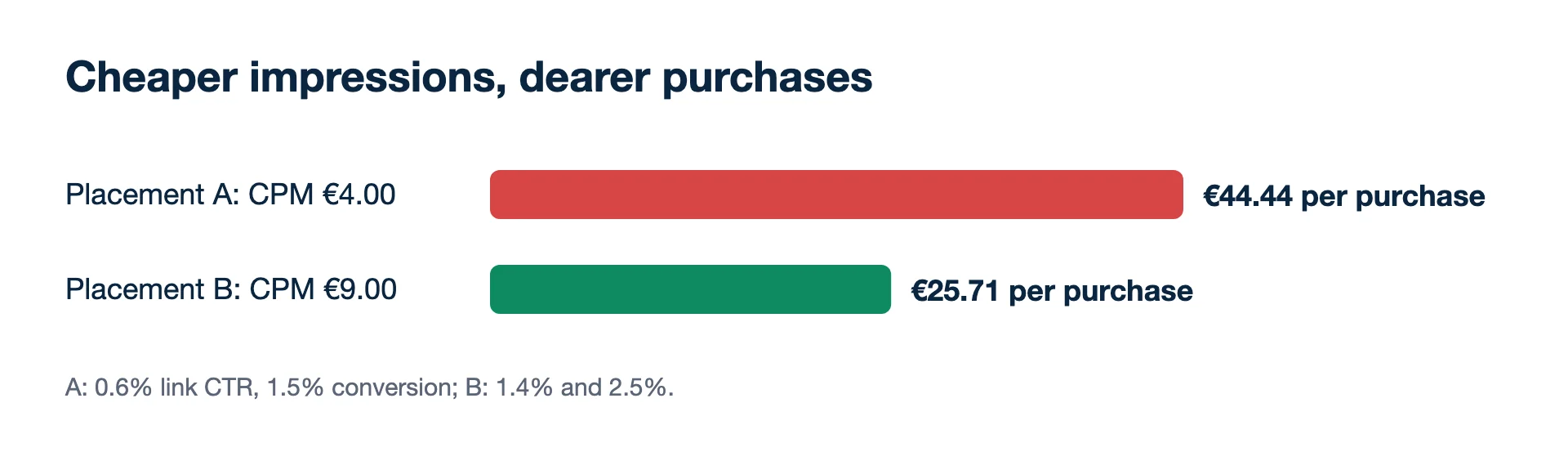
Only if the people who see the ad still click and buy; a cheap impression that nobody acts on is the most expensive kind. Compare two placements in the same jewellery campaign, using the formula above:
| CPM | Link CTR | Conversion rate | Cost per purchase | |
|---|---|---|---|---|
| Placement A | €4.00 | 0.6% | 1.5% | €4.00 ÷ 0.09 = €44.44 |
| Placement B | €9.00 | 1.4% | 2.5% | €9.00 ÷ 0.35 = €25.71 |
(1,000 × 0.006 × 0.015 = 0.09 and 1,000 × 0.014 × 0.025 = 0.35.) Placement A is less than half the price per impression and costs 73% more per purchase. A report sorted by CPM would move budget the wrong way.
How Google uses CPM
In Google Ads, CPM is mainly a way to bid: you pay per thousand impressions on the Display Network. Google has moved CPM bids to viewable CPM (vCPM), where you pay only when the ad can be seen, and converts existing CPM bids automatically. So a Google Display vCPM and a Meta CPM do not count the same unit: one is per thousand viewable impressions, the other per thousand times the ad first appeared on screen. Compare each with its own history, and compare the two platforms on cost per result instead.
What a rising CPM tells you
CPM is the first place auction pressure shows up. When it climbs across all campaigns at once, it is usually the market (seasonal competition, a big event), not your ads. When it climbs on one ad set only, the audience may be small and saturated, or the platform may be rating the ad as less relevant. Reading CPM next to frequency and CTR tells you which.
CPM also helps estimate someone else's spend. Impressions are roughly reach × frequency, and impressions × CPM ÷ 1,000 is spend, so a competitor's visible reach with your own CPM gives a rough range. Kunads uses exactly this, and shows the result as a range rather than one figure; see competitor ad tracking.
Where CPM misleads
- Reading CPM by day. A small ad set's CPM can swing widely from one day to the next when it rests on a few thousand impressions. Read a week before you act.
- Comparing CPM across objectives. A campaign optimised for purchases bids for people likely to buy, so its CPM is higher than a reach campaign's. That is the point, not a problem.
- Confusing CPM with cost per reach. Meta also reports cost per 1,000 Accounts Center accounts reached (spend ÷ reach × 1,000), which is higher whenever people see the ad more than once. If the jewellery campaign's 240,000 impressions reached 96,000 accounts, frequency is 2.5 and the cost per 1,000 accounts reached is €1,800 ÷ 96,000 × 1,000 = €18.75, against a CPM of €7.50.
- Panicking in the run-up to Black Friday. More advertisers compete for the same attention, so CPM rises across the board. Compare with the same weeks last year, not with October.
- Meta Business Help Centre: CPM (cost per 1,000 impressions) (checked 2026-11-19)
- Meta Business Help Centre: Impressions (checked 2026-11-19)
- Meta Business Help Centre: Cost per 1,000 Meta accounts reached (checked 2026-11-19)
- Google Ads Help: Cost-per-thousand impressions (CPM), including viewable CPM (checked 2026-11-19)
Would rather not do this by hand? Kunads' agents check every campaign against your margin each day and propose a fix you approve or ignore.
Audit my ads for free Try Kunads, no card