Broad match
Broad match is the Google Ads keyword match type that can show your ad for searches related to your keyword, including searches that do not contain any of its words. It reaches further than phrase and exact match, and Google says it is the default for new keywords.
How the three match types compare
| Keyword | Query | Exact | Phrase | Broad |
|---|---|---|---|---|
| running shoes | running shoes | Yes | Yes | Yes |
| running shoes | women's trail running shoes | No | Yes | Yes |
| running shoes | best trainers for a marathon | No | No | Possibly |
Does broad match need Smart Bidding?
Google says yes: it is critical to use Smart Bidding with broad match, so bids reflect each auction's context rather than one fixed amount. Google describes broad match as identifying related queries and using additional signals to keep expansions relevant. With manual CPC, a broad keyword pays the same bid for a loosely related search as for a perfect one, which is how off-target terms quietly take a share of the budget.
The check that matters: split the search terms
Cost per conversion of a group of search terms = spend on those terms ÷ conversions from them
Group the search terms report into "relevant" and "not relevant" and run the sum for each group, not only for the keyword as a whole.
Worked example: a month of "running shoes" on broad
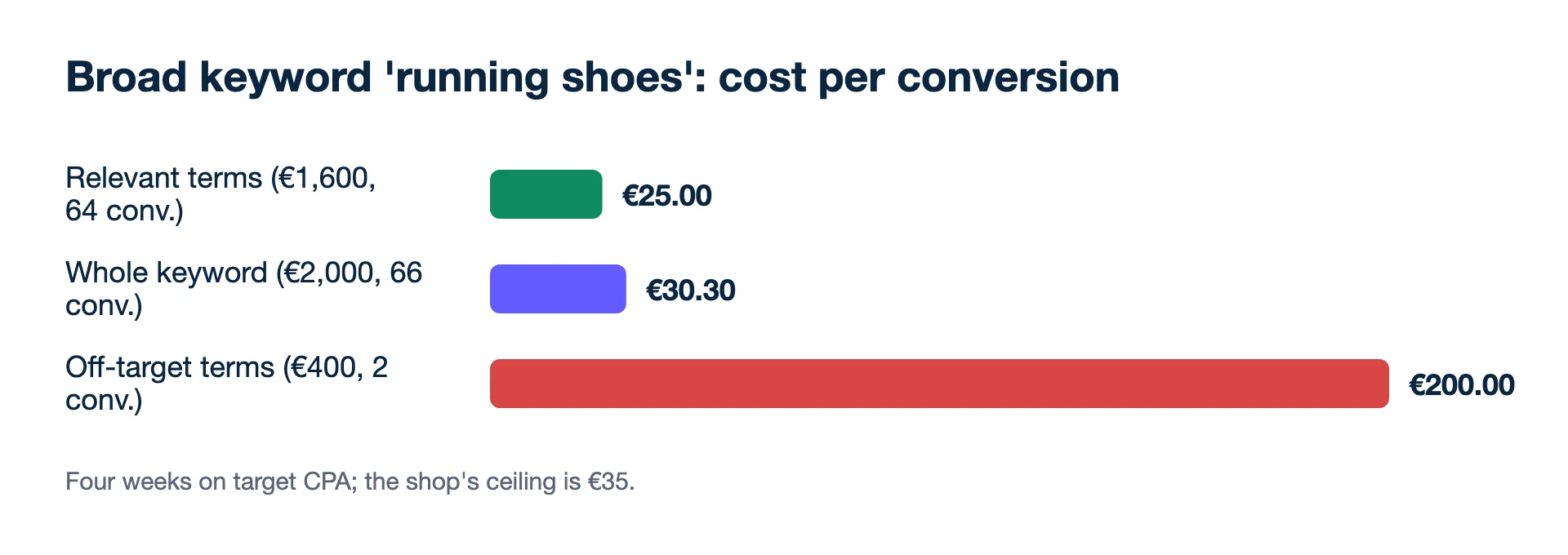
A shop runs the broad keyword running shoes with target CPA bidding. Over four weeks it spent €2,000 and got 66 conversions: €2,000 ÷ 66 = €30.30 per conversion. The shop's ceiling is €35, so the keyword looks fine.
The search terms report, sorted into two groups:
- Relevant terms (shoe models, "trail running shoes", "running shoes sale"): €1,600 spend, 64 conversions, €1,600 ÷ 64 = €25.00 each.
- Off-target terms ("running shoes repair", "running club near me", "marathon training plan"): €400 spend, 2 conversions, €400 ÷ 2 = €200.00 each.
Totals check: 1,600 + 400 = €2,000 and 64 + 2 = 66. One fifth of the spend bought almost nothing. Adding negatives for "repair", "club" and "training plan" would, if the rest held steady, bring cost per conversion towards €25, or free €400 a month for searches that sell.
A second check: compare the converting search terms with your exact and phrase keywords. Terms that convert well and spend steadily are candidates for their own exact match keyword, which gives you a clean line in reports and a bid you can see. Terms that never convert, after enough clicks to judge, become negatives.
How many clicks before you call a search term bad?
More than most people wait. Say a new search term has taken 40 clicks at €0.90, so €36, and has no conversions yet. If the keyword usually converts 3% of clicks, 40 clicks should bring about 1.2 conversions (40 × 0.03), so zero is not yet unusual. At 100 clicks (€90) you would expect 3; still zero at that point is a fair sign the term does not sell. Set the threshold from your own conversion rate and the cost you can carry, and add the negative once the term passes it, not on the first day.
How does Microsoft Advertising define broad match?
Microsoft Advertising also treats broad match as its least restrictive match type: the words of the keyword appear in the search in any order, and it can match synonyms and other semantic variations, so red flower may show for red carnation. Its developer guide warns that this can match irrelevant queries and recommends adding them as negative keywords. Kunads does not connect to Microsoft Ads, but if you import Google campaigns there, run the same search-terms split on both.
What broad match gives you, and what it costs
- Reach. Broad match finds searches you would not have thought to add.
- Fewer keywords to manage, with Smart Bidding doing the per-query work.
- The average hides the tail. A healthy keyword-level CPA can contain an expensive group of irrelevant terms.
Where accounts go wrong with it
- Broad match on manual CPC, against Google's own advice.
- Never opening the search terms report. Do it weekly while a broad keyword is new.
- Optimising to a soft conversion such as page views, so Smart Bidding happily buys irrelevant traffic that "converts".
- Judging it in the first week. A new broad keyword has not yet met most of the searches it will match. Read the search-terms split after a few weeks of data, not after three days.
- Running the same broad keyword in several campaigns and letting them compete.
To find money-losing parts of an account in general, see how to find money-losing campaigns.
See also
- Google Ads Help: Your guide to broad match (checked 2026-11-19)
- Google Ads Help: About the search terms report (checked 2026-11-19)
- Microsoft Advertising API docs: Budget and bid strategies (keyword match types) (checked 2026-11-19)
See it on your own campaigns. Kunads reads your Meta and Google ads and your shop's orders, read-only, and shows the result per campaign.
Run the free profit audit Start a 14-day trialBroad match settings
Is broad match the default?
Yes. Google says broad match is the default match type for new keywords.