How do I work out what a lead is worth?
A lead is worth average deal value × the share of leads that become customers. For the most you can pay per lead, swap deal value for profit: what a won deal keeps × the close rate. Work it out per source and per stage, because a search lead and a social lead rarely close at the same rate.
Two values, two jobs
- Revenue value of a lead = deal value × close rate. This is the figure to send to Google and Meta as a conversion value, so value-based bidding can rank one lead above another.
- Profit value of a lead = profit per won deal × close rate. This is your ceiling for cost per lead. Pay above it and each lead loses money.
Keep both in the same sheet. Mixing them up is the usual reason a lead campaign "hits target" while the business earns nothing from it.
Where the numbers come from
- Export leads and won deals from the CRM for three to six months, with each lead's source.
- Close rate per source = won deals ÷ leads.
- Average deal value per source; referrals and search often buy bigger.
- Profit per deal = deal value − cost to deliver (materials, labour, subcontractors, fees).
- Multiply, and repeat for stages: qualified lead, booked meeting, proposal sent.
Example one: a software reseller, by source
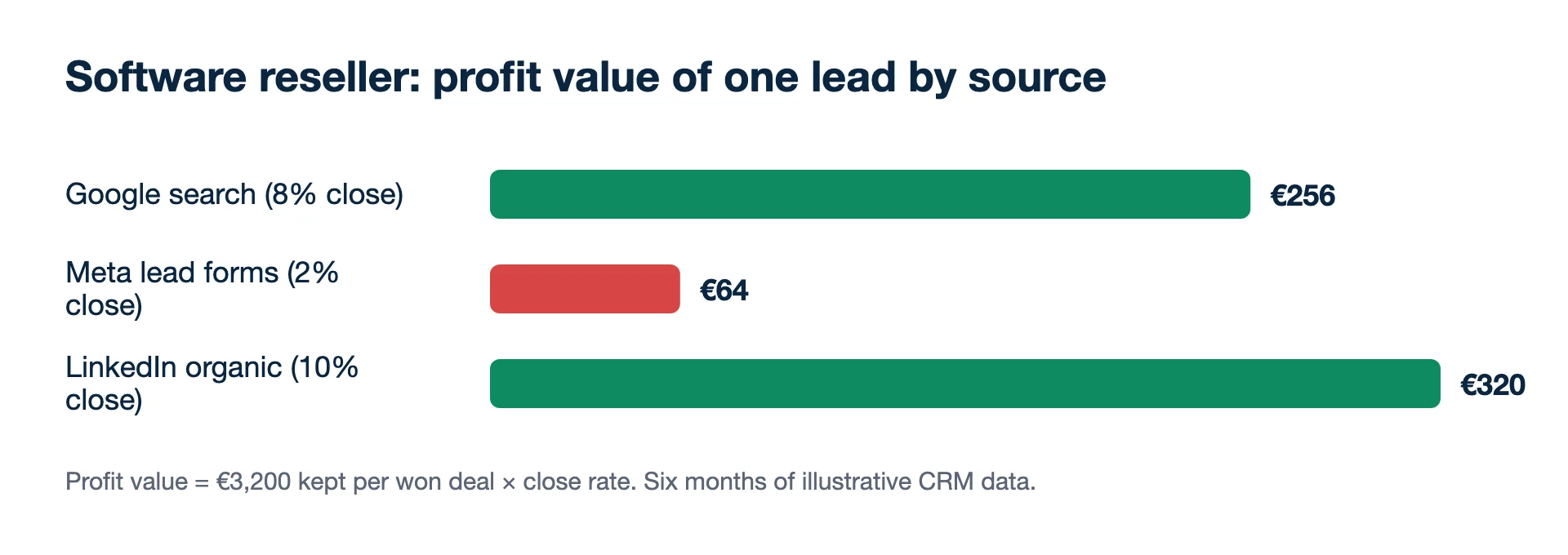
Six months of CRM data. Average deal €8,000, of which €3,200 is kept after licences and onboarding.
| Source | Leads | Won | Close rate | Revenue value per lead | Profit value per lead |
|---|---|---|---|---|---|
| Google search | 200 | 16 | 8% | €640 | €256 |
| Meta lead forms | 500 | 10 | 2% | €160 | €64 |
| LinkedIn organic | 60 | 6 | 10% | €800 | €320 |
Check one row: 16 ÷ 200 = 8%; €8,000 × 0.08 = €640; €3,200 × 0.08 = €256. If Meta form leads cost €70, each loses €6 against its €64 profit value. If Google leads cost €180, each leaves €76.
Example two: a dental clinic with a booking step
Some businesses have a step between lead and sale. A clinic offering implant consultations sees 60% of leads book a consultation, and 30% of consultations go ahead with treatment. Treatment averages €2,500 and keeps €1,000 after lab work and chair time.
- Lead to treatment: 0.60 × 0.30 = 18%.
- Revenue value per lead: €2,500 × 0.18 = €450. Per booked consultation: €2,500 × 0.30 = €750.
- Profit value per lead: €1,000 × 0.18 = €180, the most a lead may cost.
If a new form doubles leads but only 30% of them book, the lead-to-treatment rate halves to 9%, and each lead is worth €90 in profit. Measuring the booking step catches that within weeks rather than months.
How do I value leads that have not closed yet?
Give each pipeline stage a value from history and send it when the stage is reached. Won deals are often too few, and too slow, for bidding to learn from; earlier stages happen more often. Using the reseller's totals:
- Lead (all sources): 32 won ÷ 760 leads = 4.2%, so €8,000 × 0.042 ≈ €337.
- Qualified: if 304 of the 760 (40%) were qualified, 32 ÷ 304 = 10.5%, so €8,000 × 0.105 ≈ €842.
- Won: the real deal value, sent when the contract is signed.
What value do Google and Meta expect?
Both expect a number you choose, sent with the conversion. Google Ads lets each conversion action carry a value, either the same for every conversion or a different one per conversion, and value-based bidding then works towards the total. Meta's conversion leads optimisation uses CRM events you send back to find people more likely to become customers. The set-up is in how to send CRM conversions to Meta and Google; the term is explained under offline conversions.
Where lead value goes wrong
- Slow sales. Judge cohorts: leads from three to six months ago and how many of them closed, never this month's leads against this month's deals.
- Contracts that renew. Use profit you have actually seen over a fixed window such as 12 months, not a hoped-for lifetime value.
- Thin data. With fewer than about 20 won deals per source, pool sources and treat the result as rough.
Kunads works out lead value as deal value × close rate from won deals in any CRM; it reads won deals only, not pipeline stages. Run your own rows in the lead value calculator, then set a ceiling with how much should a lead cost?
- Google Ads Help: About conversion values (checked 2026-11-19)
- Google Ads API: Manage offline conversions (checked 2026-11-19)
- Meta Business Help Centre: Differences between conversion optimisations (conversion leads) (checked 2026-11-19)
- Reseller and clinic figures: illustrative.
Would rather not do this by hand? Kunads' agents check every campaign against your margin each day and propose a fix you approve or ignore.
Audit my ads for free Try Kunads, no cardLead value in practice
Should I send revenue value or profit value to the ad platforms?
Either works for bidding as long as it is consistent across conversions; revenue value is simpler to explain, profit value keeps bidding closer to what you keep. Your cost-per-lead ceiling should always come from profit.
How often should I recalculate lead value?
Monthly, per source, once you have enough won deals. Close rates move when forms, audiences or offers change, and a value set once and forgotten drifts away from reality.