How do I set a monthly ad budget?
Set a monthly ad budget from the goal backwards: (revenue goal − revenue that comes without ads) ÷ revenue per €1 of ads. Then check that the goal still leaves a profit at that spend. If it does not, lower the goal or improve efficiency first; a bigger budget will not close the gap on its own.
The five inputs
- Revenue goal for the month. Start from the same month last year and your growth plan.
- Revenue without ads. Repeat customers, email, organic search, direct. Use a month with little or no ad spend if you have one, or the shop's non-paid channels.
- Revenue per €1 of ads. The ad-driven part of your blended ROAS: (revenue − revenue without ads) ÷ ad spend, over the last 60–90 days.
- Divide. The gap ÷ revenue per €1 = the budget the goal needs.
- Check profit. Revenue × contribution margin − ad spend. If that is below what you need, the goal is too high for today's efficiency.
A shop's November, worked through
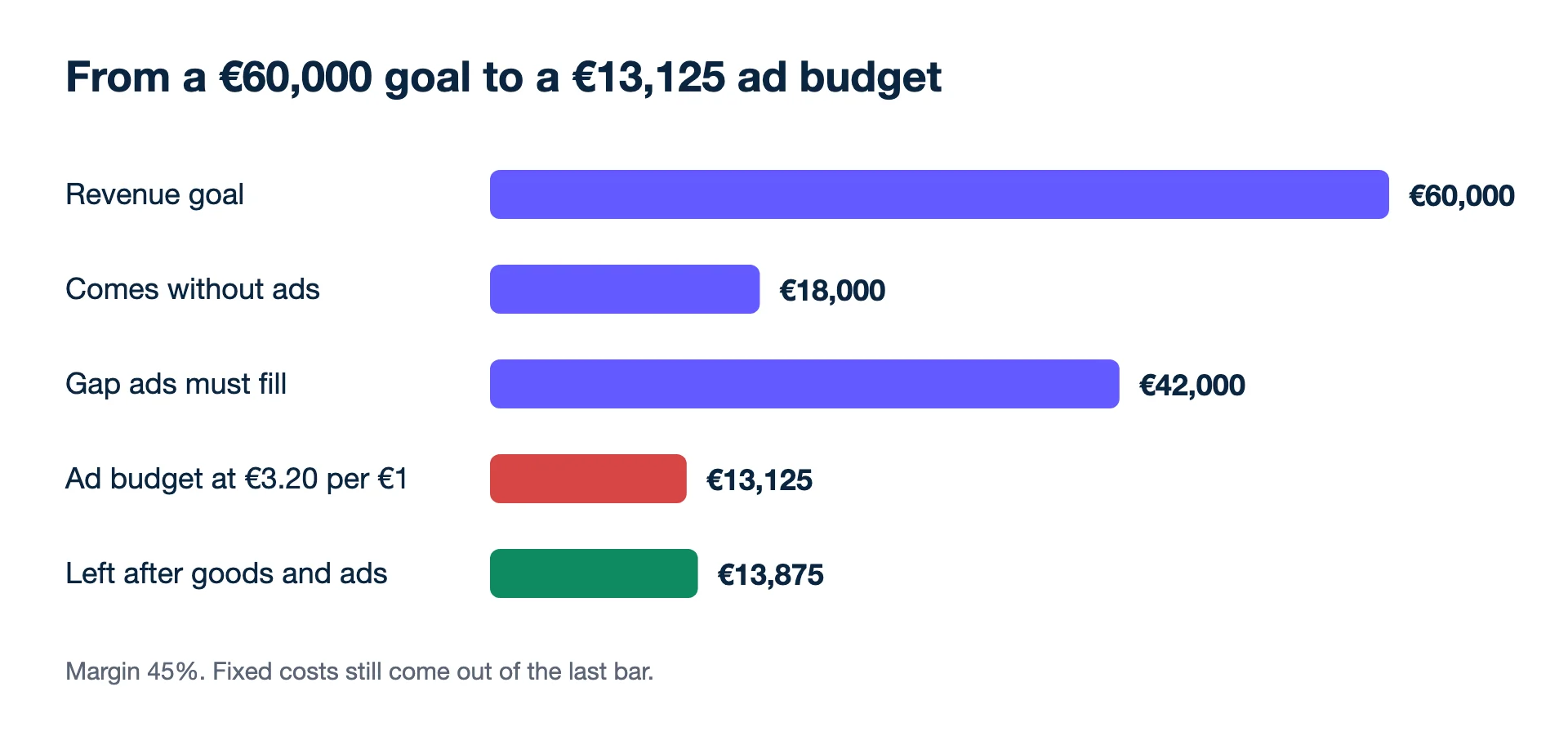
A shop wants €60,000 in November. Without ads it brings about €18,000 a month. Over the last 90 days, each €1 of ads brought €3.20 of revenue on top of that. Margin 45%.
- Gap: €60,000 − €18,000 = €42,000.
- Budget: €42,000 ÷ 3.20 = €13,125.
- Profit check: €60,000 × 0.45 = €27,000 kept; minus €13,125 of ads = €13,875 before fixed costs.
Now the catch. If last month's spend was €8,000, the goal needs +64%. Efficiency usually falls as spend rises, so €3.20 may become €2.80 at the higher level, and €42,000 ÷ 2.80 = €15,000. Profit then drops to €27,000 − €15,000 = €12,000. Either plan a smaller goal this month or accept the lower profit knowingly. Try your own figures in the ad budget calculator.
How much of my revenue should go to ads?
There is no honest fixed percentage; it falls out of the goal and the efficiency. In the example, €13,125 of a €60,000 month is about 22%. A shop with the same goal but €30,000 of revenue without ads would need €30,000 ÷ 3.20 = €9,375, about 16%. Same goal, same efficiency, different share, because the base differs. A percentage rule copied from another shop ignores both its base and its margin. What matters is the profit line: the share is fine as long as revenue × margin − ads leaves what the business needs.
How do I turn a monthly budget into daily budgets?
Divide by 30.4 for Google and by the days in the month for Meta, then check pacing weekly. The two platforms spend differently:
- Google: a campaign "might spend up to twice your average daily budget" on a given day, and over the month "no more than 30.4 times your average daily budget".
- Meta: a daily budget is a target over a Sunday-to-Saturday week. Meta may spend up to 75% over it on a good day, but not more than 7× the daily budget in the week. A lifetime budget is spread over the schedule you set.
Split the €13,125 example 60/40: Meta gets €7,875, which over a 30-day month is €262.50 a day; Google gets €5,250, which is €5,250 ÷ 30.4 ≈ €172.70 a day. Check that they add up: €7,875 + €5,250 = €13,125. Start the split from where each €1 has done best recently, then move money between platforms in steps (see how often to change ad budgets). The budget pacing calculator shows mid-month whether you will land on the total; more on that in budget pacing.
For lead generation, count deals instead
Swap revenue for won deals. Deals needed ÷ close rate = leads needed; leads needed × the cost per lead you can afford = budget. Example: 15 deals at a 10% close rate need 150 leads; at €60 each, that is €9,000. The affordable cost per lead comes from what a won deal keeps; see how much a lead should cost. Check that the deals are worth it: if each keeps €1,200 after delivery, 15 deals keep €18,000, leaving €9,000 after the ads.
Where the formula needs care
- Seasonality. December's revenue per €1 is rarely November's. Use last year's same month when you have it, for both the base and the efficiency.
- New accounts. With no history, set a test budget you can afford to lose, run it for a month, and work out revenue per €1 from that.
- The base is a guess. Some "revenue without ads" only happens because ads ran earlier: last month's new customers buying again. If you cut ads to zero, the base may shrink over the following months, so do not test it by switching everything off before a key month.
- Cash flow. Ads are paid now; repeat orders arrive later. Budget on what the month can pay for.
In Kunads you set a revenue and profit goal (or a leads goal and a maximum cost per lead); the CEO agent estimates the budget with this formula, caps a raise at +50% of today's spend per month, and proposes it. Approving sets the monthly budget.
- Google Ads Help: About overdelivery and your average daily budget (checked 2026-11-19)
- Meta Business Help Centre: About daily budgets (checked 2026-11-19)
- Meta Business Help Centre: About budgets (checked 2026-11-19)
- Example figures: illustrative.
Breakeven, per campaign. Give Kunads your margin once; it marks which Meta and Google campaigns sit below it and by how many euros.
Find my losing campaigns Try it for 14 days