Budget pacing
Budget pacing is tracking ad spend against a planned budget for a period, usually a calendar month, to see whether you are ahead or behind and what daily budget will land exactly on the target. Pace is spend so far ÷ spend expected by today; 100% is on plan. For agencies it separates "on plan" from "we overspent".
The four formulas
Expected spend to date = monthly budget × days elapsed ÷ days in month
Pace = actual spend to date ÷ expected spend to date
Projected month-end spend = actual spend to date ÷ days elapsed × days in month
Daily budget needed for the rest = (monthly budget − spend to date) ÷ days remaining
Use full days elapsed (yesterday's close), not today's partial spend.
Worked example: 17 November
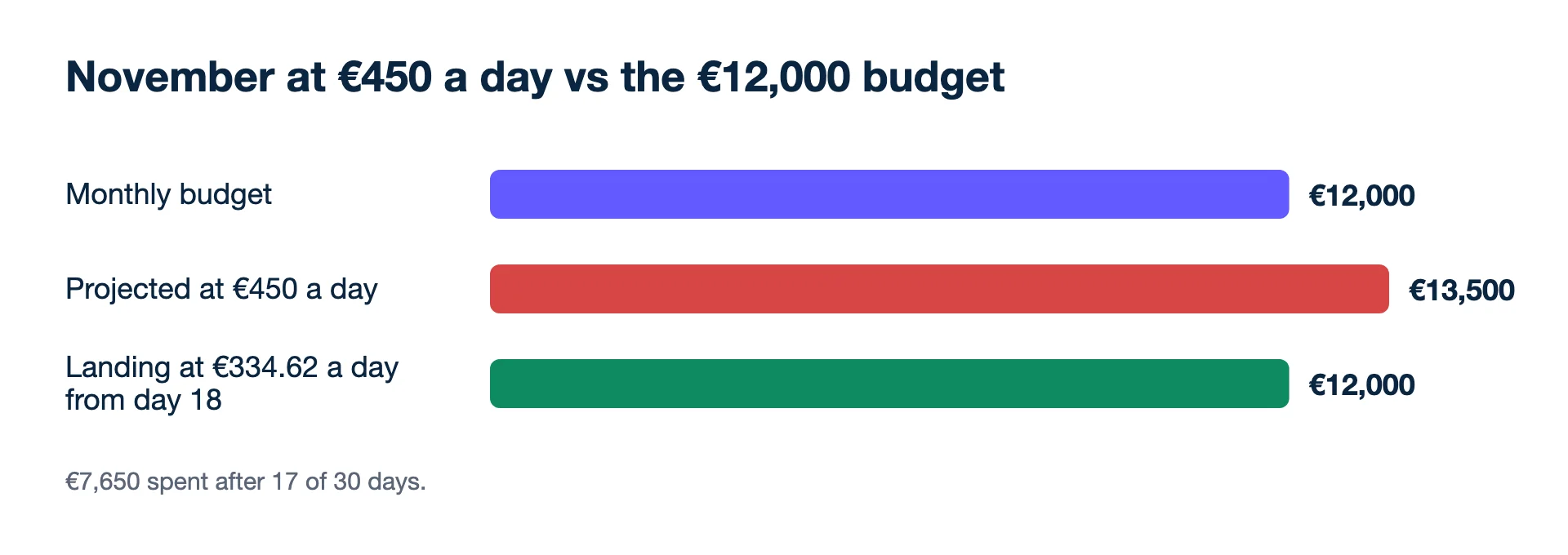
A client's November budget is €12,000. November has 30 days. After 17 full days, spend across Meta and Google is €7,650.
- Expected by now: 12,000 × 17 ÷ 30 = €6,800.
- Pace: 7,650 ÷ 6,800 = 112.5%, ahead of plan.
- Current daily rate: 7,650 ÷ 17 = €450. Projected month-end: 450 × 30 = €13,500, which is €1,500 over.
- Left to spend: 12,000 − 7,650 = €4,350 over 13 days, so €334.62 a day, down from €450.
Checks: 450 × 17 = 7,650 and 334.62 × 13 ≈ 4,350. Cutting from €450 to about €335 a day is a 26% drop. If the account's rule is to move budgets in 20% steps, the planner has to start now, not on the 28th.
Pacing says how much; it does not say where. Take the cut from campaigns earning least per extra euro, not evenly from all.
What if spend is behind?
Then the daily budget has to rise, and the sooner you start the smaller each step. A December budget is €9,000 over 31 days. After 10 days the account has spent €2,400. Expected by now is 9,000 × 10 ÷ 31 = €2,903.23, so pace is 2,400 ÷ 2,903.23 = 82.7%. At the current €240 a day the month ends at 240 × 31 = €7,440, €1,560 short. Landing on €9,000 needs (9,000 − 2,400) ÷ 21 = €314.29 a day, a 31% raise. In 20% steps: raise to €288 today (240 × 1.2). After three days at €288 the total is €3,264, leaving €5,736 for 18 days, or €318.67 a day, which a second, smaller raise covers. Wait until the 20th and the gap needs a far bigger jump than any single step allows.
Can Google Ads or Meta spend more than my daily budget?
Yes, both can, by design, and each sets its own limit:
| One day | Longer period | |
|---|---|---|
| Google Ads | Up to 2× the average daily budget | No more than 30.4× the average daily budget per month |
| Meta (Advantage+ campaign budget) | Up to 75% above the daily budget on some days | No more than 7× the daily budget per week |
| Microsoft Advertising | Usually less than 100% above the daily limit | Monthly limit = daily budget × days in the month |
So a single day's spend is a weak signal. Read pace on the running total, daily.
One budget, two platforms
A total can be on pace while both halves are wrong. Split the €12,000 November budget as €7,200 for Meta and €4,800 for Google. After 17 days, Meta has spent €4,930 and Google €2,720, which together make the €7,650 above. Meta's expected spend is 7,200 × 17 ÷ 30 = €4,080, so it runs at 120.8%; Google's is €2,720 against an expected €2,720, exactly 100%. The whole overspend sits in Meta, so that is where the cut belongs. Pace each platform against its own share as well as the total.
Why pacing is worth a daily look
- Overspend is a client conversation nobody wants. Underspend is lost sales in a month that had budget for them.
- Late corrections are big corrections. Big budget swings can push Meta ad sets back into the learning phase.
- Several platforms share one budget. Meta and Google each pace only themselves.
Pacing errors
- Pacing on a month of 30 days when it has 31.
- Counting today's partial spend as a full day.
- Forgetting a lifetime-budget campaign that will spend its remainder in the last week.
- Cutting every campaign by the same percentage.
- Reading spend in one time zone and the month's calendar in another, so the last day of the month lands in the wrong report.
In Kunads
Kunads holds a monthly budget per account, spreads it across campaigns (or lets them run on their own), and moves budgets in 20% steps with one change per campaign per 7 days, a monthly cap and a brand floor. For a quick number without an account, use the budget pacing calculator.
Related: campaign budget optimization, learning phase, MER.
- Google Ads Help: About overdelivery and your average daily budget (checked 2026-11-19)
- Meta Business Help Centre: Understand Advantage+ campaign budget results (checked 2026-11-19)
- Microsoft Advertising API docs: Budget and bid strategies (daily and monthly budget limits) (checked 2026-11-19)
Agencies: one screen for every client account, with each campaign measured on what the client kept and a white-label report each Monday.
Free audit for one client Trial for agencies