How often should I change my ad budgets?
Change a campaign's budget at most once a week, and read each change on a full 7 days of results. Daily numbers swing on chance, weekdays differ, and part of each day's sales is credited days later. Meta advises avoiding frequent budget changes; the exceptions are fixes, such as broken tracking or a sold-out product.
Why wait a full week between budget changes?
Because a week is the shortest period in which a change can be told apart from noise. Four reasons, in order of how often they fool people:
- Daily results are noisy. A campaign that averages 10 sales a day can show 6 one day and 14 the next with nothing changed. A cut after the 6-sale day reacts to chance.
- Weekdays differ. Many shops sell more on Sunday evening than on Friday. A full week covers each day once, so this week and last week compare fairly.
- Sales are credited late. On a 7-day click window, a click on Monday that turns into an order on Thursday is credited to Monday. Read on Tuesday, Monday looks worse than it will by the weekend.
- Platforms adjust over days. Meta paces a daily budget across a Sunday-to-Saturday week and re-plans the rest of the week after a change. Google says a new budget takes effect in the next auction, while Smart Bidding's performance adjusts "over the course of your conversion cycle".
The cost of reacting daily
Two people manage the same €100-a-day campaign for two weeks.
- Daily: Monday was poor, so cut to €80. Tuesday was good, so raise to €110. Wednesday flat, back to €95. After 14 days and 11 changes, nobody can say which change did what, and on Meta several were big enough to risk sending the ad set back into the learning phase.
- Weekly: week 1 at €100, return above breakeven. Raise to €120. Three days later still good, raise to €144. Week 2 holds. Two changes, each with clear data.
A second example shows the late-credit trap. A campaign spends €700 in a week and by the following Monday has €2,100 credited: ROAS 3.00×. Read the same week on Thursday, when perhaps only €1,500 of it was in, and it looked like 2.14× (1,500 ÷ 700). With breakeven at 2.50×, the Thursday reading would have cut a campaign that was in fact profitable. How much arrives late depends on how long your customers take to buy; compare a few past weeks read on day 1 and on day 7 to see your own lag.
A weekly review in five steps
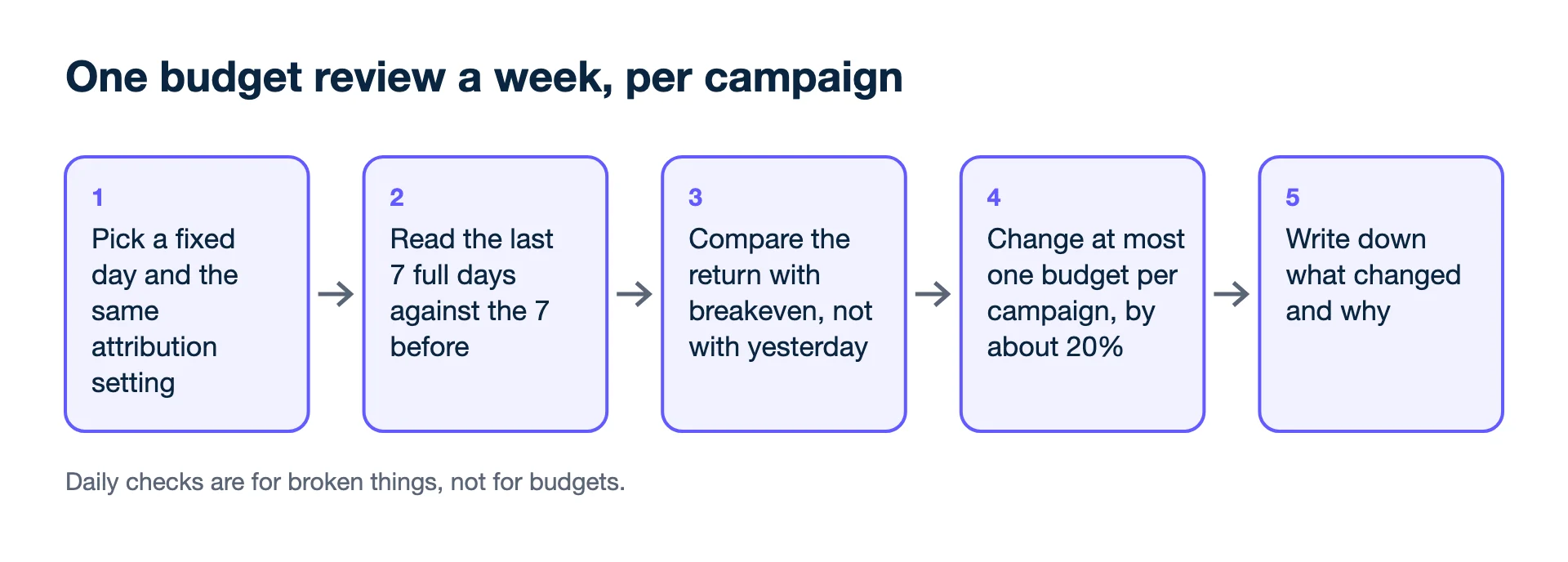
Kunads' budget rules follow the same rhythm: one change per campaign per 7 days, a second raise allowed after 3 days if the first held up, 20% steps, a monthly cap and a brand floor. That is a working practice, not a Meta or Google rule. Whether the month as a whole is on course is a separate question, answered with the budget pacing calculator rather than by moving budgets each day to hit a daily figure.
When should I change a budget the same day?
When something is broken or a date is fixed, change it now and do not wait for the week:
- tracking has failed (conversions at zero, or suddenly doubled);
- a product is out of stock, or the site or checkout is down;
- spend is heading past the monthly cap;
- a planned event starts tomorrow or ends today.
Those are repairs, not optimisation. Note the date, so that next week's numbers are read with the outage in mind, and restart the 7-day count from the repair.
Large and small accounts
An account with hundreds of conversions a day gets enough data in two or three days, and on Google a budget change does not trigger Smart Bidding's Learning status, so a faster rhythm can work there. Its limit is the conversion lag, not the volume: if customers take five days to buy, three-day reads are still incomplete.
A small account with ten sales a week may need two weeks per change before the difference is bigger than chance. There the better move is often fewer, larger campaigns, so each one collects data faster. In both cases the principle holds: change, then wait long enough to know what the change did. Related: how much to increase ad budget.
- Meta Business Help Centre: Significant edits and learning phase (checked 2026-11-19)
- Meta Business Help Centre: About daily budgets (checked 2026-11-19)
- Google Ads Help: About Smart Bidding learning (checked 2026-11-19)
- Example figures: illustrative.
Agencies: one screen for every client account, with each campaign measured on what the client kept and a white-label report each Monday.
Free audit for one client Trial for agenciesOdd cases in the weekly rhythm
Does moving budget between campaigns count as one change?
It is two changes, one to each campaign, and each needs its own week of results before you read it.
Can I check results daily even if I change weekly?
Yes. Look daily for things that are broken, such as zero conversions or spend far above plan, and decide on budgets weekly. Watching is not the same as acting.