How do I fix ad fatigue?
Fix ad fatigue by adding a new ad that is materially different (new hook, new visual, new angle, not a recolour), widening the audience if it is small, and keeping a steady flow of new creative. First confirm it really is fatigue: frequency rising, CTR falling and cost per result rising on the same ad.
Is it really fatigue?
It is fatigue only when three signals move together, on the same ad, over the same dates:
- Frequency rising: the same people see it more often. Frequency is impressions ÷ reach.
- CTR falling: fewer of them click.
- Cost per result rising: each sale or lead costs more.
If CPM rose across every ad at once, it is more likely the auction (season, competition). If conversion rate fell but CTR held, look at the site. See why did my ROAS drop?
What does Meta's "Creative fatigue" status mean?
It means the ad's cost per result has reached at least twice that of your past ads, after Meta has looked at how often people have recently seen its image or video. In the Delivery column Meta can show Creative limited or Creative fatigue. It counts all recent exposures of the creative, including other campaigns from your page: more than your past ads but under twice as much is "Creative limited"; twice or more is "Creative fatigue". The status is only available for ad sets with one creative (not Advantage+ catalog ads, dynamic creative or Advantage+ app campaigns). Meta's recommendations: create another ad with a new image or video "materially different from the original", expand your audience, or try Advantage+ creative.
No status does not mean no fatigue. If your ad set runs several creatives, or the status is not offered, read frequency and CTR per ad yourself, in Ads Manager or through the Ads Insights API, which reports both for each ad.
Fixes, in order
- Add a new angle, not a new colour. A different problem, benefit, proof or format reaches people the old ad did not convince. Small edits to the same image are seen as the same ad.
- Keep the old ad running for now. Meta notes keeping the original active "may maximize results". Pause it when it is clearly below breakeven and the new one has picked up delivery.
- Widen the audience if it is small: broader targeting, more countries, or merging ad sets.
- Refresh on a rhythm. A few new ads a month in a structured creative test beat one big refresh when results have already collapsed.
- Remember the learning cost. Adding a new ad to an ad set is on Meta's list of significant edits, so batch new ads rather than adding one every day.
Worked example: a prospecting ad
An ad for a skincare set, 60 days live, audience of about 400,000 people.
| Period | Frequency | Link CTR | Cost per purchase |
|---|---|---|---|
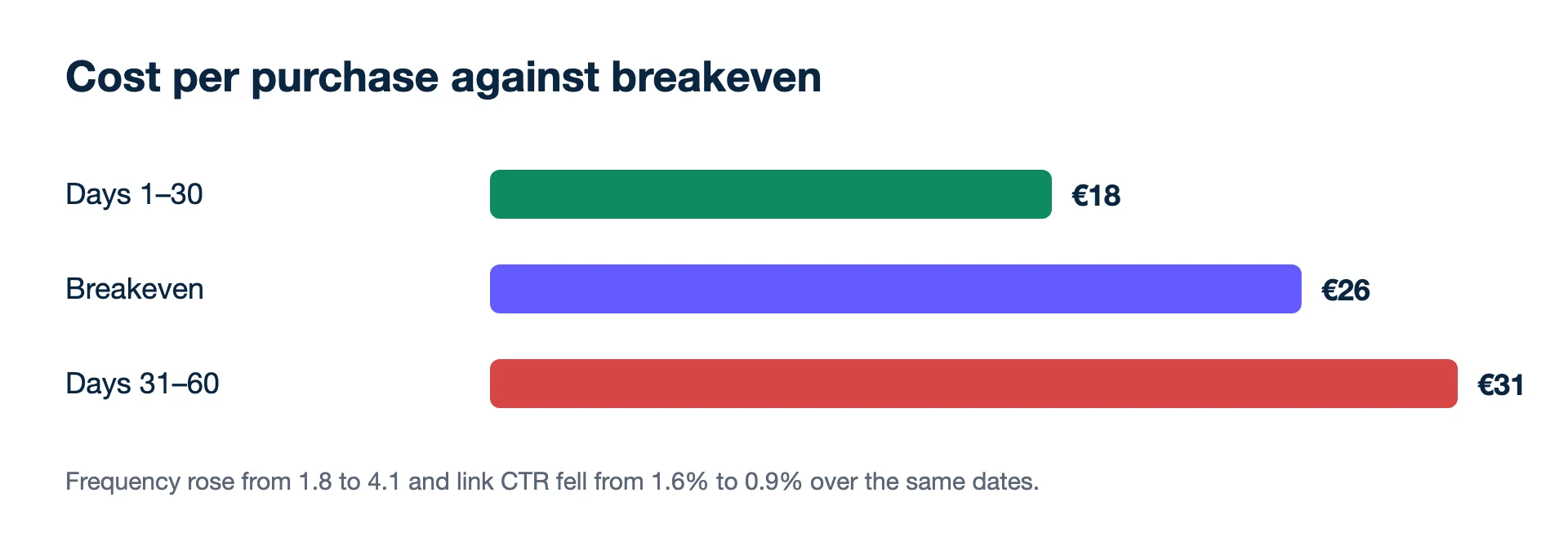
| Days 1–30 | 1.8 | 1.6% | €18 |
| Days 31–60 | 4.1 | 0.9% | €31 |
All three moved the wrong way. With a breakeven cost per purchase of €26 (what an order keeps), the ad went from €8 of profit per sale to losing about €5 per sale. Fix: launch two new angles (a before-and-after video and a customer review), keep the old ad live for a week, then pause it if it stays above €26. Check your breakeven with the breakeven ROAS calculator.
A small audience tires faster
Retargeting shows the same mechanics in a fortnight. Take a pool of 20,000 site visitors, €30 a day, CPM €12: that buys 2,500 impressions a day. After 14 days, 35,000 impressions reached 14,000 people, a frequency of 2.5. After 28 days, 70,000 impressions have reached only 17,500 people, because most of the pool has already been reached: frequency 4.0, and still rising every day. A new ad helps for a while, but the lasting fix here is less money or a larger pool, not more creative. Cap retargeting spend at what the pool can absorb.
How often should I add new ads?
Add new ads before the old ones fade, on a fixed rhythm that fits your spend, rather than when the numbers have already collapsed. Larger audiences fatigue slowly, and a winning prospecting ad can last months. Catalogue ads rotate products by themselves, so fatigue shows less in single-ad numbers. Seasonal drops look like fatigue; compare with other ads on the same dates before you replace anything.
Kunads gives every Meta ad a verdict (stop, fading, scale, iterate, keep, early) with frequency shown. "Fading" means profitable in the earlier half of the chosen dates and below water in the later half, and the creative agent proposes the next ad from what worked.
- Meta Business Help Centre: About creative fatigue recommendations in Meta Ads Manager (checked 2026-11-19)
- Meta Business Help Centre: Significant edits and learning phase (checked 2026-11-19)
- Meta Business Help Centre: About reach metrics (checked 2026-11-19)
- Meta for Developers: Ads Insights API (checked 2026-11-19)
- Example figures: illustrative.
Lead generation? Send won deals from your CRM and Kunads ranks campaigns by what the leads were worth, not by how many came in.
Check my lead campaigns Start free for 14 daysStill seeing tired ads?
What frequency causes ad fatigue?
There is no fixed number. It depends on audience size, format and how varied your ads are. Watch the trend: rising frequency with falling CTR and rising cost per result on the same ad.