Should I use Performance Max?
Use Performance Max when your conversion tracking is reliable, the conversion value reflects what you earn (ideally profit), and you have enough conversions for Google's bidding to learn. Do not use it to paper over bad tracking: it optimises hard toward whatever you send, including brand searches and junk leads.
What is Performance Max, in practice?
It is one Google Ads campaign that buys across all Google inventory (YouTube, Display, Search, Discover, Gmail and Maps) and lets Google's AI decide where each euro goes. You give it conversion goals (with an optional target ROAS or CPA), asset groups (images, text, logos and videos around a theme) and audience signals; Google builds and places the ads. Google's API documentation says PMax allocates budget dynamically across those channels, which is why you cannot set a budget per channel the way you would with separate campaigns.
Controls added in 2025 updates: campaign-level negative keywords on Search and Shopping inventory, shared negative keyword lists, 50 search themes per asset group, device and age targeting, search terms reporting for all campaigns, full asset statistics and new-customer reporting. Brand exclusions are available too, and channel prioritisation lets you put Search partners and the Display Network in separate priority tiers.
Will PMax take traffic from my Search campaigns?
Not on exact match: Google says a Search campaign with an exact match keyword is prioritised over Performance Max when a query matches that keyword. Search themes in PMax carry the same priority as phrase and broad match keywords, so on those the two can compete. If you want a search term kept in your Search campaign, make it an exact match keyword there.
Use it when
- Tracking is solid. Purchases or qualified leads are counted once, with the right value, without VAT.
- Values carry margin. If products have different margins, send profit or margin-weighted values; otherwise it will push the cheapest bestsellers. See is POAS better than ROAS?
- There is volume. Dozens of conversions a month, not a handful.
- Shops have a clean product feed in Merchant Center.
- You can judge it on the shop's numbers, through blended ROAS or profit, not only the campaign report.
Think twice when
- Brand search is most of the result. PMax can serve on your brand terms, where people would have found you anyway. Use brand exclusions and compare with a brand search campaign.
- Lead gen without offline data. If it only sees form fills, it finds form fillers. Send qualified and won leads as offline conversions first.
- Very small budgets. Spread over six channels, a small budget learns slowly.
- You need strict placement control for legal or brand reasons.
Worked example 1: judge it on profit
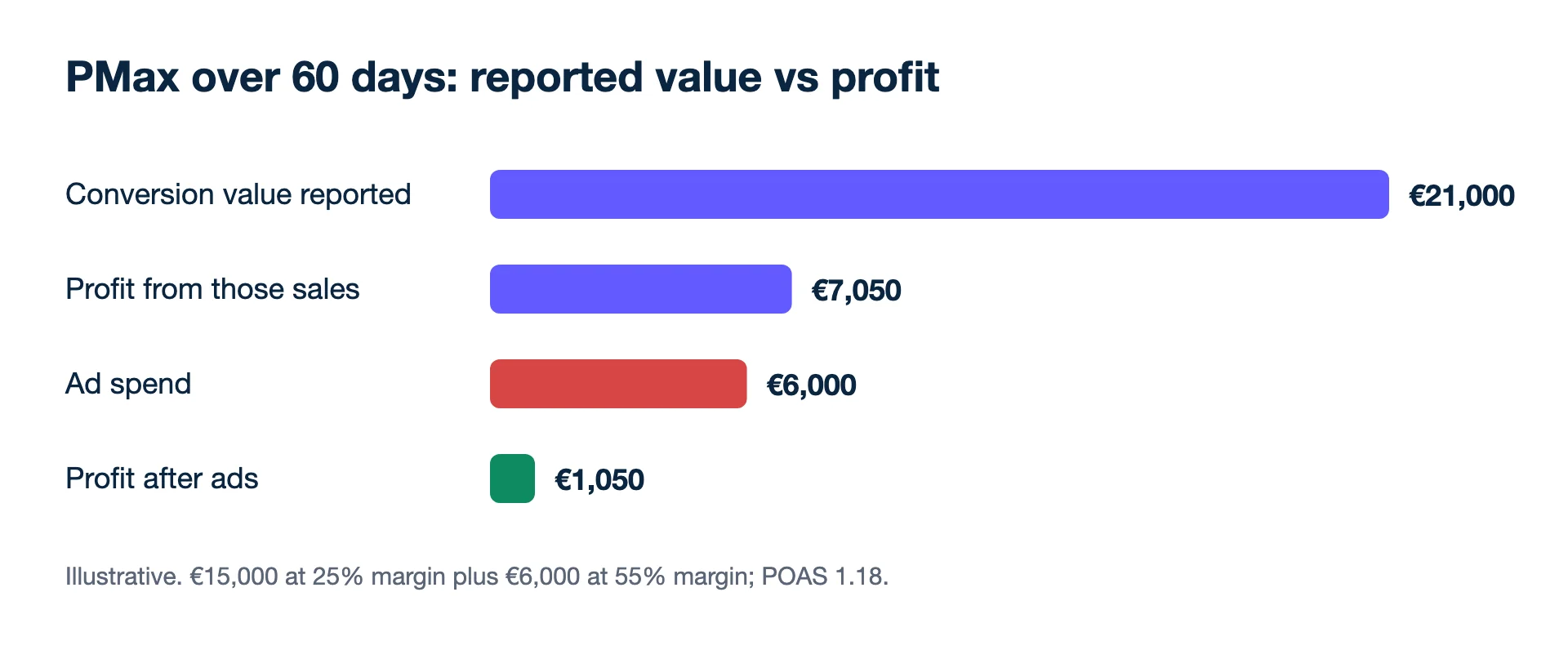
A shop with margins from 20% to 60% runs PMax for 60 days: €6,000 spend, Google reports €21,000 conversion value (ROAS 3.50×). Splitting by product: €15,000 came from items with a 25% margin, €6,000 from items with a 55% margin.
- Profit from sales: €15,000 × 0.25 + €6,000 × 0.55 = €3,750 + €3,300 = €7,050.
- Profit after ads: €7,050 − €6,000 = €1,050. POAS 1.18: positive, but far thinner than 3.50× suggests.
- Fix: send margin-weighted conversion values, or split low-margin products into their own campaign with a higher target.
Check splits like this with the POAS calculator.
Worked example 2: a brand exclusion test
Another shop keeps 40% of each order, so it breaks even at ROAS 2.50×. Its PMax campaign shows €3,000 spend and €15,000 value (5.00×), profit after ads €15,000 × 0.40 − €3,000 = €3,000. The search terms report shows many brand queries, so it adds a brand exclusion and lets its own brand Search campaign take those searches. A month later PMax spends €2,500 for €6,000 of value: ROAS 2.40×, profit €6,000 × 0.40 − €2,500 = −€100. Most of the earlier result was brand demand. The decision now rests on the non-brand part alone: cut its budget, raise its target, or fix values, and judge the account on the shop's total, since the brand sales did not disappear, they moved to the brand campaign.
Other cases that change the answer
If PMax runs next to Search or Shopping campaigns aimed at the same products, their results overlap; compare them on the shop's total, not each campaign's report. For a cleaner read of what PMax adds, pause it in one region for a few weeks (a holdout test) and compare sales. And after any big structural change, give it the week of Learning status before judging it.
Kunads puts PMax next to every other campaign on real profit and POAS from your measured margin, and can send profit back to Google as a separate conversion, opt-in per account.
- Google Ads Help: About Performance Max campaigns (controls, exact match priority, Final URL expansion) (checked 2026-11-19)
- Google Ads Help: Unlock more visibility and control in Performance Max (7 August 2025) (checked 2026-11-19)
- Google Ads API: Performance Max overview (dynamic budget allocation across channels) (checked 2026-11-19)
- Google Ads Help: About Smart Bidding learning (checked 2026-11-19)
- Example figures: illustrative.
Numbers from your shop, not from the ad platforms. Connect Meta, Google and Shopify, WooCommerce or Magento and see what each campaign kept.
Get my profit audit Open a free workspaceRunning PMax day to day
How long does PMax take to settle after a change?
Google shows a Learning status for up to 7 days after structural changes, while ads keep serving. Budget and target changes take effect in the next auction without triggering Learning, but results converge to a new target over your conversion cycle.
Should I leave Final URL expansion on?
Only if every page on your site is one you are happy to land paid traffic on. With it on, Google may send people to a different page than your final URL and write a matching headline and description, and Google says you remain responsible for that page content and the generated assets.