View-through conversion
A view-through conversion is a conversion from someone who was shown an ad, did not click it, and then converted within the platform's view window. On Meta that window is 1 day; on Google Ads it defaults to 1 day and can be set to as many as 30. Whether the ad caused the sale is a separate question.
View-through conversion = an impression of the ad + no click on it + a conversion within the view window
How Meta and Google define the window
- Meta: the ad set's attribution setting combines a click window with an optional 1-day view window. For "maximise number of conversions" the choices are 1-day click, 7-day click, 1-day click or 1-day view, and 7-day click or 1-day view, which is the default.
- Meta's value optimisation is different. For website ad sets on "maximise value of conversions", Meta lists only 1-day click and 7-day click, so a ROAS-goal ad set has no view-through credit at all. Comparing its numbers with a default ad set mixes two definitions.
- Meta engage-through: a separate 1-day window for people who engage with an ad without a link click, such as watching a video for at least 5 seconds.
- Google Ads: the view-through window defaults to 1 day and can be set from 1 to 30 days. YouTube engaged-view conversions have their own window, 3 days by default.
Worked example: what one day of views adds on Meta
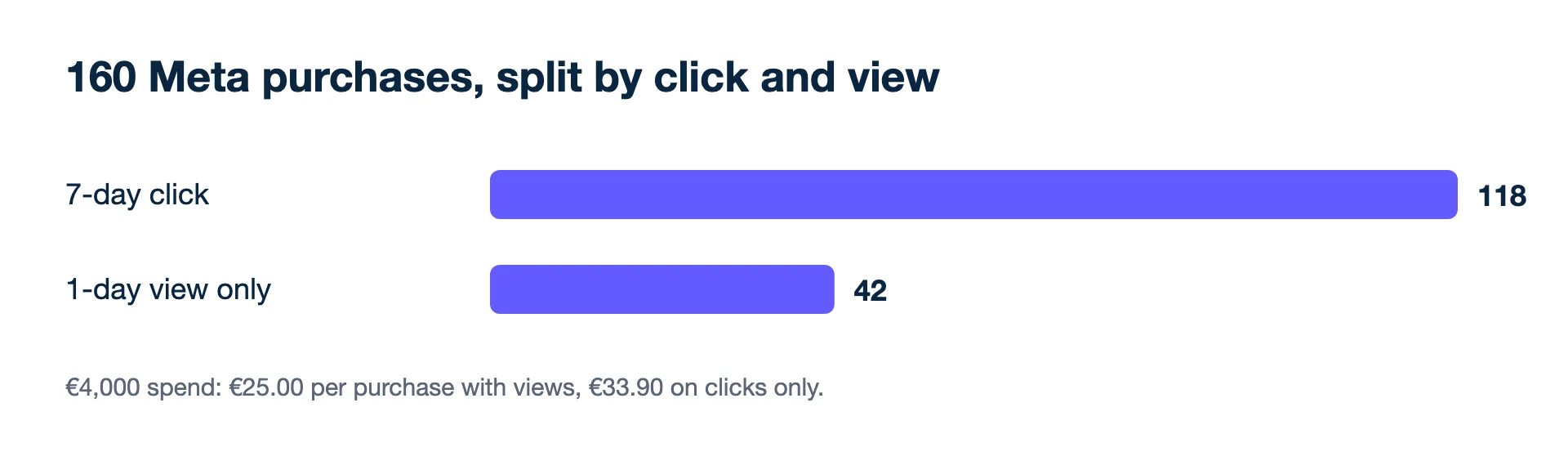
A Meta campaign spends €4,000 in a month on the default 7-day click or 1-day view setting and reports 160 purchases. The comparison columns split them:
- 7-day click: 118 purchases
- 1-day view only (no click): 42 purchases
- Total: 118 + 42 = 160
So 42 ÷ 160 = 26% of the reported purchases are view-through. Cost per purchase is €4,000 ÷ 160 = €25.00 with views, and €4,000 ÷ 118 = €33.90 on clicks only.
Are view-through conversions real sales?
The orders are real; what a view-through count cannot show is how many of them the ad caused. Some of those 42 people would have bought anyway, especially if they were already on a retargeting list. Suppose a holdout test on this account shows the campaign causes about 70 extra purchases a month in total. That number, not 118 or 160, is what the ads add. The view-through share is a reporting choice; the test is the evidence.
Second example: a longer window on Google
A Google display campaign records 30 view-through conversions a month on the 1-day default. The advertiser changes the view-through window to 7 days and the next month shows 85, with the same ads, budget and audiences. Nothing about the ads improved: the window simply let in purchases made up to a week after an impression. Judge window changes by comparing the same period on both settings, not month against month, and never put a 7-day Google view count beside Meta's 1-day view count as if they measured the same thing.
Which campaigns does it matter for most?
Video, reach and retargeting, for opposite reasons. Few people click a 15-second video, so a click-only lens can make it look useless when it may not be. Retargeting reaches people already close to buying, who often convert within a day of seeing any ad, so view-through credit there deserves the most scepticism. A high frequency pushes the count up too: the more often people see the ad, the more of them "viewed" before buying, without any change in what the ads cause.
Reading view-through without fooling yourself
- Do not add Meta views to Google clicks and call the sum "ad-driven sales". The same order can appear in both.
- Replace gut feel with a test. "Views don't count" and "views count fully" are both guesses.
- Keep one setting per comparison. Switching windows mid-period breaks week-on-week trends.
- Look at the shop. The shop has no idea anyone saw an ad. Meta, Google and the shop count differently and never agree, so compare them side by side and steer the account on blended ROAS.
In Kunads, Meta opens on its default window (7-day click + 1-day view), and 7-day click or 1-day click is a switch away, which shows quickly how much of a campaign rests on views.
Related terms
- Meta Business Help Centre: Differences between conversion optimisations in Meta Ads Manager (attribution settings) (checked 2026-11-19)
- Meta Business Help Centre: Set up engage-through in Meta Ads Manager (checked 2026-11-19)
- Google Ads Help: About conversion windows (view-through and engaged-view windows) (checked 2026-11-19)
Changes wait for you. Kunads proposes budget moves in 20% steps with the reasoning attached; nothing reaches Meta or Google until you press Approve.
See what it would change Begin a free trialView-through on Meta vs Google
How long are the view-through windows on Meta and Google?
Meta's attribution setting offers view-through as none or 1 day. Google Ads defaults to 1 day for view-through conversions and lets you set 1 to 30 days; YouTube engaged-view conversions default to 3 days.
Should I turn off 1-day view on Meta?
Only if your tests show those conversions are mostly not caused by the ads. On Meta the attribution setting also guides delivery, not only the report, so test the change rather than flipping it for a prettier or uglier number.