Multi-touch attribution
Multi-touch attribution (MTA) splits the credit for one conversion across several of the marketing touches that came before it, such as a Meta ad, a Google search and an email, instead of giving it all to one touch. A linear model, for example, gives each of four touches 25% of a €100 order.
The appeal is obvious: real journeys have several steps. The difficulty is that no single tool sees every step.
The common models
With n touches and a conversion value V:
- Linear: each touch gets V ÷ n.
- Position-based (U-shaped): first and last touch get 40% each; the middle touches share the remaining 20%.
- Time decay: credit grows the closer a touch is to the conversion, often halving for each fixed period further back.
- Algorithmic / data-driven: weights are estimated from past path data rather than set by a rule.
Worked example: one €100 order, four touches
Path: Meta video ad → Google generic search → newsletter email → Google brand search → purchase of €100.
| Touch | Linear | Position-based 40/20/40 | Last click |
|---|---|---|---|
| Meta video ad | €25 | €40 | €0 |
| Google generic search | €25 | €10 | €0 |
| Newsletter email | €25 | €10 | €0 |
| Google brand search | €25 | €40 | €100 |
| Total | €100 | €100 | €100 |
The middle 20% is split between two touches, so €20 ÷ 2 = €10 each. Every model shares out the same €100; they disagree only on who earned it. Under linear the Meta video earns €25; under last click it earns nothing. Pick the model and you have picked the answer.
Second example: time decay on an €80 order
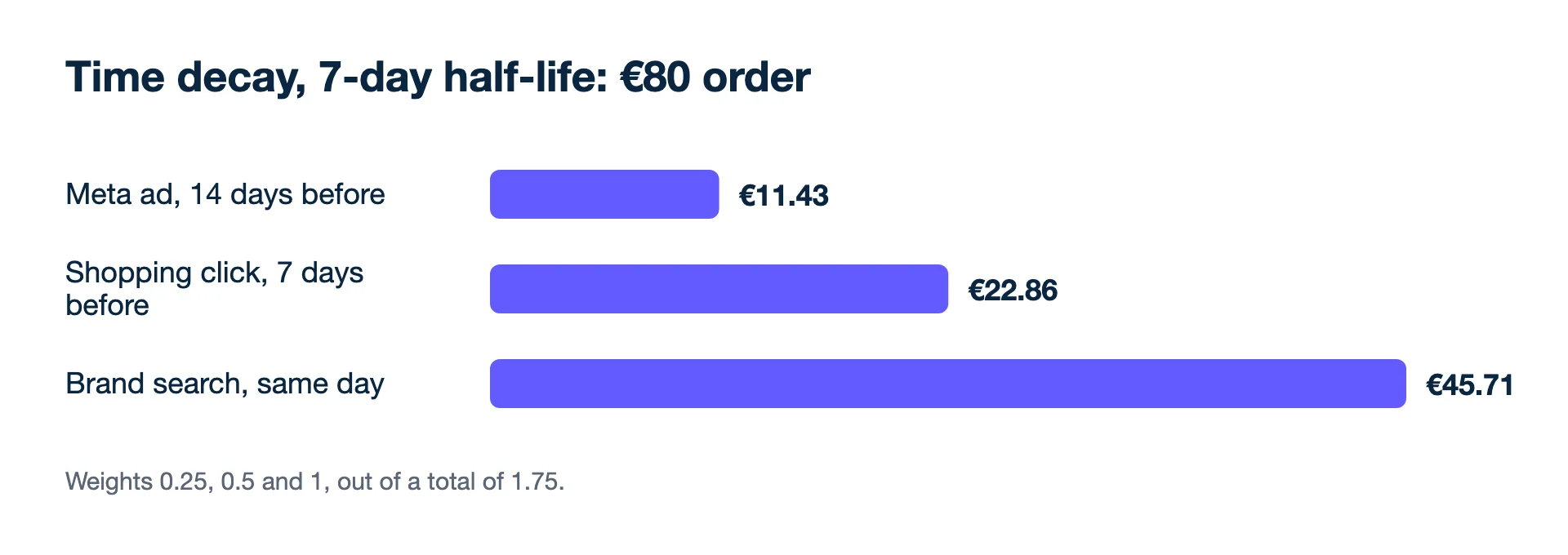
Three touches: a Meta ad 14 days before the purchase, a Google Shopping click 7 days before, and a brand search on the day. With a 7-day half-life, each touch's weight halves for every 7 days back:
- Weights: 0.25 (14 days), 0.5 (7 days), 1 (same day); total 1.75
- Meta ad: €80 × 0.25 ÷ 1.75 = €11.43
- Shopping click: €80 × 0.5 ÷ 1.75 = €22.86
- Brand search: €80 × 1 ÷ 1.75 = €45.71
The three add up to €80.00. Change the half-life to 3 days and the Meta ad's share falls to almost nothing, with no change in what any customer did. The half-life is a setting, not a measurement.
Which multi-touch models can you still use in Google Ads and GA4?
Only data-driven attribution, plus last-click variants. Google Ads and GA4 both retired first click, linear, time decay and position-based models; GA4 did so in November 2023. Data-driven is the multi-touch option left: Google says it distributes credit based on your past data for that conversion action. Meta does not split credit with other channels at all: it attributes a website purchase to its own ad if it happened within a set number of days after someone viewed or clicked it, according to the ad set's attribution setting. To run linear or position-based rules across channels today you need your own path data and a separate tool.
Does multi-touch attribution show what ads caused?
No. MTA shares out credit for sales that happened; it does not ask which of them would have happened without any ads. A loyal customer whose path includes a retargeting ad still gives that ad a share. Cause needs a holdout test or marketing mix modeling.
Where the paths break
- Incomplete data. Ad blockers, consent choices, cross-device journeys and in-app browsers cut the chain. A model built on broken paths gives confident numbers for the part it can see.
- Views are mostly missing. A site-side tool sees clicks that reach your site, not ads someone watched without clicking.
- Mixed rulebooks. Comparing one channel's MTA ROAS with another channel's platform-reported ROAS sets two different rules side by side.
- Conventions read as facts. 40/20/40 and a 7-day half-life are choices. Choosing the one that flatters your favourite channel is the most common misuse.
Where Kunads stands
Kunads does not build a multi-touch model. It puts each platform's figure beside the shop's or CRM's records and steers on blended ROAS (all revenue ÷ all ad spend), which needs no path at all; the MER calculator gives that number for any period.
Related terms
- Google Ads Help: About attribution models (rule-based models retired) (checked 2026-11-19)
- Analytics Help: Attribution models in Google Analytics (rule-based models retired November 2023) (checked 2026-11-19)
- Meta Business Help Centre: About Facebook's attribution system (checked 2026-11-19)
Lead generation? Send won deals from your CRM and Kunads ranks campaigns by what the leads were worth, not by how many came in.
Check my lead campaigns Start free for 14 daysMTA after cookies
Does multi-touch attribution still work with consent banners and ad blockers?
Only on the paths it can still see. People who decline tracking or switch devices drop out of the chain or appear as separate people, so the model shares out credit for a smaller, less typical set of journeys.
Is data-driven attribution a multi-touch model?
Yes. Google's data-driven attribution spreads credit across the ad interactions on a path, with weights based on the account's own past data for that conversion action, instead of fixed rules like 40/20/40.
Should a small shop bother with MTA?
Usually not. With a few hundred orders a month and two or three channels, blended ROAS and an occasional pause test give clearer answers than a model built on partial paths.