Data-driven attribution
Data-driven attribution (DDA) splits the credit for a conversion across the ad interactions that came before it, based on your own account's past conversion paths, instead of a fixed rule like "last click takes all". In Google Ads it is the default model for most conversion actions.
Is data-driven attribution the default in Google Ads?
Yes: Google says data-driven is the default for most conversion actions, and last click is the only other model left.
- Google Ads: two models remain, data-driven and last click. Google retired first click, linear, time decay and position-based, and moved conversion actions that used them to data-driven.
- Google Analytics 4: three models in the attribution reports: data-driven, paid and organic last click, and Google paid channels last click. The rule-based models went in November 2023.
Google describes data-driven as distributing credit "based on your past data for this conversion action". It compares the paths of people who converted with those who did not, and gives more credit to interactions that appear to change the odds of converting.
The idea in one line
Credit to touch i = conversion value × (estimated contribution of i ÷ sum of contributions of all touches)
Google does not publish the weights for your account; you see their result as fractional conversions and conversion value per campaign, ad group and keyword.
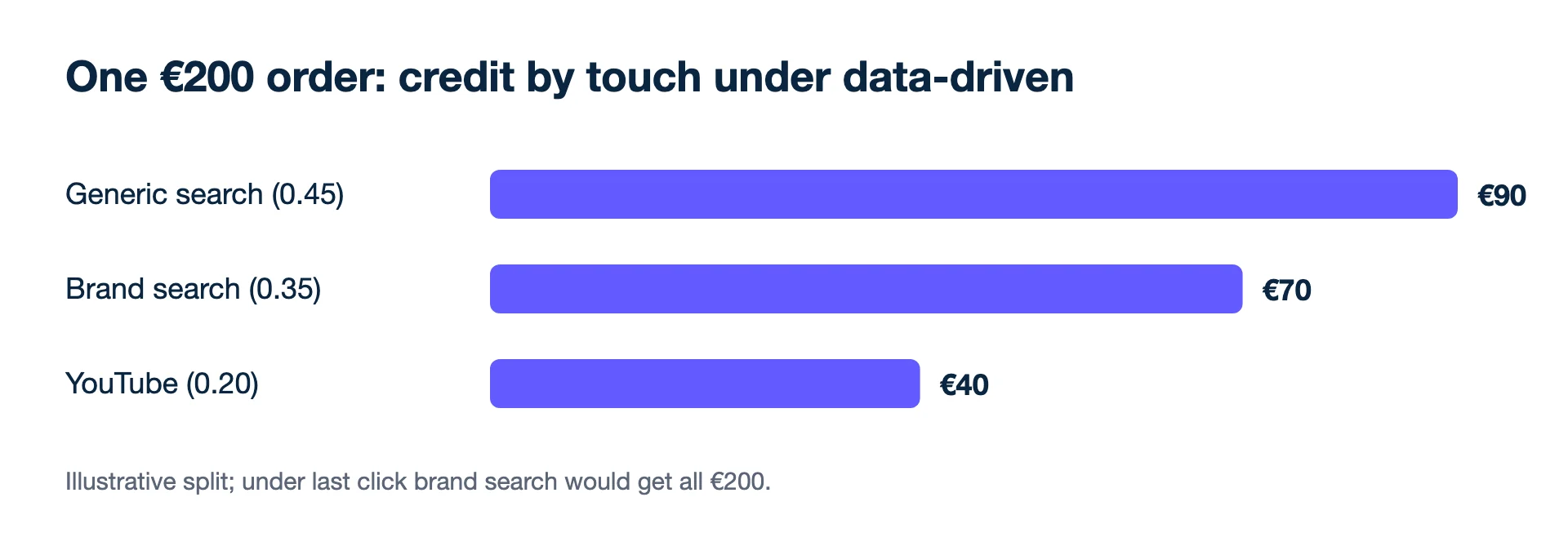
Worked example: €200 order, three Google touches
A customer clicks a generic search ad ("waterproof hiking boots"), later watches and clicks a YouTube ad, and finally clicks a brand search ad and buys for €200.
| Touch | Last click | Data-driven (illustrative split) |
|---|---|---|
| Generic search | 0 conv · €0 | 0.45 conv · €90 |
| YouTube | 0 conv · €0 | 0.20 conv · €40 |
| Brand search | 1 conv · €200 | 0.35 conv · €70 |
| Total | 1 conv · €200 | 1.00 conv · €200 |
The total never changes: one order, €200. Only the split moves. If the generic search campaign spent €45 to win its share, its ROAS goes from 0 under last click to €90 ÷ €45 = 2.0 under data-driven. That is often the difference between pausing a campaign and keeping it.
Second example: what the switch does to CPA
An account has 150 conversions a month from two Search campaigns. Under last click, brand search gets 120 of them on €600 of spend (€5.00 each) and generic search 30 on €1,980 (€66.00 each). After the switch to data-driven, an illustrative split gives brand 84 and generic 66; the total is still 150. Brand's CPA rises to €600 ÷ 84 = €7.14, and generic's falls to €1,980 ÷ 66 = €30.00. Nothing about the customers changed. If generic search runs on target CPA bidding, Google now sees it as far cheaper and will bid more aggressively there, which is the point of the model, and also why you should not read the first month after a switch as a performance change.
What it changes in practice
- Smart Bidding learns from it. With data-driven, bids for upper-funnel keywords reflect their share of conversions, not zero.
- Generic and video campaigns get visible credit they would never get from last click.
- It changes over time. The model updates as your paths change, so the same campaign can earn a different share next quarter.
Does data-driven attribution include Meta?
No. In Google Ads it shares credit only across Google ad interactions, so a Meta ad that started the journey is not in the path and its share goes to Google touches. GA4 can include the other channels it tracks, but only visits that reach your site. Meta, for its part, credits orders under its own attribution setting, by default 7-day click or 1-day view, without seeing Google's touches. Both can credit the same order, which is why the account as a whole is best steered on blended ROAS.
Limits to keep in mind
- It is attribution, not proof of cause. It estimates contribution from observed paths. It does not run a control group. For cause, use an incrementality test.
- It is a black box. You cannot audit the weights, only the outcome.
Misreadings
- Switching a conversion action from last click to data-driven mid-month and reading the jump in generic search as an improvement.
- Summing Google's data-driven conversions with Meta's 7-day click conversions as one "total".
- Comparing a campaign's CPA before and after the switch as if it were the same measurement.
- Expecting whole numbers in exports and treating 0.35 conversions as a tracking error.
Kunads shows each platform's own reported conversions next to the shop's orders. For why those never match, see why Meta, Google and Shopify never agree.
Related: last-click attribution, multi-touch attribution, marketing mix modeling.
- Google Ads Help: About attribution models (checked 2026-11-19)
- Analytics Help: Attribution models in Google Analytics (checked 2026-11-19)
- Meta Business Help Centre: Differences between conversion optimisations (attribution setting and default) (checked 2026-11-19)
Lead generation? Send won deals from your CRM and Kunads ranks campaigns by what the leads were worth, not by how many came in.
Check my lead campaigns Start free for 14 daysFractional conversions explained
Why do I see fractional conversions?
Because credit is split. A conversion shared between three keywords might show as 0.45, 0.20 and 0.35 conversions, adding up to 1.