Last-click attribution
Last-click attribution gives 100% of the credit for a conversion to the last ad, keyword or channel the customer clicked before converting, and zero to every earlier touch. It is the simplest attribution rule and is still offered in Google Ads and GA4, but it systematically favours whatever sits at the end of the journey.
Credit to touch i = conversion value if i is the last click; otherwise 0
Does Google Ads still offer last-click attribution?
Yes. Google Ads supports two models today: data-driven, which is the default for most conversion actions, and last click. First click, linear, time decay and position-based were retired, and conversion actions that used them were moved to data-driven. GA4 has two last-click variants in its attribution settings: "Paid and organic last click" and "Google paid channels last click". Meta does not use the term at all: Ads Manager credits a conversion to an ad if it happened within a set number of days after someone clicked or viewed it, according to the ad set's attribution setting.
Worked example: a three-step journey
A customer buys a €120 jacket after this path:
- Day 1: clicks a Meta ad and browses.
- Day 3: clicks a Google Shopping ad for the same jacket, leaves again.
- Day 4: searches the brand name on Google, clicks the brand search ad, buys.
| Touch | Last click (GA4, Google paid + organic) | Google Ads, last click | Meta, 7-day click |
|---|---|---|---|
| Meta ad (day 1) | €0 | not visible | €120 |
| Shopping ad (day 3) | €0 | €0 | not visible |
| Brand search ad (day 4) | €120 | €120 | not visible |
The shop recorded one €120 order. GA4 on last click gives it to brand search. Google Ads, seeing only its own clicks, also gives it to brand search. Meta, seeing only its own click, counts it within its 7-day click window. Each tool reports its own count by its own rule, and the counts never agree. That is not a fault of any one tool. It is why the whole account is best judged on blended ROAS: €120 of revenue against all ad spend, counted once.
Why does last click favour brand search?
Because people often search the brand name right before they buy, after discovering the brand somewhere else. The brand search is the last click, so it collects the whole sale, even when a video, a Meta ad or a generic search started the journey. Retargeting benefits in the same way. A second example, with a month of Google Ads data, shows how far the split can move. A shop has 100 purchase conversions across three campaigns. Under last click, brand search gets 60, generic search 25 and Shopping 15. After switching the conversion action to data-driven, the same 100 conversions read: brand search 45, generic search 33, Shopping 22.
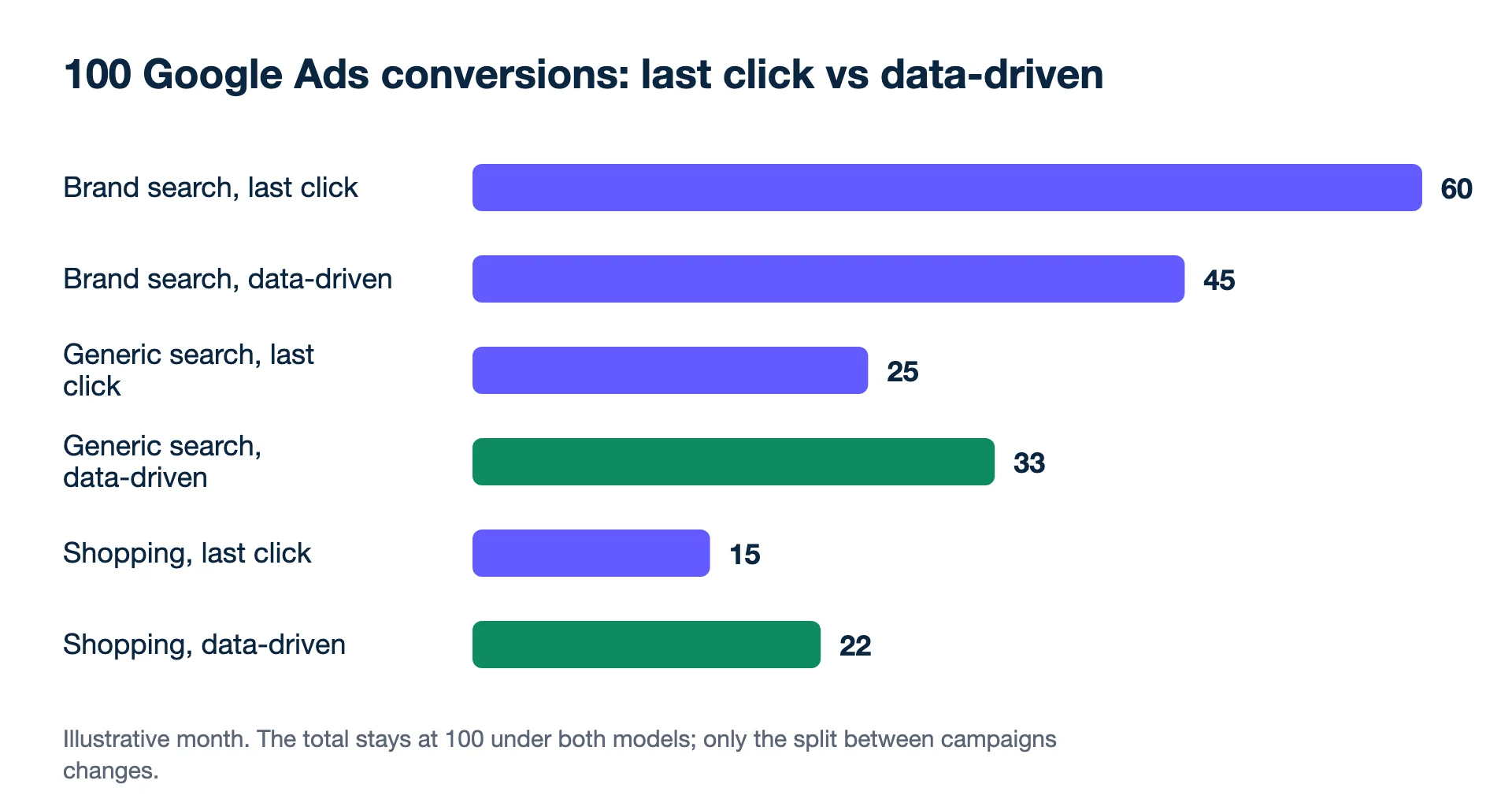
Nothing about the business changed; only the credit moved. If generic search had been cut because last click showed it at 25 conversions, the brand campaign would probably have lost some of its 60 later, because fewer people would have discovered the shop in the first place. Two practical points from Google's own help: the model affects how Smart Bidding strategies that use the Conversions column (Target CPA, Target ROAS) optimise bids, and a model change applies only from that point on. Old rows keep the old model unless you add the "current model" columns.
Why people still use it
- It is stable. The same journey always gets the same answer, so weeks compare cleanly.
- It needs little data. Data-driven attribution needs enough conversions to learn from; last click works from the first sale.
- It is easy to explain to a client. "The sale came from the ad they clicked last" needs no model.
What it hides
- Discovery work. Prospecting ads, video and generic search start journeys and rarely finish them. Under last click they look worse than they are.
- The weight of the end of the path. Brand and retargeting collect the sale even when the customer had already decided.
- Views. A customer who saw a video and never clicked it does not exist for last click.
Mistakes to avoid
- Cutting prospecting because last click says it does nothing. Watch what happens to brand search volume afterwards; it often falls too. A holdout test answers this properly.
- Calling one report "right". A last-click report and a platform's own report answer different questions.
- Mixing GA4's last click with Google Ads' data-driven numbers in one table without labelling which is which.
Kunads takes no side between models: it puts each platform's own count next to the shop's orders and steers on blended ROAS. You can work out that number for any period with the MER calculator.
Related terms
- Google Ads Help: About attribution models (checked 2026-11-19)
- Analytics Help: Attribution models in Google Analytics (checked 2026-11-19)
- Meta Business Help Centre: About Meta's attribution system (checked 2026-11-19)
Would rather not do this by hand? Kunads' agents check every campaign against your margin each day and propose a fix you approve or ignore.
Audit my ads for free Try Kunads, no cardLast click in GA4 and Google Ads
What is last non-direct click in GA4?
GA4 calls it Paid and organic last click. It ignores direct visits and gives the credit to the last channel the user came from before converting, such as organic search or a paid ad.
Does switching from last click rewrite my old reports?
No. Google Ads applies a model change going forward only. To see past data under the new model, add the 'current model' columns, such as Conversions (current model).