How do I calculate breakeven ROAS?
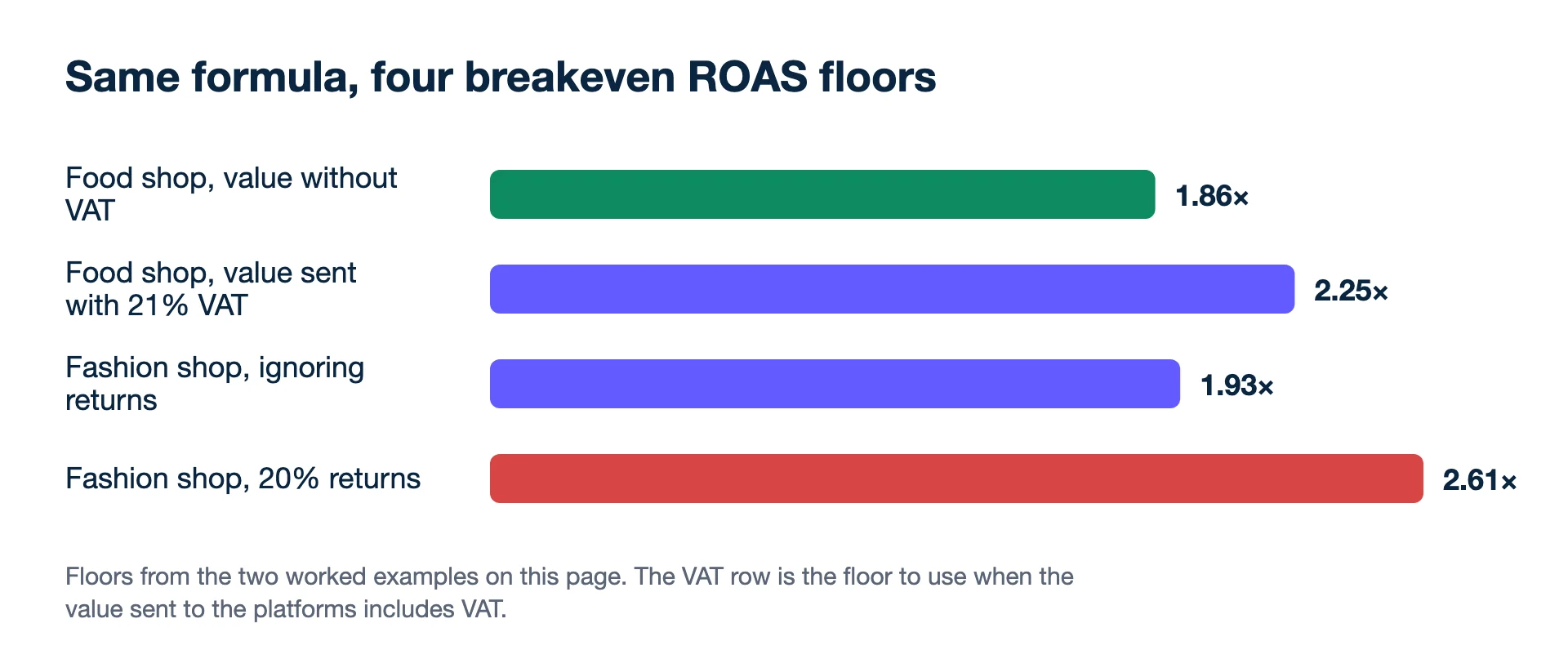
Breakeven ROAS is average order value ÷ what you keep from that order before ads, the same as 1 ÷ contribution margin. A food shop that keeps €13.57 of a €25.20 order breaks even at 25.20 ÷ 13.57 = 1.86×. Below that, every sale the ads bring costs money.
Five steps
- Average order value without VAT. Net revenue ÷ orders for the last 90 days. See AOV.
- Subtract the cost of goods in an average order.
- Subtract the costs that come with each order: payment fees, delivery you pay, packaging, pick-and-pack.
- Subtract expected refunds and discounts, from your actual return rate and average discount.
- Divide. Order value ÷ what is left = breakeven ROAS. What is left is also your maximum cost per purchase.
Which costs go into breakeven ROAS?
Only the costs that rise with each extra order. Ask of every line: does it go up when one more order comes in? Goods, payment fees, delivery, packaging and expected refunds do. Rent, salaries and software do not; they are paid from total contribution, so dividing them by order count gives a number that shifts with volume and misleads you in both directions.
Example one: a food shop with almost no returns
One European food shop's figures, anonymised:
| Line | Per order | Left |
|---|---|---|
| Average order value (no VAT) | €25.20 | €25.20 |
| Goods | −€8.40 | €16.80 |
| Payment fee (2%) | −€0.50 | €16.30 |
| Delivery the shop pays | −€2.73 | €13.57 |
Margin = 13.57 ÷ 25.20 = 53.8%. Breakeven ROAS = 25.20 ÷ 13.57 = 1.86×; maximum cost per purchase €13.57. Packaging sat inside delivery and food refunds were close to zero.
Example two: a fashion shop where returns decide it
A clothing order of €80 without VAT. Goods cost €32, the payment fee is 2% (€1.60, usually not given back on a refund), outbound delivery €5. On those lines alone the shop keeps 80 − 32 − 1.60 − 5 = €41.40, so breakeven looks like 80 ÷ 41.40 = 1.93×.
Now add a 20% return rate. Only 80% of revenue stays: €64. Returned items go back into stock, so goods are only lost on kept orders: €32 × 0.8 = €25.60. Return postage of €6 on one order in five adds €1.20. What the average order keeps: 64 − 25.60 − 1.60 − 5 − 1.20 = €30.60. The platforms still report the €80 purchase, so breakeven on reported value is 80 ÷ 30.60 = 2.61×. Returns moved the floor more than any other line. The ROAS after returns calculator does this for your rate.
How do I calculate breakeven ROAS with VAT?
Use the same basis on both sides: if the conversion value sent to Meta or Google includes VAT, the breakeven must be calculated on the VAT-inclusive value too. The food shop's €25.20 order is €30.49 with 21% VAT. If that gross figure is what the pixel reports, the floor is 30.49 ÷ 13.57 = 2.25×, not 1.86×. Comparing a VAT-inclusive ROAS with a VAT-free breakeven makes every campaign look about a fifth healthier than it is. The cleaner fix is to send values without VAT. The value is whatever your tag passes; Google's help on conversion values explains how dynamic values in the tracking code record each order's own amount.
Other traps
- Catalogue gross margin. Gross margin leaves out fees, delivery and refunds, so the floor looks lower than it is.
- Discounts. A 20% sale on a 40%-margin product: you keep €20 on an €80 sale instead of €40 on €100, so breakeven moves from 2.50× to 4.00×. The discount calculator shows it before the sale.
- One margin for a mixed catalogue. A shop-wide floor hides a campaign that sells only the low-margin lines. Calculate per product group and hold each campaign to what it actually sells.
What ROAS should I target above breakeven?
Target 1 ÷ (margin − the share of revenue you want left after ads). For the food shop, keeping 10% of revenue: 1 ÷ (0.538 − 0.10) = 1 ÷ 0.438 = 2.28×. Google's target ROAS is entered as a percentage, so that is 228%; Meta's ROAS goal takes a plain number, so 2.28. If customers reliably buy again, a first-order target below breakeven can be right, but only on repeat contribution you have measured. Check the target against ROAS from the same source: blended ROAS for the account, or one fixed platform setting per campaign. The long version is breakeven ROAS: formula, worked example and table, and the breakeven ROAS calculator takes your own lines.
Kunads measures what each order keeps from your shop data and shows each campaign's return next to its floor, in euros.
- Food shop figures: one anonymised European client, 90 days, from the shop's own orders and costs. Fashion figures: illustrative.
- Google Ads Help: About Target ROAS bidding (checked 2026-11-19)
- Google Ads Help: About conversion values (checked 2026-11-19)
- Meta Business Help Centre: About ROAS goal (checked 2026-11-19)
Would rather not do this by hand? Kunads' agents check every campaign against your margin each day and propose a fix you approve or ignore.
Audit my ads for free Try Kunads, no cardBreakeven ROAS, the awkward cases
Is breakeven ROAS the same as a 1.00 ROAS?
No. At 1.00 the ad spend comes back as revenue, but the goods, fees and delivery are still unpaid. Real breakeven is almost always above 1.
How often should I recalculate it?
Whenever a cost moves: a supplier price rise, a new delivery contract, a discount period or a change in return rate. Quarterly at minimum.
What if I sell subscriptions?
Calculate it on the first payment for a strict floor, then decide separately how much of the measured repeat contribution you are willing to spend up front.