Gross margin
Gross margin is the share of revenue left after the cost of the goods sold: a €30 candle that cost €9 to make has a 70% gross margin. It tells you how much a product earns before anything else is paid: delivery, fees, marketing, rent or salaries.
Gross margin = (revenue − cost of goods sold) ÷ revenue
Cost of goods sold (COGS) is what you paid for the products themselves: purchase price from a supplier, or materials and production if you make them. For a shop, inbound freight and import duties are usually part of it too.
Worked example: a scented candle
A candle shop sells its best-seller for €30.00 without VAT. Wax, wick, jar, fragrance and labour cost €9.00 per candle.
- Gross profit: €30.00 − €9.00 = €21.00
- Gross margin: €21.00 ÷ €30.00 = 70%
- Markup (a different number, often confused with it): €21.00 ÷ €9.00 = 233%
Now follow one online order of that candle to the customer:
- Delivery the shop pays: €4.20
- Payment fee (2.5%): €0.75
- Box and padding: €1.05
- What is left: €21.00 − €4.20 − €0.75 − €1.05 = €15.00, a 50% contribution margin
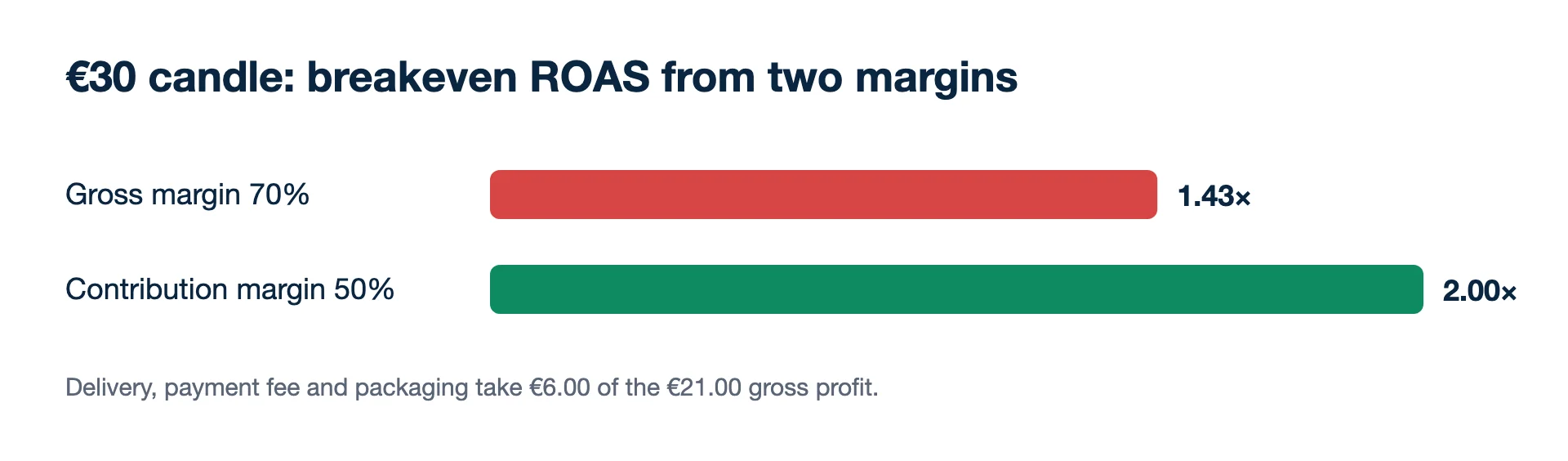
Use the 70% gross margin to set an ad floor and you get a breakeven ROAS of 1 ÷ 0.70 = 1.43×. Use the 50% contribution margin and it is 2.00×. A campaign at 1.7× ROAS looks profitable on the first number and loses about €2.65 on every €30 order on the second (the ad cost per order is €30 ÷ 1.7 = €17.65, against €15.00 left).
Can I use gross margin to set my target ROAS?
No: it gives a floor that is too low, because it leaves out delivery, payment fees, packaging and returns. The candle shows the size of the error, 1.43× against 2.00×.
Where gross margin is the right number
Gross margin is the right number for pricing and product decisions: which products to stock, how much room there is for a discount, whether a supplier price increase hurts. It is the number in your accounts, and lenders and investors ask for it.
It is the wrong number for advertising targets, because online orders carry costs that a catalogue margin leaves out. For ads, use contribution margin; the contribution margin calculator takes you from one to the other.
What is the difference between margin and markup?
Margin divides the gross profit by the selling price; markup divides it by the cost. The €30 candle that cost €9 has a 70% margin and a 233% markup. The two get mixed up all the time, and it matters when a supplier quotes "a 100% markup":
| Markup on cost | Gross margin on price |
|---|---|
| 25% | 20.0% |
| 50% | 33.3% |
| 100% | 50.0% |
| 200% | 66.7% |
| 300% | 75.0% |
Margin = markup ÷ (1 + markup). A 100% markup means you sell at twice the cost, which is a 50% margin, not 100%.
Second example: the average that ads do not sell
The shop also resells diffusers at a 40% gross margin. Last month it sold €10,000 of its own candles (€7,000 gross profit at 70%) and €10,000 of diffusers (€4,000 at 40%): €11,000 on €20,000, a 55% average. A Meta campaign built around a diffuser bundle sold €8,000 of diffusers and €2,000 of candles, so its own gross margin was (8,000 × 0.40 + 2,000 × 0.70) ÷ 10,000 = (3,200 + 1,400) ÷ 10,000 = 46%. Setting that campaign's target from the 55% shop average would let it spend as if every euro of revenue kept 9 points more than it does. Calculate margin for what each campaign actually sells.
How Shopify and Google calculate it
Shopify's gross margin report uses ((net sales − cost) ÷ net sales) × 100, where net sales already reflect discounts and refunds, and cost comes from the cost per item you enter, so the report is only as good as those cost fields. Google Ads can report gross profit on purchases through conversions with cart data, using the cost of goods sold you send in your Merchant Center feed. Google says that figure is for reporting and can be an estimate, or an average if a product's cost varies.
Errors to avoid
- Quoting markup as margin. A "200% margin" is impossible; margin can never reach 100%.
- Leaving inbound costs out of COGS. Freight and duties on the stock you bring in are part of what the goods cost. Leave them out and margin looks better than it is.
- VAT in the revenue. €36.30 with 21% VAT is still €30.00 of revenue for margin purposes.
Related: breakeven ROAS, POAS.
- Shopify Help Center: Profit reports (gross margin formula) (checked 2026-11-19)
- Google Merchant Center Help: Cost of goods sold (cost_of_goods_sold) (checked 2026-11-19)
- Google Ads Help: About conversions with cart data (checked 2026-11-19)
Would rather not do this by hand? Kunads' agents check every campaign against your margin each day and propose a fix you approve or ignore.
Audit my ads for free Try Kunads, no cardGross margin and delivery costs
Does gross margin include delivery to the customer?
No. Inbound freight and import duties on stock usually sit in cost of goods, but the delivery you pay to send an order to a customer does not. That cost belongs in contribution margin.