Impression share
Impression share (IS) is the percentage of impressions your ads received out of the total they were eligible to receive. Google calculates it as impressions ÷ estimated eligible impressions, with eligibility judged from your targeting, approval status, bids and quality. The rest is split into share lost to budget and share lost to Ad Rank.
Impression share = impressions ÷ total eligible impressions
Google estimates eligible impressions from the auctions over each day, including auctions where your ad showed and ones where it was competitive enough to show. Because it is an estimate, small day-to-day moves are noise; Google itself says small fluctuations do not necessarily need action. The data can take 24–48 hours to process, and low-traffic keywords may show a dash.
The two ways to lose impressions
- Search lost IS (budget): in Google's words, the percentage of time your ads were not shown on the Search Network due to insufficient budget. Campaign level only.
- Search lost IS (rank): the percentage of time your ads were not shown due to poor Ad Rank in the auction. Ad Rank depends on your bid, ad quality and expected impact of assets, among other things.
Read together with impression share, these describe every eligible auction: the share you won, the share budget cost you and the share rank cost you.
Worked example: a non-brand Search campaign
A locksmith service in one city runs a Search campaign on "emergency locksmith" keywords for 30 days:
- Impressions: 18,000
- Estimated eligible impressions: 40,000
- Search impression share: 18,000 ÷ 40,000 = 45%
- Search lost IS (budget): 20% (about 8,000 impressions)
- Search lost IS (rank): 35% (about 14,000 impressions)
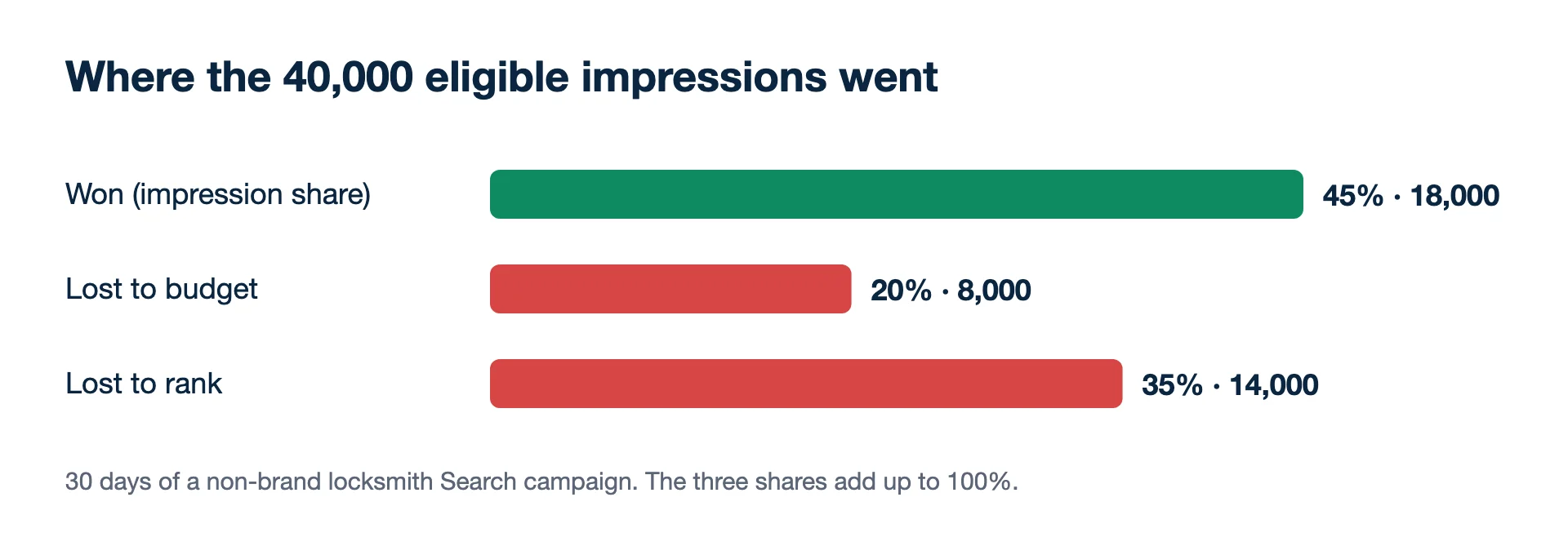
45% + 20% + 35% = 100%. The campaign runs out of budget on some days, and on the days it does run, it loses many auctions on rank.
A rough upper bound on what budget would buy: at a 6% CTR, 8,000 more impressions is about 480 more clicks. At the current €3.10 average CPC, that is around €1,490 more a month. Real results are usually lower, because the extra auctions tend to be at times of day or on queries that convert less well.
Should I fix lost impression share with budget or with bids?
Fix budget loss with budget, and rank loss with bids, ads or landing pages, but only if the campaign already makes money. More budget does nothing in auctions you lose on Ad Rank, and a higher bid does nothing on days the budget has already run out. If the locksmith campaign is profitable at its current cost per job, raising the budget is the cheap fix: it buys more of the auctions it already wins at today's prices. Improving rank is slower and more expensive. If the campaign is not profitable, neither loss is worth fixing yet. Use the ad budget calculator to check what the extra spend should bring back before you raise it.
What is a good impression share?
On your own brand name, close to 100%; on generic keywords, whatever share stays profitable, which is often well below that. A second example shows why the two differ. The same locksmith also runs a brand campaign:
- Impressions: 2,850 of 3,000 eligible, so impression share 95%.
- Lost IS (budget): 0%. Lost IS (rank): 5%, about 150 impressions.
- Brand clicks cost €0.40 and convert well. Winning those 150 impressions back at a similar CTR costs very little.
Here a few points of rank loss often mean a competitor bidding on the brand name, and closing the gap is cheap. On the generic campaign, the last share points are typically the most expensive clicks of the month. The same 5% has opposite economics in the two campaigns.
Reporting limits worth knowing
- Floors and ceilings. In the Google Ads API, Search impression share is reported between 0.1 and 1, and any value below 10% shows as 0.0999. Lost IS (budget) and lost IS (rank) are capped the other way: anything above 90% shows as 0.9001. A campaign showing "<10%" may be at 9% or at 1%.
- Top of page is separate. Being shown is not the same as being near the top. Google reports top and absolute top impression share as their own metrics.
- Search only. The budget and rank metrics quoted here are Search Network metrics. Meta Ads Manager offers no impression share column, so there is no like-for-like figure to compare across the two platforms.
- Estimates move. Look at weeks, not days, before acting on a change.
Related terms
- Google Ads Help: Impression share (checked 2026-11-19)
- Google Ads Help: Get impression share data (checked 2026-11-19)
- Google Ads API: metrics reference (search_impression_share, search_budget_lost_impression_share, search_rank_lost_impression_share) (checked 2026-11-19)
Would rather not do this by hand? Kunads' agents check every campaign against your margin each day and propose a fix you approve or ignore.
Audit my ads for free Try Kunads, no cardImpression share, budget and rank: edge cases
How often is impression share updated?
Google notes the data can take 24–48 hours to process, and shows a dash when there is not enough data, for example on low-traffic keywords.
Why does lost IS (budget) only show at campaign level?
Budgets are set per campaign (or shared across campaigns), so Google reports the budget loss where the budget lives. Rank loss can also be read lower down, at ad group level.