Why don't my Meta and Shopify numbers match?
Meta and Shopify never match because they count different things. Shopify records every order that happened; Meta reports the conversions it can connect to an ad under its attribution setting, by default 7-day click or 1-day view. Keep both side by side and steer the business on blended ROAS: all revenue ÷ all ad spend.
Five reasons the counts differ
- Attribution setting. A purchase six days after a click, or the day after someone only saw the ad, can be counted by Meta. Shopify does not look at ads at all; its marketing reports use a last-click or referrer view of the visit.
- View-through conversions. Meta can credit a purchase to an impression with no click. Meta's help centre gives this as a reason third-party tools differ: they "may struggle to attribute conversions to impressions". See view-through conversion.
- People, not cookies. Meta measures across devices for logged-in users. Someone who sees the ad on a phone and buys on a laptop is one journey to Meta and an unknown visitor to a cookie-based tool.
- Dates. Ads Manager reports a conversion on the date of the ad interaction, not the order date. A Monday sale from a Sunday click sits on Sunday in Meta and on Monday in Shopify. Short date ranges magnify this.
- Signal loss and modelling. Ad blockers stop the pixel, consent choices limit what is shared, and Meta fills some gaps with modelled conversions. Sending events through the Conversions API as well as the pixel narrows the gap without closing it.
Then there are plain bookkeeping differences: refunds and cancellations stay in Meta's number but leave Shopify's net sales; Shopify's "total sales" can include tax and shipping; draft and POS orders never touched an ad.
Is Meta or Shopify right?
Both are right about what they measure, and neither tells you what the ads caused. Shopify answers "how many orders did we take?"; Meta answers "how many of those can be linked to an ad under this counting rule?". Asking which one is correct is like asking whether a till receipt or a footfall counter is correct. A holdout test or Meta's conversion lift study is the only way to measure cause.
Example: one month, four numbers
A shop spends €6,000 on Meta and €2,000 on Google in a month. Shopify records €30,000 of revenue from all channels, including email and returning customers.
- Meta reports €19,000 of purchase value on its default setting, and €13,500 on 7-day click only.
- Google Ads reports €7,000 on its own conversion settings.
- The platforms together report €26,000 against the shop's €30,000. Some sales are counted by both platforms, some by neither, and email drove part of the total.
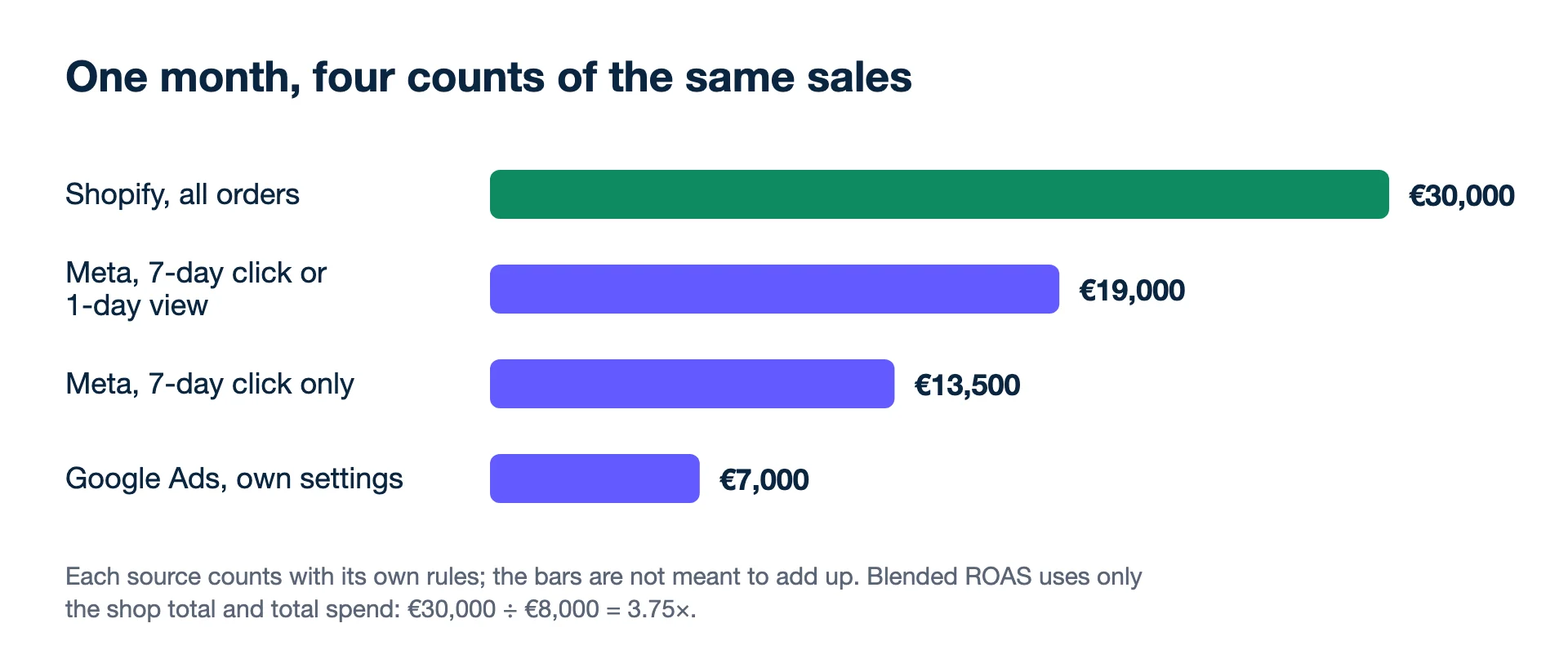
None of these is "the" answer. What needs no attribution is blended ROAS: €30,000 ÷ €8,000 = 3.75×. If the shop keeps 40% of each order before ads, breakeven is 1 ÷ 0.40 = 2.50×, so the ads as a whole pay. The MER calculator takes your own figures.
How big a gap is normal?
There is no normal size; what matters is whether the gap stays stable. It depends on your attribution setting, how many buyers see but never click, how many devices they use and how complete your pixel and Conversions API set-up is. Watch it over time instead.
A second shop: in September Meta reports €12,000 and Shopify records €20,000; the two move together for three months. In December Meta's figure jumps to €18,000 while Shopify only reaches €21,000. Shop revenue rose €1,000; Meta's reported value rose €6,000. Before scaling on that, check what changed: a new attribution setting, duplicate purchase events after a theme update, or a Christmas rush of buyers who would have come anyway. A sudden widening is a question to answer, not a result.
Google Ads counts its own way too
The same sale can appear in Google Ads as well. Google's help on conversion measurement says it attributes conversions to the date of the ad click, and shows cross-device and cross-browser conversions in the "All conversions" column. So Google, Meta and the shop each give a different total for the same month, and adding the two platform numbers double-counts buyers who touched both.
What to do with two numbers
- Compare inside the platform with the platform number. Campaign A against campaign B in Meta, on one fixed setting, week after week.
- Judge the business with the shop number. Blended ROAS, profit after ads, new customers.
- Fix what is fixable. Pixel plus Conversions API with deduplication, purchase value without VAT, the same currency on both sides.
- Mind repeat revenue. A shop with heavy email or repeat sales gets a flattering blended ROAS; compare with a period when ads were off, or use new-customer ROAS.
Facebook and Instagram shop checkouts and offline sales may never reach Shopify's reports at all, and changing Meta's attribution setting moves the reported numbers overnight while sales stay the same. The longer walk-through is why Meta, Google and Shopify never agree.
Kunads puts each platform's count next to what the shop recorded, opening Meta on its default window with 7-day click and 1-day click a switch away.
- Meta Business Help Centre: About conversion count differences between Meta ads reporting and third-party reporting tools (checked 2026-11-19)
- Meta Business Help Centre: Differences between conversion optimisations (default attribution setting 7-day click or 1-day view) (checked 2026-11-19)
- Meta Business Help Centre: How conversions are attributed (reported on the impression date) (checked 2026-11-19)
- Google Ads Help: About conversion measurement (checked 2026-11-19)
- Meta for Developers: Conversions API (checked 2026-11-19)
- Example figures: illustrative.
Changes wait for you. Kunads proposes budget moves in 20% steps with the reasoning attached; nothing reaches Meta or Google until you press Approve.
See what it would change Begin a free trial