What is a good ROAS?
A good ROAS is any ROAS above your breakeven, and breakeven is 1 ÷ contribution margin. A shop that keeps 40% of each order before ads needs 2.50× just to stand still, so "good" for it starts around 3×. No universal figure is honest, because margin, attribution setting and repeat purchases differ by shop.
Why is there no single good ROAS?
There is no single good ROAS because the same ratio makes money for one shop and loses it for another. ROAS is revenue ÷ ad spend; whether it pays depends on how much of that revenue you keep after goods, payment fees, delivery and refunds, which is your contribution margin. A 3× is a strong result for a skincare brand keeping 70% and a loss for an electronics reseller keeping 15%.
We looked for a named, dated, public benchmark study that publishes ROAS with a clear method and did not find one we would stand behind. Many "average ROAS" figures online come from vendors' own customers, on unstated attribution settings. A Meta ROAS on 7-day click + 1-day view and the same campaign on 1-day click can differ a lot with no change in sales, so comparing yourself with such a number tells you little.
How do I work out my own good ROAS?
Work it out from what one order keeps, in four steps:
- Find what you keep per order. Average order value without VAT, minus goods, payment fees, delivery you pay, packaging and expected refunds. The contribution margin calculator walks through each line.
- Breakeven ROAS = order value ÷ what you keep. This is the floor (breakeven ROAS).
- Target ROAS = 1 ÷ (margin − profit share you want left after ads). This is the number you aim for.
- Measure on the right source. Judge the account on blended ROAS (all revenue ÷ all ad spend); compare campaigns inside a platform on one fixed attribution setting.
Worked example: a food shop
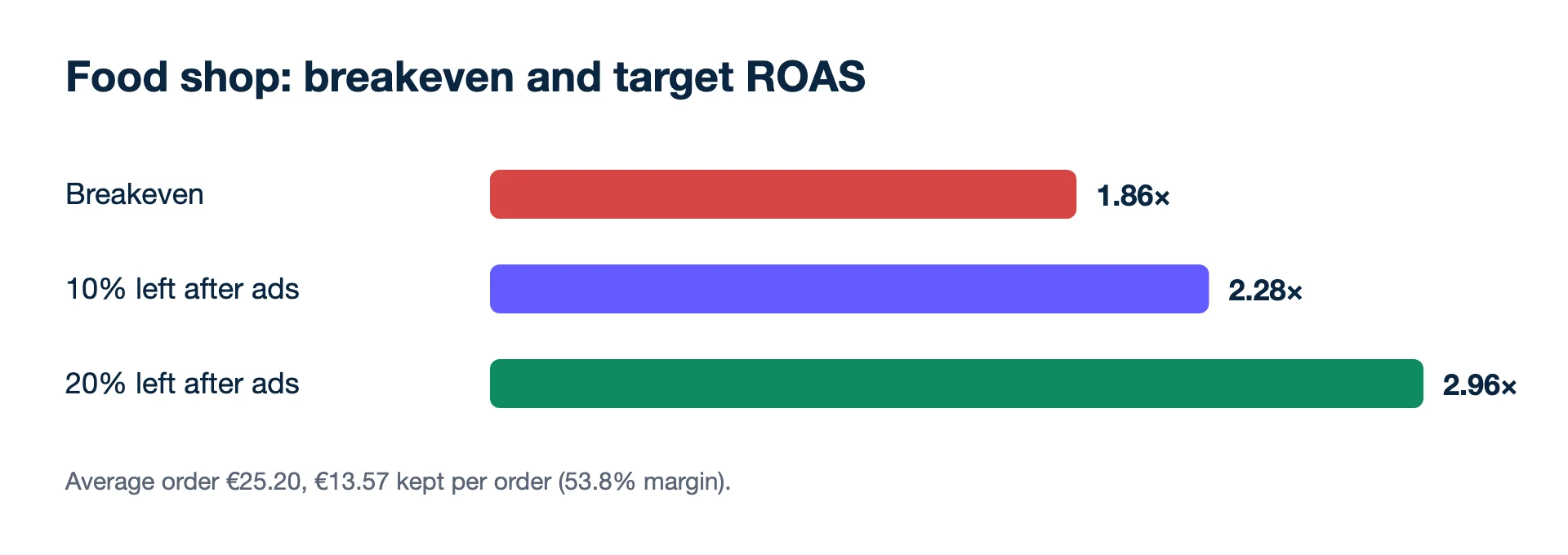
One European food shop (anonymised): average order €25.20, kept €13.57 after goods, fees and delivery. Margin = 13.57 ÷ 25.20 = 53.8%.
- Breakeven ROAS = 25.20 ÷ 13.57 = 1.86×.
- Wanting 10% of revenue left after ads: 1 ÷ (0.538 − 0.10) = 2.28×.
- Wanting 20%: 1 ÷ 0.338 = 2.96×.
For this shop, a good ROAS is about 2.3–3.0× on its own orders. Check yours with the breakeven ROAS calculator.
| Contribution margin | Breakeven ROAS | Target for 10% left after ads |
|---|---|---|
| 20% | 5.00× | 10.00× |
| 30% | 3.33× | 5.00× |
| 40% | 2.50× | 3.33× |
| 50% | 2.00× | 2.50× |
| 60% | 1.67× | 2.00× |
Is a higher ROAS always better?
No: a higher ROAS often earns less money in total, because total profit is profit per order × number of orders, and pushing the ratio up usually means spending less and selling less. Take a campaign with a 40% margin:
- At €50 a day and 6.00×: revenue €300, kept €120, profit after ads €70 a day.
- At €400 a day and 3.00×: revenue €1,200, kept €480, profit after ads €80 a day.
The lower ROAS earns €10 a day more, and it brings four times the orders. Below 2.50× the larger budget would start to lose money, so the best spend level sits between breakeven and the highest ROAS you have seen at small spend. Look at profit in euros, not only the ratio; POAS helps here.
What Meta and Google mean by ROAS
Both platforms divide the conversion value they credit to the ads by spend, but the value is what you send them. Google states that conversion values are the values you assign to your conversion actions, so a store that sends order totals with VAT and shipping shows a higher ROAS than one that sends net product revenue, for the same sales. Google's Target ROAS bidding predicts the value of each search and bids higher where it expects high value; the target you type in should come from your margin, not from a round number. In Meta, ROAS sits on whichever attribution setting the ad set uses, so note the setting next to every ROAS you report.
When the answer changes
- Repeat buyers. If you have measured that new customers buy again, a first-order ROAS below breakeven can pay back. Hold retargeting and brand search to the first-order floor; they mostly reach people who would buy anyway.
- Sales and discounts. A 20% discount on a 40%-margin product moves breakeven from 2.50× to 4.00×. Update the target before the sale starts.
- Different margins by category. A campaign selling mostly low-margin items needs its own, higher floor.
Kunads measures margin from your own costs and puts each campaign's ROAS and POAS next to its breakeven, with blended ROAS for the account as a whole. Related: how to calculate breakeven ROAS and is POAS better than ROAS?
- Food shop figures: one anonymised European client, 90 days, from the shop's own orders and costs. Other figures: illustrative.
- Meta Business Help Centre: How to compare attribution settings in Meta Ads Manager (checked 2026-11-19)
- Google Ads Help: About Target ROAS bidding (checked 2026-11-19)
- Google Ads Help: About conversion values (checked 2026-11-19)
Agencies: one screen for every client account, with each campaign measured on what the client kept and a white-label report each Monday.
Free audit for one client Trial for agenciesStill weighing your ROAS target?
Is 4× a good ROAS?
Only if your margin makes it one. A shop that keeps 50% of each order breaks even at 2.00×, so 4× is very good; a shop that keeps 20% breaks even at 5.00×, so 4× loses money on every order.
Why don't you give an industry average ROAS?
We could not find a named, dated, public benchmark study with a clear method for ROAS. Platform-reported ROAS also depends on the attribution setting, so two shops with identical sales can show very different numbers.
Can a ROAS below breakeven be good?
Sometimes, for new customers who reliably buy again. Only accept it when you have measured repeat contribution in your own orders over a window your cash flow can survive.