POAS vs ROAS: what profit on ad spend is and how to bid for it
POAS vs ROAS is the difference between knowing what your ads sold and knowing what they earned. ROAS counts revenue, POAS counts profit, and the ad platforms will optimise for whichever number you send them. Bid on ROAS and they chase revenue, whatever each sale leaves you.
This guide is for e-commerce marketers and agency owners who bid on ROAS and suspect it is pushing budget toward the wrong products.
- ROAS = revenue ÷ ad spend. POAS = contribution profit ÷ ad spend. POAS breakeven is always 1.0; ROAS breakeven is 1 ÷ your margin.
- Two campaigns with a 4.0 ROAS can make €1,000 or lose €200, depending on margin.
- Revenue-based bidding favours products that convert easily at high prices, whatever they leave you. Sending profit as the conversion value fixes that.
- Google has a profit optimisation goal (beta) for Performance Max and Standard Shopping. Meta's profit-based option is still a test; sending profit through the Conversions API works today.
What is POAS? Definitions and formulas
ROAS (return on ad spend) is the revenue attributed to ads divided by the cost of those ads. €4,000 of sales from €1,000 of spend is a ROAS of 4.0.
POAS (profit on ad spend) replaces revenue with profit. The useful profit here is contribution profit: revenue minus the cost of goods, payment fees, delivery and packaging. It is the money each order leaves before advertising and fixed costs.
- Contribution margin = contribution profit ÷ revenue
- POAS = (revenue × contribution margin) ÷ ad spend
- POAS = ROAS × contribution margin
- Breakeven ROAS = 1 ÷ contribution margin
- Profit after ads = revenue × contribution margin − ad spend
With this definition, a POAS of 1.0 means the ads paid for themselves and nothing more. Some tools define POAS as (profit − spend) ÷ spend, which moves breakeven to 0. Neither is wrong, but check which one a report uses before you compare numbers across tools.
The POAS calculator does the arithmetic from spend, revenue and margin. The breakeven ROAS calculator works out your margin from order value, product cost, fees and delivery if you do not know it yet.
POAS vs ROAS: a worked example
Two campaigns, same spend, same revenue, same ROAS:
| Campaign A | Campaign B | |
|---|---|---|
| Ad spend | €1,000 | €1,000 |
| Revenue | €4,000 | €4,000 |
| ROAS | 4.0 | 4.0 |
| Contribution margin | 50% | 20% |
| Contribution profit | €2,000 | €800 |
| Breakeven ROAS | 2.0 | 5.0 |
| POAS | 2.0 | 0.8 |
| Profit after ads | +€1,000 | −€200 |
A dashboard sorted by ROAS shows these as equals. One should get more budget; the other loses €200 for every €1,000 you give it. A target ROAS of 4.0 would be generous for A and a loss for B.
One shop's numbers
Here is a real, anonymised case: a European food shop. Its average order was €25.20, and each order kept €13.57 after goods, fees and delivery. That is a contribution margin of about 54% and a breakeven ROAS of 1.86 (1 ÷ 0.54).
Margin is what turns revenue into profit. Whatever revenue figure you start from, each €1 of this shop's sales kept about €0.54. A campaign returning 1.86× in sales only breaks even; one returning 3× keeps about €0.62 of profit per €1 of ads.
Which revenue figure, though? Meta, Google and the shop each count sales their own way, so POAS read from Ads Manager and POAS read from the shop's orders will not match. Pick one source for campaign decisions, use it consistently, and check the whole account with blended ROAS. More in why Meta, Google and Shopify never agree.
Why ROAS bidding favours low-margin bestsellers
Target ROAS and value-based bidding try to buy as much conversion value as possible at your target. If the value is revenue, the system cannot see margin. It will push toward whatever turns clicks into revenue most reliably, and that is often the cheap-to-make-the-sale, thin-margin bestseller.
A simple illustration with two products:
| Product X (bestseller) | Product Y | |
|---|---|---|
| Price | €100 | €80 |
| Contribution margin | 15% | 55% |
| Conversion rate | 4% | 3% |
| Revenue per click | €4.00 | €2.40 |
| Profit per click | €0.60 | €1.32 |
A revenue-based bidder is willing to pay up to 67% more per click for X. A profit-based bidder would pay more than twice as much for Y. Over months, ROAS bidding concentrates spend on X, revenue grows, and profit does not. Discounts make it worse: a 20%-off promotion lowers revenue per order a little but can wipe out most of the margin on a 25% product.
How to move toward POAS bidding in Google Ads
Google's own help pages describe several routes. They differ in how precise they are and how much work they take.
1. Profit optimisation goal (beta) for Shopping and Performance Max
Google lists a "Profit optimization goal (beta)" that lets you optimise Performance Max and Standard Shopping campaigns "using data from your cart-level conversions and cost of goods sold in Merchant Center". It needs two things:
- Conversions with cart data. Your purchase tag sends the items in each order, not only the total. Google then combines the revenue from those items with the cost of goods sold from your Merchant Center feed to report gross profit.
- Cost of goods in Merchant Center. Add the cost_of_goods_sold attribute to each product in your feed, in the same currency as the price you report in conversions.
Google states that customers using gross profit optimisation in Smart Bidding see on average a 15% uplift in campaign profit compared with revenue-only bidding. That figure comes from Google's own data on Shopping campaigns from September–October 2023, with profit defined as revenue minus cost of goods. Treat it as Google's claim, not a forecast for your account.
Two limits. First, Google's "gross profit" is revenue minus cost of goods only. It does not include payment fees, delivery or returns, so it overstates contribution profit. Second, the Merchant Center help page says the cost of goods you share is "for reporting purposes and does not need to be exact". If you plan to bid on it, make it accurate anyway.
2. Send profit as the conversion value
Google's help page on conversion values says Target ROAS bids "to maximize conversion value, such as sales revenue or profit margins". Nothing forces the value to be revenue. You can send each order's contribution profit as its value, then set Target ROAS or Maximise conversion value on that action. Your "ROAS" target then becomes a POAS target: 1.0 is breakeven, 1.3 means 30% profit on spend.
In practice:
- Calculate profit per order on your server: revenue minus goods, fees, delivery and any discount.
- Send it as a new conversion action, either from the server or as an offline import. Avoid putting product margins in the browser's data layer, where anyone can read them. See sending offline conversions through Google's Data Manager API.
- Run it as a secondary action for a few weeks while revenue stays primary, so you can check the values look right.
- Switch the campaign's goal to the profit action and reset the target (see the mistakes below).
This covers every campaign type that bids on value, including Search, and it can include fees and delivery that Google's cost-of-goods route leaves out.
3. Conversion value rules
Conversion value rules adjust values by audience, location or device, and Google says Smart Bidding uses them in real time for Target ROAS and Maximise conversion value. Google gives "different margins for different types of users" as an example. They apply to Search, Shopping, Display, Travel and Performance Max. They are useful when margin differs by country or customer type, but they cannot tell one product from another, so they do not solve the bestseller problem on their own.
How to optimise for profit on Meta ads
Meta's value optimisation bids on the value you send with each event. Meta's developer guide asks for a value that is "correlated to your true business goal". So the working method today is the same as Google's route 2:
- Compute profit per order on your server.
- Send it through the Conversions API with the purchase, or as a separate event so your reported purchase ROAS keeps meaning revenue. Meta said in June 2025 that optimising for the value of events other than purchases was expanding globally.
- Use a value-based performance goal or a minimum ROAS on that event once it has enough history.
Meta also has a dedicated profit option. In June 2025 Meta wrote that it was testing letting advertisers send information through the Conversions API that shows the profit made on a sale, so it can focus on ROAS based on profit rather than purchase size. Stape, a server-side tracking provider, wrote in August 2026 that the feature is in closed beta and that access comes through a Meta representative. We could not find a Meta page announcing general availability as of 7 October 2026. If you do not have a Meta rep, assume you cannot get it.
Common mistakes
- Expecting no learning reset. On Meta, changing the optimisation event is a significant edit that sends the ad set back into the learning phase. A large change to the ROAS goal may do the same. On Google, a setting change puts the bid strategy into a "Learning" status. Switch in one step, not in five small ones, and do not judge results during learning.
- Keeping the old target. Profit values are smaller than revenue. A campaign with a 4.0 revenue ROAS at 30% margin has a POAS of 1.2. If you keep a target of 4.0, delivery will collapse. Convert the target: new target = old target × margin.
- Ignoring refunds and returns. A profit value sent at checkout overstates returned orders. Google lets you restate or retract conversions by order ID, and says to do it within 7 days of the conversion being recorded for bidding to use it. Retracting or restating to 0 cannot be undone. Use the ROAS after returns calculator to see how much returns move your numbers.
- Using one blended margin. If every order gets the same 40%, profit values are just revenue × 0.4 and the bidder behaves exactly as before. POAS only helps when margin varies by product or order.
- Mixing revenue sources. POAS from Ads Manager and POAS from your shop's orders differ. Say which one you used, and compare like with like.
- Mixing definitions. Google's gross profit leaves out fees and delivery; your contribution margin includes them. Write down which one each report uses.
How Kunads handles this
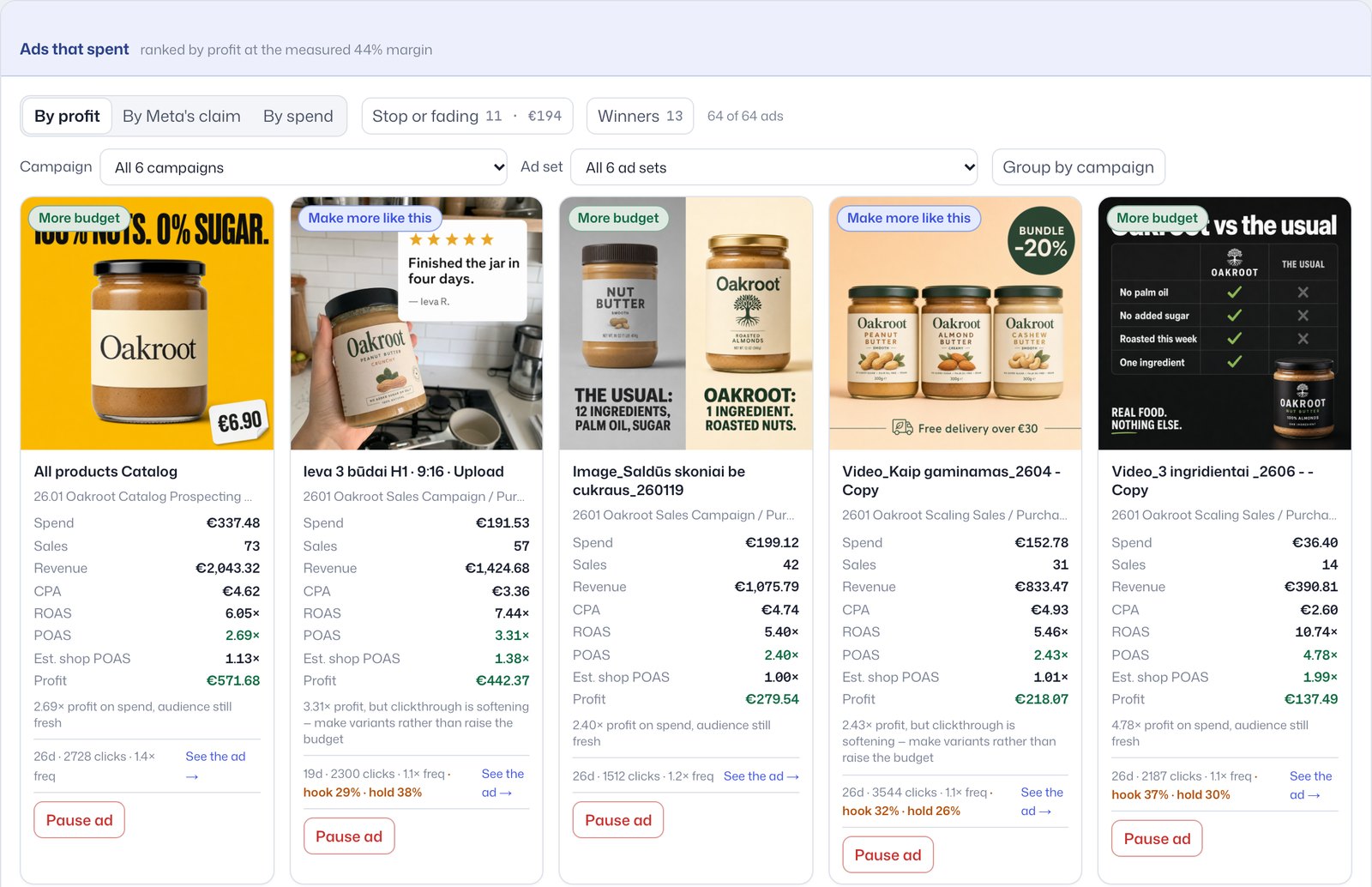
Kunads reads Shopify, WooCommerce or Magento orders and shows profit and POAS per campaign (revenue × measured margin − ad spend) next to what Meta and Google report. If you opt in, it sends real profit values back to Meta through the Conversions API and to Google through the Data Manager API as a separate conversion, so you can test profit bidding without touching your existing goals.
- Google: Online sales deep dive (profit optimisation goal beta, 15% uplift claim and its footnote), checked 7 October 2026
- Google Ads Help: About conversions with cart data, checked 7 October 2026
- Google Merchant Center Help: Cost of goods sold [cost_of_goods_sold], checked 7 October 2026
- Google Ads Help: About conversion values, checked 7 October 2026
- Google Ads Help: About conversion value rules, checked 7 October 2026
- Google Ads Help: About bid strategy statuses, checked 7 October 2026
- Google Ads Help: How to adjust your conversions, checked 7 October 2026
- Meta for Developers: Conversions API integration guidance, value optimisation, checked 7 October 2026
- Meta newsroom (Latin America, Spanish), 4 June 2025: new tools to optimise for what your business values (profit-margin ROAS "now testing"), checked 7 October 2026
- Meta Business Help Center: Significant edits and learning phase, checked 7 October 2026
- Stape: Meta's profit-based campaign optimisation (closed beta status), published 7 August 2026, checked 7 October 2026
Kunads works this out every morning from your real orders — per campaign, for Meta and Google, and its agents propose the fix. Nothing changes until you approve.
Get a free profit audit Try it free for 14 daysQuestions people ask
What is POAS?
POAS (profit on ad spend) is the profit a campaign produced divided by what it cost. In this guide profit means contribution profit: revenue minus goods, payment fees and delivery. A POAS of 1.0 is breakeven; above 1.0 the ads paid for themselves and left something over.
Is a higher ROAS always better than a lower one?
No. Two campaigns with the same ROAS can make opposite amounts of money if they sell products with different margins. ROAS only becomes meaningful once you compare it with your breakeven ROAS, which is 1 divided by your contribution margin.
Can Google Ads bid for profit instead of revenue?
Yes, in two ways. Google lists a profit optimisation goal (beta) for Performance Max and Standard Shopping that uses conversions with cart data and the cost of goods sold in Merchant Center. You can also send gross profit instead of revenue as the conversion value, since Google says Target ROAS can maximise values such as profit margins.
Can Meta optimise for profit?
Meta's value optimisation uses whatever value you send, so you can send a profit value through the Conversions API. Meta's own dedicated profit-margin ROAS option was described by Meta in June 2025 as being tested, and third parties describe it as a closed beta available through a Meta representative.
Will switching to profit values reset the learning phase?
Usually yes. On Meta, a change to the optimisation event is a significant edit that sends the ad set back into learning. On Google, a setting change on the bid strategy puts it into a Learning status, so plan the switch for a quiet week and measure it against a holdout.